
 Norway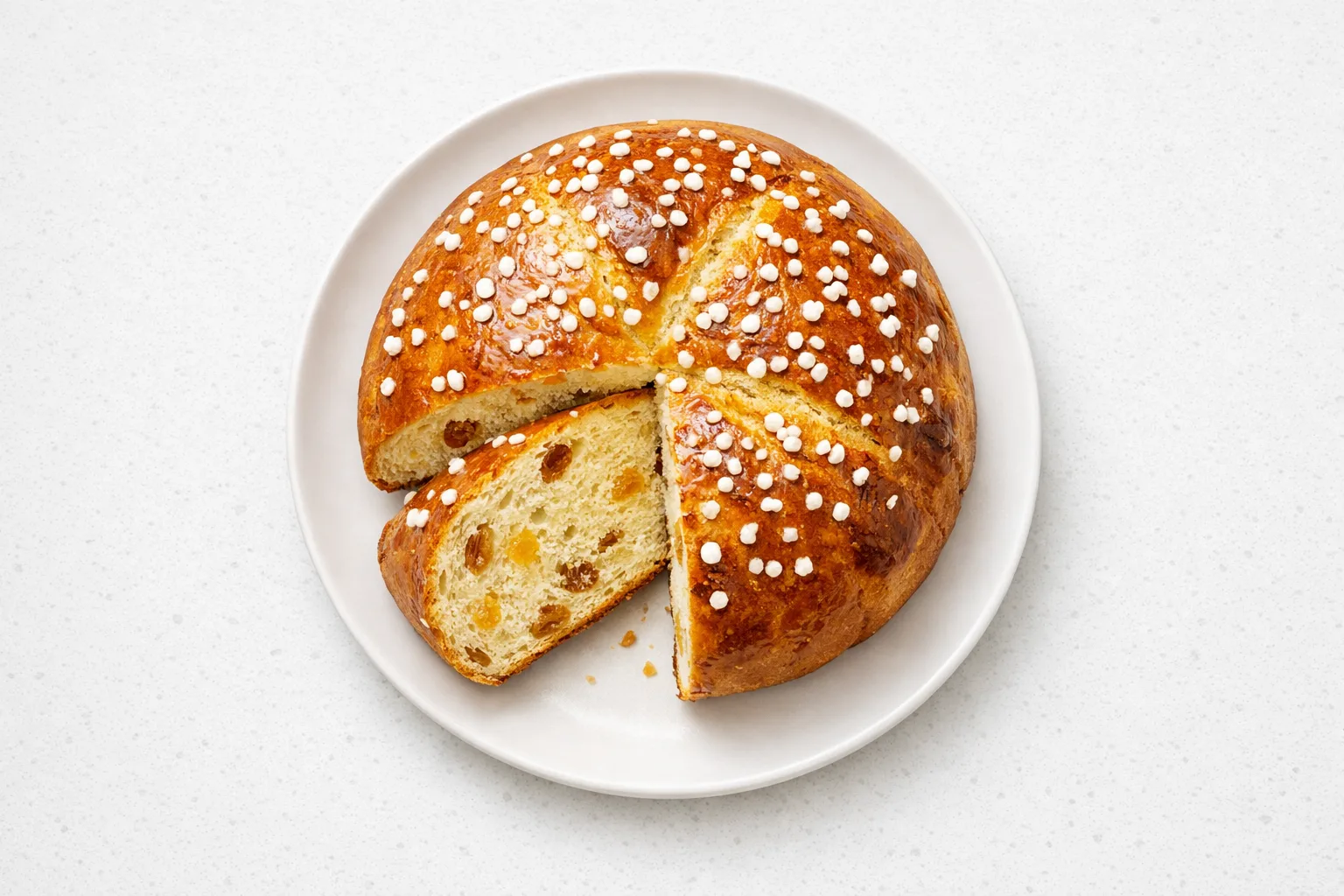
Julekake (literally "Christmas cake" in Norwegian) is a lightly enriched yeast bread scented with ground cardamom and packed with raisins and candied citrus peel. It sits somewhere between a brioche and a fruit bread: soft and pillowy from the butter and egg, but not too sweet. Every Norwegian household makes it, and the smell of it baking is, for many people, the definitive smell of the Christmas season.
The bread is part of a broader Scandinavian tradition of cardamom-spiced holiday breads: Sweden has lussebulle and julbrod, Denmark has julekage. The Norwegian version leans heavier on cardamom and is typically shaped as a round, slightly domed loaf with pearl sugar and almond flakes on top. It is sliced thickly and served with good butter, sometimes a slab of gjetost (Norwegian brown cheese), and black coffee.
This recipe uses freshly ground cardamom, which makes an enormous difference to the final flavor. Pre-ground cardamom loses its punch quickly; buy whole green pods and grind them yourself.
Equipment
Instructions
Tap each step to track your progress
- 1
Combine the warm milk, yeast, and 1 teaspoon of the sugar in a small bowl. Stir gently and let stand for 8-10 minutes until foamy. If it doesn't foam, your yeast is dead; start again with fresh yeast.
- 2
In a large bowl or the bowl of a stand mixer, whisk together the flour, remaining sugar, ground cardamom, and salt. Make a well in the center and add the yeast mixture and 1 egg.
- 3
Mix on low speed with the dough hook (or stir by hand) until the dough just comes together into a shaggy mass, about 2 minutes. Increase to medium speed and knead for 5 minutes.
- 4
Add the softened butter a few pieces at a time, kneading well between additions. Continue kneading on medium speed for 8-10 minutes until the dough is smooth, slightly tacky, and pulls cleanly from the bowl sides. It should pass the windowpane test: stretch a small piece thin enough to see light through without tearing.
- 5
Turn the dough out onto a lightly floured surface and flatten gently. Scatter the golden raisins and candied peel over the surface, then fold the dough over and knead briefly to distribute the fruit evenly, about 2 minutes.
- 6
Shape the dough into a smooth ball, place in a lightly oiled bowl, and cover tightly with plastic wrap or a damp towel. Let rise at room temperature until doubled in size, 1 to 1.5 hours.
- 7
Punch down the dough gently and shape it into a tight round by pulling the surface taut and tucking the seams underneath. Place on a parchment-lined baking sheet. Cover loosely and let rise again for 45-60 minutes until noticeably puffed and the dough springs back slowly when poked.
- 8
Preheat the oven to 350F (175C). Brush the risen loaf generously with beaten egg wash, then scatter pearl sugar and sliced almonds evenly over the top.
- 9
Bake for 30-35 minutes until the loaf is deep golden brown and a skewer inserted into the center comes out clean. If the top browns too quickly in the last 10 minutes, tent loosely with foil. The internal temperature should read 190F (88C).
- 10
Transfer to a wire rack and cool for at least 30 minutes before slicing. The crumb continues to set as it cools; cutting too early compresses it.
Tips & Tricks
Grind your cardamom fresh
Freshly ground cardamom from whole green pods is two to three times more fragrant than pre-ground. Crush the pods in a mortar, remove the husks, and grind the seeds. For 1.5 teaspoons ground, you need about 12-14 pods.
Don't rush the second rise
The second rise after shaping builds the open, pillowy crumb. If you cut it short, the loaf will be denser and less springy. When the dough springs back slowly (not immediately) when poked, it's ready to bake.
Soak the raisins first
Soaking the golden raisins in warm water for 10 minutes before adding them to the dough prevents them from drawing moisture out of the crumb during baking. Pat them dry before incorporating.
Make it the day before
Julekake actually improves overnight. Bake it the evening before Christmas morning, wrap in a cloth, and let it sit at room temperature. By the next day the flavors have melded and the crumb has settled into something even better.
Test the yeast before committing
If you aren't certain your yeast is fresh, proof it in the warm milk with a pinch of sugar before mixing the dough. A foamy, bubbly surface after 10 minutes means it's active. If it's flat, use a fresh packet.
Troubleshooting
The dough is too sticky to knead
This is normal during the butter addition stage. Add the butter slowly and keep kneading; the dough will become smooth. Do not add extra flour at this stage, or the bread will be dense. If kneading by hand, use a dough scraper to work the dough and keep your hands lightly floured, not the dough itself.
The bread didn't rise properly
The most common cause is yeast that failed to activate. Always proof your yeast in warm milk first. Milk that is too hot (above 120F / 49C) kills yeast; too cold and it won't wake up. If your kitchen is cold, place the covered bowl near a warm oven or inside the oven with just the light on.
The top browns but the center is still doughy
The loaf is too large or the oven is too hot. Tent the top with foil after 20 minutes and reduce heat by 25F. Use an instant-read thermometer: the bread is done at 190F (88C) in the center, not before.
The raisins and peel are falling out of the dough
You added them before the gluten had developed, or the dough was too dry. They should be folded in after kneading. Soaking the raisins in warm water for 10 minutes before adding them also helps them stay moist and adhere better within the crumb.
The crust is very hard after cooling
You overbaked it or the oven runs hot. Let the loaf cool covered loosely with a clean towel, which traps some steam and softens the crust. An internal thermometer is the only reliable way to know when it's done.
Variations
Dairy-Free Adaptation
Replace the milk with unsweetened oat milk or almond milk, warmed to the same temperature. Substitute the butter with refined coconut oil (use the same quantity, softened to a spreadable consistency). The crumb will be slightly less tender but still fragrant and flavorful.
Julekake with Dried Cranberries and Orange Zest
Swap the golden raisins for dried cranberries and replace the candied peel with the zest of two oranges added directly to the dough. The result is tarter and brighter, with a more pronounced citrus note that cuts through the richness.
Cardamom and Marzipan Swirl
After the first rise, roll the dough into a large rectangle, spread with 150g of soft marzipan (almond paste), then roll tightly into a log. Tuck the ends under and shape into an oval loaf. This version is richer, denser, and deeply almond-forward.
Mini Rolls (Juleboller)
Divide the risen dough into 12 equal portions and shape each into a smooth ball. Arrange on two parchment-lined baking sheets with space between them. Let rise 30 minutes, then egg wash, top with pearl sugar, and bake at 375F (190C) for 16-18 minutes. These are perfect for a Christmas breakfast spread.
Serving & Gifting
Slice julekake thickly at room temperature and serve with cold unsalted butter. The traditional Norwegian pairing is gjetost (a sweet, fudgy Norwegian brown cheese), which sounds unusual but works beautifully against the cardamom and raisins. It is also excellent with cream cheese, strawberry jam, or just plain. Serve alongside strong black coffee or tea for breakfast on Christmas morning, or as part of a holiday tea spread.
Storage & Freezing
Julekake keeps well wrapped in a clean kitchen towel or stored in an airtight bag at room temperature for up to 4 days. Do not refrigerate it as the fridge accelerates staling. To freeze, cool completely, then wrap tightly in cling film and then in foil; freeze for up to 2 months. Thaw overnight at room temperature still wrapped, or thaw slices individually in a toaster.
Common Questions
What does julekake taste like?
Julekake is mildly sweet with a prominent cardamom fragrance, similar to Swedish cardamom buns but in loaf form. The raisins add bursts of sweetness and the candied peel gives faint citrus bitterness. It is less sweet than most fruitcakes and lighter in texture, closer to a good dinner roll than a cake.
Can I make julekake without a stand mixer?
Yes. Knead by hand on a lightly floured surface for 12-15 minutes total, adding the softened butter in stages. The dough will feel sticky during the butter stage; use a bench scraper and be patient. It takes longer but produces the same result.
Can I use ground cardamom from a jar?
You can, but the flavor will be noticeably weaker. If using pre-ground, increase the quantity to 2 teaspoons and use it within 6 months of opening. Freshly ground cardamom from whole pods gives the most authentic, intensely aromatic result.
How long does julekake stay fresh?
Wrapped in a clean towel or stored airtight at room temperature, julekake stays fresh for up to 4 days. It freezes well for 2 months. Avoid the refrigerator, which makes the crumb stale and rubbery within a day.
Is julekake the same as Danish julekage?
They are closely related. Danish julekage tends to be slightly sweeter and often includes more candied fruit; Norwegian julekake is simpler, more bread-like, and relies primarily on cardamom for its character. Both belong to the same tradition of Scandinavian enriched holiday breads.
Can I add chocolate chips to julekake?
You can, though it's not traditional. Use dark chocolate chips (70% cocoa) and reduce the raisins to 1/2 cup to keep the dough from being overloaded with mix-ins. The cardamom and dark chocolate pair well together.