
 Sweden
  Norway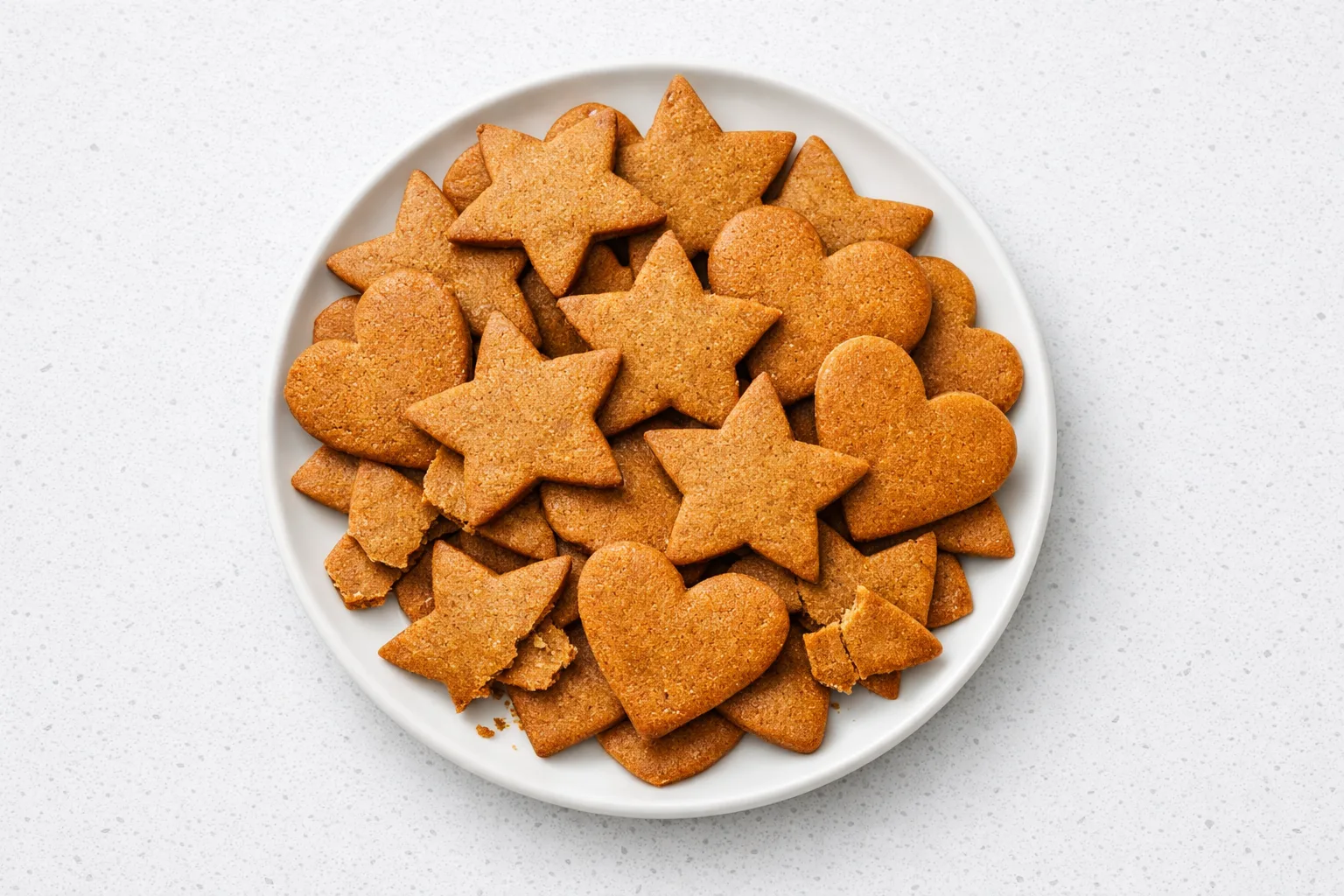
Pepparkakor are Sweden's signature Christmas cookie: wafer-thin, deeply spiced ginger snaps that shatter with a satisfying crack when you bite into them. The name translates to "pepper cookies," and while black pepper is indeed one of the spices, it's the combination of ginger, cinnamon, cloves, and cardamom that gives pepparkakor their unmistakable warm depth. In Sweden, they appear in every bakery, kitchen, and advent calendar from late November onward, and the smell of them baking is as much a part of jul (Christmas) as any decoration.
What separates pepparkakor from other ginger cookies is thickness, or rather the lack of it. They must be rolled almost paper-thin, 2mm at most, to achieve the proper snap. Thicker versions are softer and lose the defining texture entirely. The dough is also rest-heavy: it needs at least 8 hours in the refrigerator, ideally overnight, to fully hydrate and develop flavor. This is not a shortcut-friendly recipe in that regard, but the actual active work is minimal.
This version uses dark syrup (mörk sirap) for the most authentic flavor, though golden syrup or even dark corn syrup works as a reasonable substitute. The dough is forgiving and freezes beautifully, making pepparkakor the ideal make-ahead Christmas cookie.
Equipment
Instructions
Tap each step to track your progress
- 1
Whisk together the flour, baking soda, ginger, cinnamon, cloves, cardamom, black pepper, and salt in a medium bowl until evenly combined. Set aside.
- 2
In a stand mixer fitted with the paddle attachment, beat the butter and sugar on medium speed for 2 minutes until pale and fluffy. Scrape down the sides.
- 3
Add the syrup and egg to the butter mixture. Beat on medium for another minute until fully incorporated. The mixture will look slightly curdled at first; this is normal.
- 4
Add the flour mixture all at once. Mix on low speed until the dough just comes together and no dry streaks remain. Do not overmix.
- 5
Turn the dough out onto a lightly floured surface and bring it together into a flat disc. Divide into two equal portions, wrap tightly in cling film, and refrigerate for at least 8 hours or overnight. The dough will firm up considerably and the spice flavor will deepen.
- 6
When ready to bake, preheat the oven to 375F (190C). Line baking sheets with parchment paper.
- 7
Remove one dough disc from the refrigerator. On a lightly floured surface (or between two sheets of parchment), roll it out to 2mm thickness. This is thinner than you think; you should be able to see light through the dough faintly at the thinnest points.
- 8
Cut into shapes using cookie cutters. Traditional shapes include stars, hearts, gingerbread people, and pigs (the pig is a classic Swedish Christmas symbol). Transfer cut-outs carefully to the prepared baking sheets, spaced about 1 inch apart. Re-roll scraps once.
- 9
Bake for 8-10 minutes until the cookies are a uniform deep golden-brown and the edges look set and slightly darker. They will feel soft straight from the oven; this is normal.
- 10
Leave the cookies on the baking sheet for 2 minutes, then transfer to a wire rack to cool completely. They will crisp up fully as they cool. If they remain soft after 30 minutes, they need a few more minutes in the oven on your next batch.
- 11
Repeat with the remaining dough disc, always starting with cold dough from the refrigerator.
Tips & Tricks
Roll thinner than you think
The single most common mistake with pepparkakor is rolling too thick. At 3-4mm, you get a soft chewy cookie, which is not the goal. At 2mm or under, you get the proper crisp snap. Use guides (two wooden skewers or 2mm dowels on either side of the dough) to keep thickness consistent.
Rest the dough overnight, not just 2 hours
The flour needs time to fully absorb the liquid and the spices need time to meld. Dough made the day before has noticeably more complex flavor and rolls more evenly than dough used the same day. Make the dough the evening before you plan to bake.
Watch the color, not just the timer
Oven temperatures vary. Perfectly baked pepparkakor are a deep, uniform golden-brown across the entire surface, including the center. Pale centers mean more time is needed. The cookies smell nutty and spiced when done, not raw. Pull them at the first sign of the edges going very dark.
Keep unused dough cold between batches
Work with one disc at a time and return cut-out shapes to the refrigerator if your kitchen is warm. Warm dough bakes into flat, spread-out cookies that lose their sharp edges. Speed is not the goal; cold is.
Use dark syrup for the most authentic flavor
Swedish <em>mörk sirap</em> (dark syrup) has a distinct, slightly bitter molasses-adjacent flavor that is central to traditional pepparkakor. Golden syrup produces a milder cookie. Dark corn syrup is an acceptable substitute. Avoid light corn syrup; it lacks the depth that defines the cookie.
Troubleshooting
My pepparkakor came out soft, not crisp
Either the dough was rolled too thick or the cookies needed more time in the oven. Proper pepparkakor must be 2mm or under. If they're still soft after cooling for 30 minutes, return the next batch to a 300F (150C) oven for 5 minutes to drive off more moisture without burning.
The dough keeps tearing when I roll it
The dough is too cold from the refrigerator. Let it sit at room temperature for 5 minutes before rolling. If it tears, press it back together; the dough is very forgiving. Rolling between two sheets of parchment eliminates most sticking and tearing issues.
My cookies are burning on the bottom before the tops color
Your oven runs hot on the floor heat. Move the rack to the center or upper-center position, or stack two baking sheets together to create an insulating buffer between the cookie base and the heat source.
The cookies spread and lose their shape in the oven
The dough was too warm when it went in. After cutting your shapes, slide the whole baking sheet into the refrigerator for 10 minutes before baking. Cold dough holds sharp edges far better.
The dough is too sticky to roll
The dough needs more chilling time. Wrap it again and return it to the refrigerator for at least 30 more minutes. Avoid adding too much extra flour when rolling; it toughens the cookies and can make them taste floury.
Variations
Vegan Pepparkakor
Replace the butter with solid refined coconut oil (same quantity by weight) and substitute the egg with 1 tablespoon of golden syrup plus 2 tablespoons of plant milk. The dough will be slightly softer to work with; keep it well chilled. The finished cookies are indistinguishable from the original in texture and flavor.
Cardamom-Forward Version
Double the cardamom to 1 teaspoon and reduce the ginger to 1 teaspoon. This leans into the Nordic cardamom tradition and gives the cookies a slightly floral, citrusy quality. It pairs particularly well with coffee.
Orange-Glazed Pepparkakor
After the cookies cool completely, drizzle or dip one side in a simple glaze: mix 1 cup powdered sugar with 2-3 tablespoons fresh orange juice until smooth. Let set on a wire rack. The citrus cuts through the spice and adds a touch of elegance for gift-giving or a cookie platter.
Gluten-Free Adaptation
Substitute the all-purpose flour with a 1-to-1 gluten-free baking flour blend (one that contains xanthan gum). The dough will be a bit more crumbly when rolling; work with smaller portions and roll between parchment sheets. The cookies will be very slightly less crisp but still have good snap after cooling fully.
Serving & Gifting
Pepparkakor are traditionally stacked in a tin or arranged on a platter alongside other <em>julbord</em> (Christmas table) treats. They pair naturally with glgg (Swedish mulled wine), strong black coffee, or a glass of cold milk for children. For a gift, pack them in a decorative tin with layers of parchment between cookies; they are sturdy enough to ship without breakage, making them an ideal edible Christmas gift. At parties, they work well as a crunchy element on a cheese board alongside sharp aged cheese.
Storage & Freezing
Pepparkakor keep remarkably well. Store in an airtight tin at room temperature for up to 4 weeks; they actually improve in flavor over the first few days as the spices settle. The unbaked dough keeps in the refrigerator for up to 5 days or in the freezer for up to 3 months, tightly wrapped in cling film and then in a freezer bag. Thaw overnight in the refrigerator before rolling. Do not freeze baked cookies in airtight bags with moisture; use a tin or a container with a loose-fitting lid to keep them crisp.
Common Questions
What is the difference between pepparkakor and gingerbread cookies?
Pepparkakor are rolled much thinner than typical gingerbread cookies and are baked until fully crisp, giving them a snap rather than a chew. They also use a blend of spices that includes cardamom and black pepper alongside the usual ginger and cinnamon, which gives them a more complex, slightly sharper flavor than most gingerbread recipes.
Can I make pepparkakor without a stand mixer?
Yes. The dough comes together easily by hand or with a hand mixer. Cream the softened butter and sugar vigorously with a wooden spoon for 3-4 minutes, then beat in the syrup and egg before working in the flour. The key is that the butter must be genuinely soft at room temperature, not melted and not cold.
Do pepparkakor need to be refrigerated?
No. Baked pepparkakor store best at room temperature in an airtight tin. Refrigerating them exposes them to moisture and humidity, which softens the crisp texture. A tin with a tight lid kept in a cool, dry spot is ideal.
How thin should pepparkakor be rolled?
Approximately 2mm, which is roughly the thickness of two stacked coins. This is significantly thinner than most cookie recipes. At this thickness, the cookies bake quickly (8-10 minutes) and achieve the definitive crisp snap. Any thicker and you lose the characteristic texture.
Can I use molasses instead of dark syrup?
Unsulfured molasses works as a substitute, but use only 1.5 tablespoons instead of 2, as molasses is more intensely flavored and slightly more bitter than Swedish dark syrup. Avoid blackstrap molasses entirely; it will overwhelm the spices and produce a very bitter cookie.
How far in advance can I make pepparkakor?
The dough can be made up to 5 days ahead and kept in the refrigerator, or up to 3 months ahead and frozen. Baked cookies keep for up to 4 weeks in an airtight tin at room temperature and actually taste better after a few days as the spices meld. This makes them one of the best Christmas cookies to bake early in the season.