
 Sweden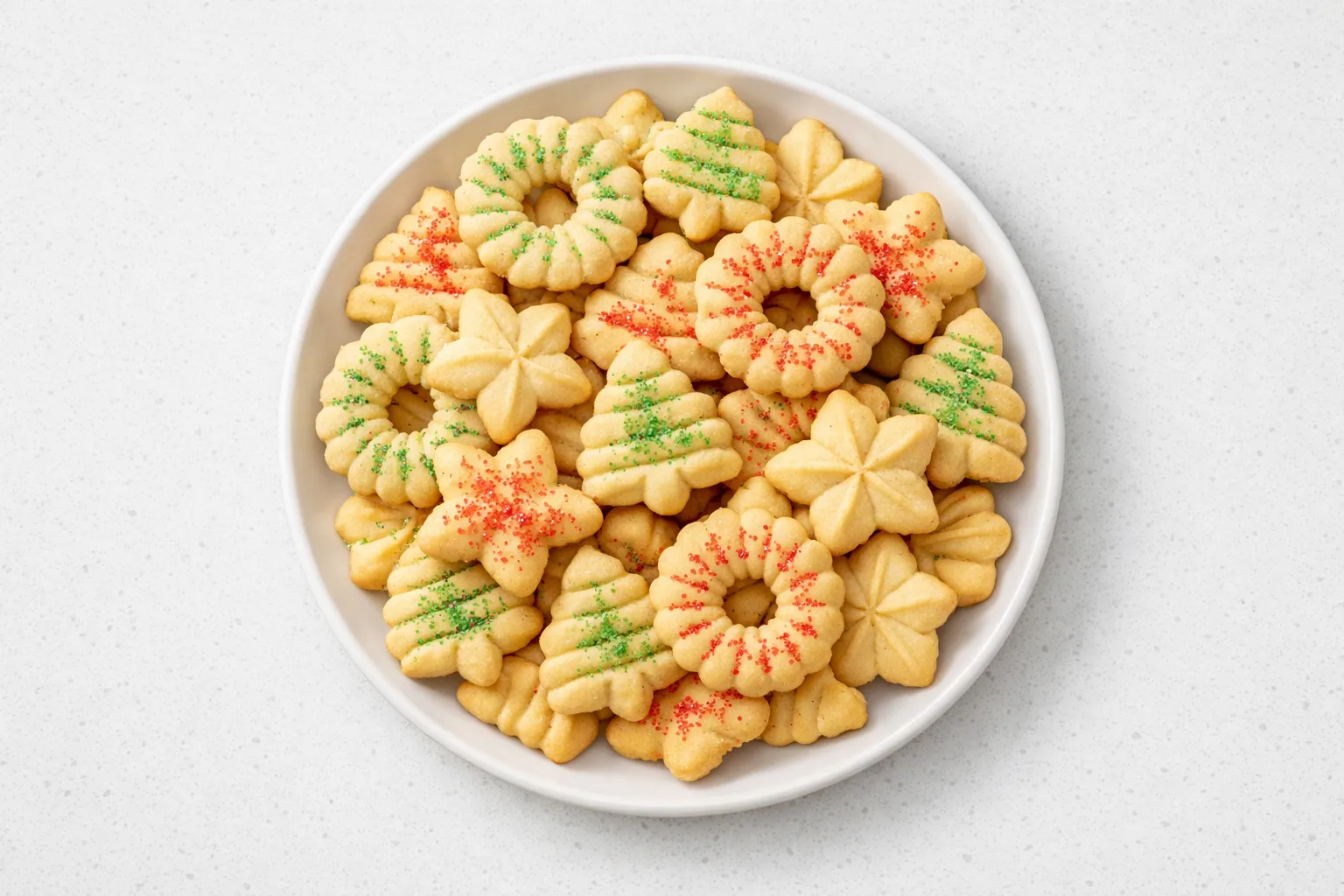
Spritz cookies are a Christmas staple with roots in Scandinavia, where the name comes from the German and Swedish word spritzen, meaning "to squirt" or "to press." Scandinavian immigrants brought the tradition to the United States in the 19th century, and today christmas spritz cookies are one of the most-made holiday butter cookies in American homes. The dough is pressed through a cookie press fitted with decorative discs to produce stars, wreaths, trees, and ribbons in seconds.
What makes this recipe work is the ratio: enough butter to give that melt-in-your-mouth quality, enough flour to hold the pressed shape, and just enough sugar to keep things crisp rather than cakey. The dough has to be the right temperature to press cleanly, which is the one thing most recipes get wrong. This version nails that window and gives you consistent results across the entire batch.
Equipment
Instructions
Tap each step to track your progress
- 1
Preheat your oven to 375 F (190 C). Line two baking sheets with parchment paper. Do not grease them, the dough needs to grip the surface to press cleanly.
- 2
Whisk together the flour and salt in a medium bowl. Set aside.
- 3
In a stand mixer fitted with the paddle attachment, beat the softened butter and granulated sugar on medium speed for 3 minutes until pale and very fluffy. Scrape down the sides of the bowl after 2 minutes.
- 4
Add the egg, vanilla extract, and almond extract. Beat on medium speed for 1 minute until fully incorporated. The mixture should look smooth and slightly glossy.
- 5
With the mixer on low, add the flour mixture in three additions, mixing just until no dry streaks remain after each addition. Do not overmix. The dough will be soft but not sticky, it should pull away from the sides of the bowl cleanly.
- 6
Load the dough into a cookie press fitted with your chosen disc. Press cookies directly onto the ungreased, unlined (or parchment-lined) baking sheet, holding the press perpendicular to the surface and applying even pressure. Space cookies about 1 inch apart; they spread very little.
- 7
Decorate immediately with colored sugar or sprinkles before baking. Press any toppings gently so they adhere.
- 8
Bake one sheet at a time on the center rack for 10-12 minutes until the edges are just turning golden. The centers should look set but not browned. The cookies will look pale and underdone but firm up completely as they cool.
- 9
Let cool on the baking sheet for 5 minutes before transferring to a wire rack. They are fragile when hot.
Tips & Tricks
Use room temperature butter, not melted
The creaming method builds the structure the dough needs to hold its pressed shape. Melted or very soft butter will make the dough too slack, and the cookies will spread and lose definition. Softened means it holds a finger indent without resistance but is not shiny or greasy.
Skip the silicone mat
Spritz dough needs to grip a slightly textured, cool surface to release cleanly from the press. Silicone mats are too slick and warm, the dough smears instead of sticking. Use parchment or a bare, ungreased aluminum pan.
Press close to the surface
Hold the cookie press almost touching the baking sheet. If you hold it too high, the dough falls rather than sticks and loses its shape. Touch the disc to the sheet, apply pressure, then lift straight up.
Chill the baking sheet between batches
If your kitchen is warm and you're pressing multiple sheets, the second and third batches can start to soften before they hit the oven. Slide the sheet into the fridge for 5 minutes between pressing and baking to keep the shapes sharp.
Make the dough ahead
The dough keeps refrigerated for 3 days and frozen for 2 months. Shape it into a log, wrap in plastic, and freeze. On baking day, thaw in the refrigerator overnight, then let it sit at room temperature until it reaches a pressable consistency, about 30-45 minutes.
Troubleshooting
The dough won't press out of the cookie press cleanly
The dough is either too cold or too warm. If it crumbles or won't release, the butter is too cold. Leave the dough at room temperature for 10 minutes and try again. If the cookies are spreading as they press and losing their shape, the dough is too warm. Refrigerate for 15 minutes. The ideal dough temperature is between 65-70 F (18-21 C).
The cookies won't stick to the baking sheet when I lift the press
Do not grease the pan and do not line it with silicone mats. The dough needs a slightly grippy, cool surface to release cleanly from the press. Parchment paper works, but an ungreased bare sheet works even better. Also, the dough may be slightly too warm; a brief chill helps.
My spritz cookies are spreading and losing their ridged shape
The butter was too soft when the dough was mixed, or the dough was allowed to get too warm during pressing. The ridged texture from the disc depends on the dough holding its structure. Keep your kitchen cool, work in smaller batches, and refrigerate any dough you're not immediately pressing.
The cookies are too hard or dry
They were overbaked. Spritz cookies should come out of the oven looking barely done. Pale centers, just-golden edges. Pull the sheet at the lower end of the time range and let carry-over baking on the hot sheet do the rest.
The dough is too soft to load into the press
You may have over-creamed the butter or the kitchen is warm. Refrigerate the dough for 20-30 minutes until it firms up slightly. It should be malleable but not sticky to the touch.
Variations
Lemon Spritz Cookies
Replace the almond extract with 1 tsp fresh lemon zest and 1/2 tsp lemon extract. Finish with a light dusting of powdered sugar after baking. The citrus lifts the richness of the butter and makes the cookies feel brighter and less sweet.
Chocolate Spritz Cookies
Replace 1/4 cup of flour with 1/4 cup Dutch-process cocoa powder and increase the sugar by 2 tablespoons. The cocoa dough is slightly firmer and may require a little more pressure through the cookie press, but the result is a deeply chocolatey, crisp butter cookie. Dip cooled cookies in melted white chocolate for contrast.
Gluten-Free Adaptation
Substitute the all-purpose flour 1:1 with a high-quality gluten-free all-purpose blend that includes xanthan gum (such as Bob's Red Mill 1-to-1). The dough will be slightly stickier; chill for 20 minutes before loading the press. The cookies will be a touch more fragile when warm but crisp up well.
Vegan Adaptation
Replace the butter with a high-quality vegan butter stick (Miyoko's or Earth Balance sticks work best; avoid spreads in tubs, which have too much water). Replace the egg with 2 tablespoons of full-fat coconut cream. The cookies will press and bake well, though they may spread very slightly more than the original.
Serving & Gifting
Spritz cookies are made for cookie swaps: they produce a high volume, they stack without sticking, and they look polished with almost no decorating effort. Arrange a mix of shapes and colors on a tiered stand or flat platter for visual variety. They pair naturally with hot cocoa, coffee, or a glass of cold milk. For gifting, pack them in a tin layered with parchment, they travel well without breaking because they are firm and compact.
Storage & Freezing
Store in an airtight container at room temperature for up to 3 weeks; they stay crisp and fresh longer than most cookies because of the low moisture content. The unbaked dough can be refrigerated for up to 3 days or frozen for up to 2 months, wrapped tightly in plastic wrap. Thaw frozen dough overnight in the refrigerator, then let it come up to pressing temperature before loading the cookie press. Baked and cooled cookies also freeze well for up to 2 months in a sealed bag.
Common Questions
Why do my spritz cookies lose their shape when baked?
The most common cause is dough that is too warm when it goes into the oven. The butter should be creamed at room temperature (not melted), and the pressed cookies should go into a preheated oven quickly. If your kitchen is warm, chill the shaped cookies on the sheet for 10 minutes before baking.
Can I make spritz cookies without a cookie press?
You can, but they won't be spritz cookies in the traditional sense. Without a press, you can roll the dough into small balls and flatten with a patterned stamp or fork, or use a piping bag fitted with a large star tip to pipe rosettes or ribbons. The result is a similar cookie but without the crisp ridged texture.
What is the difference between spritz cookies and butter cookies?
Spritz cookies are a type of butter cookie, but the term specifically refers to cookies made by pressing the dough through a cookie press. They have a higher butter-to-flour ratio than most rolled butter cookies, which gives them a more delicate, short texture. Standard butter cookies are usually thicker and chewier.
Can I add food coloring to spritz cookie dough?
Yes. Divide the dough and add a few drops of gel food coloring (not liquid, which adds too much moisture) and mix until even. Green and red are classic for Christmas. Use gel color for vivid results without affecting the dough consistency.
How far ahead can I bake spritz cookies?
Spritz cookies are an excellent make-ahead cookie. Baked cookies keep crisp in an airtight container for up to 3 weeks at room temperature, making them one of the earliest Christmas cookies you can bake. They are a common first batch in Scandinavian-American households, often baked in early December.
Do Swedish spritz cookies have almond extract?
Traditional Scandinavian spritz recipes often include both vanilla and almond extract, and sometimes a small amount of cardamom. The almond extract is not essential but it adds a distinctive, subtly nutty flavor that distinguishes spritz from a plain butter cookie. If you or your guests have a nut allergy, you can omit it without affecting the texture.