

 Germany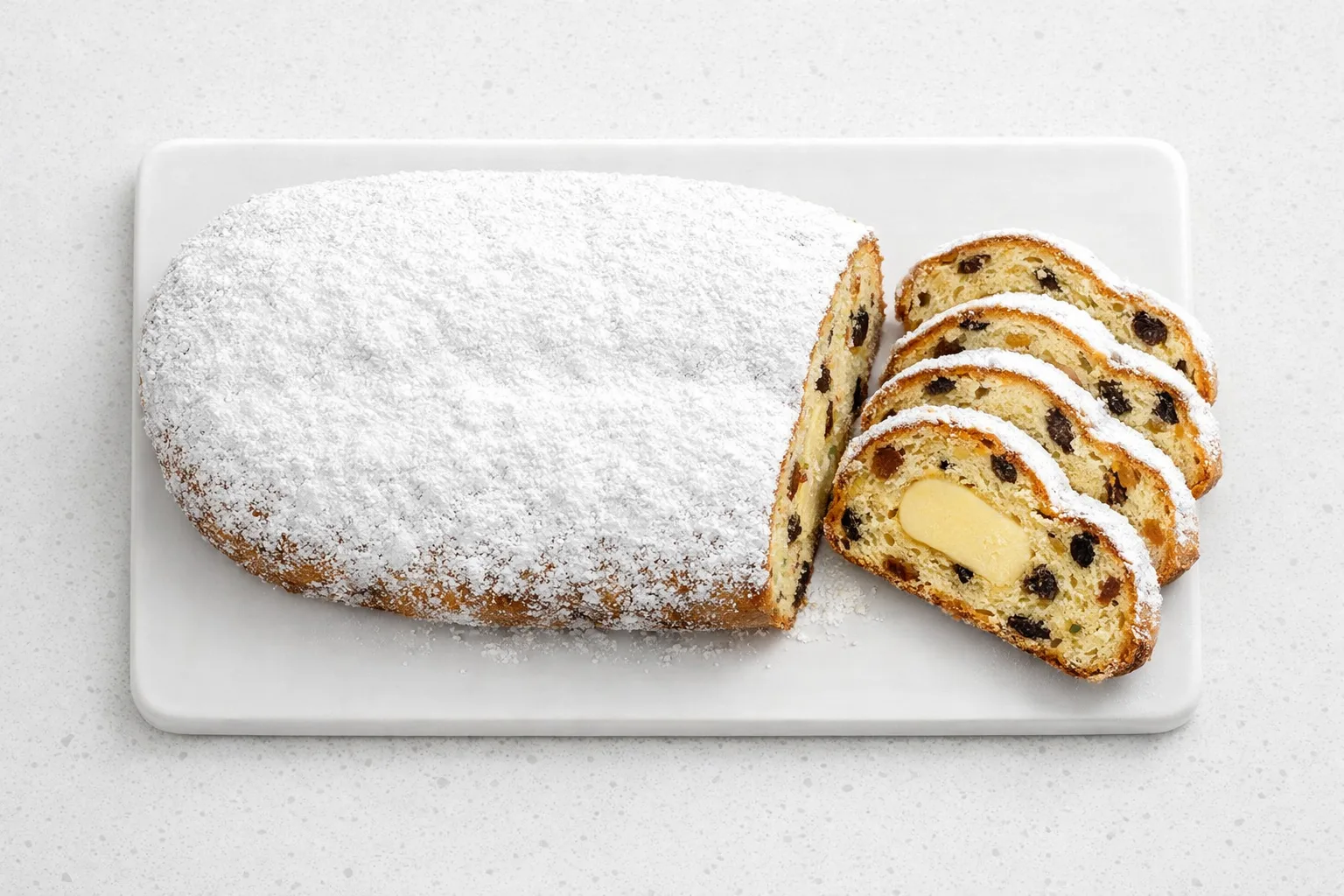
Stollen is the yeasted fruit bread that anchors Christmas across Germany, baked in households and bakeries from early November through Advent. The most famous version, Dresdner Christstollen, has been documented in Dresden since 1474, when it was a plain, austere loaf made with oil, oats, and turnip. Once the papal ban on butter was lifted in 1491 (via the so-called Butterbrief), Saxon bakers transformed it into the rich, butter-drenched bread recognized today.
A proper stollen is not a cake. It is a firm, dense yeasted bread where the dough serves as a vehicle for rum-soaked raisins, candied citrus peel, almonds, and a solid core of marzipan. After baking, the loaf is soaked in melted butter and buried under powdered sugar, creating a seal that keeps the crumb moist for weeks. This recipe makes two loaves, because stollen genuinely improves after resting for two to three weeks, and you will want one to eat now and one to save.
Equipment
Instructions
Tap each step to track your progress
- 1
Combine the raisins, candied orange peel, and candied lemon peel in a bowl. Pour the rum over the fruit, stir to coat, cover tightly, and let soak for at least 4 hours or overnight at room temperature. The fruit should absorb most of the liquid.
- 2
In a large bowl or the bowl of a stand mixer, whisk together the flour, sugar, salt, cardamom, nutmeg, cinnamon, and citrus zests. Sprinkle the yeast over the lukewarm milk in a small bowl, stir gently, and let stand for 5 minutes until foamy.
- 3
Add the yeast mixture, egg yolks, vanilla extract, and almond extract to the flour mixture. Mix on low speed with the dough hook (or stir by hand) until a shaggy dough forms. Add the softened butter a few tablespoons at a time, mixing on medium-low speed until each addition is fully incorporated before adding the next. This takes about 8 minutes total. The finished dough should be smooth, slightly tacky, and pull cleanly from the sides of the bowl.
- 4
Drain any unabsorbed rum from the soaked fruit. Add the fruit and slivered almonds to the dough and mix on low speed (or fold by hand) until evenly distributed. The dough will feel heavy and sticky. Cover the bowl with plastic wrap and let rise in a warm spot for 1 1/2 to 2 hours, until roughly doubled in size.
- 5
Divide the marzipan in half and roll each piece into a log about 8 inches long. Set aside. Line two baking sheets with parchment paper.
- 6
Turn the dough out onto a lightly floured surface and divide it in half. Working with one piece at a time, pat and roll the dough into an oval roughly 10 by 7 inches. Place one marzipan log slightly off-center along the length. Fold the larger side of the dough over the marzipan, overlapping the edge by about an inch, so the loaf resembles a slightly asymmetrical oval with a visible seam. Press the edges gently to seal without flattening the loaf. The traditional shape is not a tight roll; it is a folded oval with a raised ridge along the fold. Transfer to the prepared baking sheet. Repeat with the second piece of dough and marzipan.
- 7
Cover the shaped loaves loosely with a clean kitchen towel and let them rest for 45 minutes. They will puff slightly but will not double. Preheat the oven to 325F (165C) during this rest.
- 8
Bake for 50 to 55 minutes, until the crust is deep golden brown and the internal temperature reads 190F (88C) on an instant-read thermometer. The loaves should feel firm when tapped on the bottom. If the tops brown too quickly, tent loosely with foil after 35 minutes.
- 9
While the stollen is still hot from the oven (within the first 5 minutes), generously brush the entire surface of each loaf with melted butter, using about half the melted butter total. Let it soak in for 2 minutes, then brush again with the remaining butter. The loaf should glisten and feel saturated. Immediately sift a thick layer of powdered sugar over the entire surface, then let the loaves cool completely on a wire rack. Once fully cooled, sift a second heavy coat of powdered sugar over the top.
Tips & Tricks
Soak the fruit longer, not shorter
A 4-hour soak is the minimum, but overnight is better. Well-soaked fruit stays plump and moist inside the baked loaf. Poorly soaked fruit dries out during baking and creates hard, chewy pockets. If you have time, soak the fruit for 24 hours, stirring once halfway through.
Use block marzipan, not marzipan paste
Marzipan and almond paste are different products. Marzipan has a higher sugar-to-almond ratio and a smooth, pliable texture that holds its shape inside the stollen. Almond paste is coarser and grainier, and it melts into the dough during baking rather than forming a distinct layer. Look for marzipan with at least 50% almond content.
Control the butter temperature
The butter for the dough should be softened to a pliable state but still cool to the touch, not warm or greasy. Butter that is too warm melts into the flour and creates a greasy, flat dough that will not rise properly. If your butter is too soft, chill it for 10 minutes before adding it piece by piece.
Age the stollen before eating
Stollen is not meant to be eaten the day it is baked. The flavors need time to meld: the rum, spices, citrus, and butter all integrate over the first two weeks. Bake your stollen by the first week of December and you will have a perfectly matured loaf by Christmas Eve.
Weigh your flour
Bread flour measured by the cup can vary by 30% depending on how you scoop. For consistent results, weigh the flour: 4 cups of bread flour should be approximately 540g (19 oz). Too much flour produces a dense, tough loaf; too little makes the dough unmanageable.
Troubleshooting
My stollen is dry and crumbly
The most common cause is under-buttering after baking. The post-bake butter soak is not optional decoration; it is structural. Brush generously while the bread is still very hot so the butter penetrates deep into the crumb. If the loaf was also over-baked, reduce oven time by 5 minutes and check internal temperature at 45 minutes.
The marzipan sank to the bottom or leaked out
The marzipan was too soft, or the dough was rolled too thin underneath it. Use firm block marzipan (not marzipan paste), and make sure the dough layer beneath the marzipan log is slightly thicker than the layer folded over it. Let the marzipan come to room temperature so it bends without cracking, but it should not be warm or sticky.
The dough didn't rise enough
Stollen dough is heavy with butter, eggs, and fruit, so it rises more slowly than plain bread. Give it the full 2 hours for the first rise in a genuinely warm spot (75-80F). If your kitchen is cold, place the covered bowl on top of a towel over a pan of warm water. The yeast must be active: if the milk-yeast mixture does not foam within 5 minutes, the yeast is dead and you need a new packet.
The fruit keeps tearing through the dough
Drain the soaked fruit thoroughly before adding it. Toss the fruit with 2 tablespoons of flour to reduce surface moisture. Fold the fruit in gently on low speed or by hand rather than mixing aggressively. A few pieces poking through the surface is normal and will caramelize during baking.
Variations
Stollen Without Marzipan
If you dislike marzipan or have a nut allergy to consider, simply omit the marzipan log and shape the dough as a plain folded oval. Increase the slivered almonds in the dough to 3/4 cup for texture, or add 1/2 cup extra raisins to compensate for the missing filling. The butter and sugar coating still applies.
Mohn Stollen (Poppy Seed Stollen)
Replace the marzipan core with a poppy seed filling: simmer 1 1/2 cups ground poppy seeds with 1/2 cup milk, 1/4 cup sugar, 2 tbsp honey, and 1 tbsp butter until thick and spreadable, then cool. Spread the filling over the rolled-out dough before folding. This variation is popular in Saxony and Silesia.
Quark Stollen (Quarkstollen)
Replace 1/2 cup of the butter in the dough with 1 cup of well-drained quark (or full-fat ricotta passed through a sieve). The crumb becomes lighter and more tender, closer to a cake texture. Reduce the milk to 1/2 cup since the quark adds moisture. This version is softer and best eaten within a week rather than aged.
Gluten-Free Adaptation
Use a 1:1 gluten-free flour blend that contains xanthan gum in place of bread flour. Add 1 extra egg yolk to improve binding. The dough will be stickier and will not develop gluten structure, so handle it gently and expect a slightly denser, more crumbly crumb. Reduce kneading time and rely on the rise for structure.
Serving & Gifting
Slice stollen into thin pieces, about 1/2 inch thick, with a sharp serrated knife. It pairs well with strong coffee, tea, or a glass of German <em>Gluhwein</em>. At a holiday gathering, present the whole loaf on a board with a knife and let guests cut their own slices. For a festive breakfast or brunch, toast thin slices lightly and serve with butter (yes, more butter).
Storage & Freezing
Wrap each loaf tightly in plastic wrap, then in aluminum foil, and store at cool room temperature for up to 4 weeks. The flavors develop and improve during the first 2 to 3 weeks of resting, so baking in late November for Christmas eating is traditional timing. For longer storage, freeze the wrapped, un-sugared loaf for up to 3 months; thaw at room temperature overnight, then apply the butter coating and powdered sugar. Do not refrigerate stollen, as the cold dries out the crumb.
Common Questions
How is stollen different from fruitcake?
Stollen is a yeasted bread, not a cake. It uses yeast-leavened dough enriched with butter and eggs, while fruitcake is typically a batter-based cake leavened with baking powder or eggs alone. Stollen has a firmer, bread-like crumb and is finished with a butter soak and powdered sugar coating rather than a glaze or icing.
Can I make stollen without rum?
Yes. Replace the rum with fresh orange juice for a non-alcoholic version. The fruit will still plump up and add moisture. The flavor profile shifts slightly, losing the deep boozy warmth, but the bread is still excellent. Apple juice or strong black tea also work as substitutes.
How long does stollen last?
A properly made and wrapped stollen lasts 4 to 6 weeks at cool room temperature. The thick butter coating and powdered sugar act as a seal that slows moisture loss. Frozen, it keeps for up to 3 months. The bread actually improves during the first 2 to 3 weeks as the flavors meld and the crumb softens from the rum-soaked fruit.
What is Dresdner Stollen?
<em>Dresdner Christstollen</em> is a protected regional designation for stollen baked in and around Dresden, Germany, following strict traditional standards. Bakers must use a minimum ratio of butter, almonds, and dried fruit to flour. The recipe in this article follows the Dresdner tradition closely, though it cannot legally carry the name unless baked in the Dresden region by a registered baker.
Can I use almond paste instead of marzipan?
Almond paste has a higher almond-to-sugar ratio and a coarser, grittier texture. It tends to melt and spread during baking rather than holding a clean shape. If almond paste is all you can find, freeze it for 30 minutes before rolling it into a log, and expect it to blend more into the surrounding dough. The flavor is still good, but the visual distinction of the marzipan core will be less defined.
Is stollen difficult to make?
The technique is straightforward if you have experience with enriched yeasted doughs. The main demands are patience (soaking the fruit, two rises, aging the finished loaf) rather than skill. The dough handles more like brioche than a lean bread. Allow a full afternoon for mixing, shaping, and baking, plus 2 to 3 weeks of aging before serving.