
 Czech Republic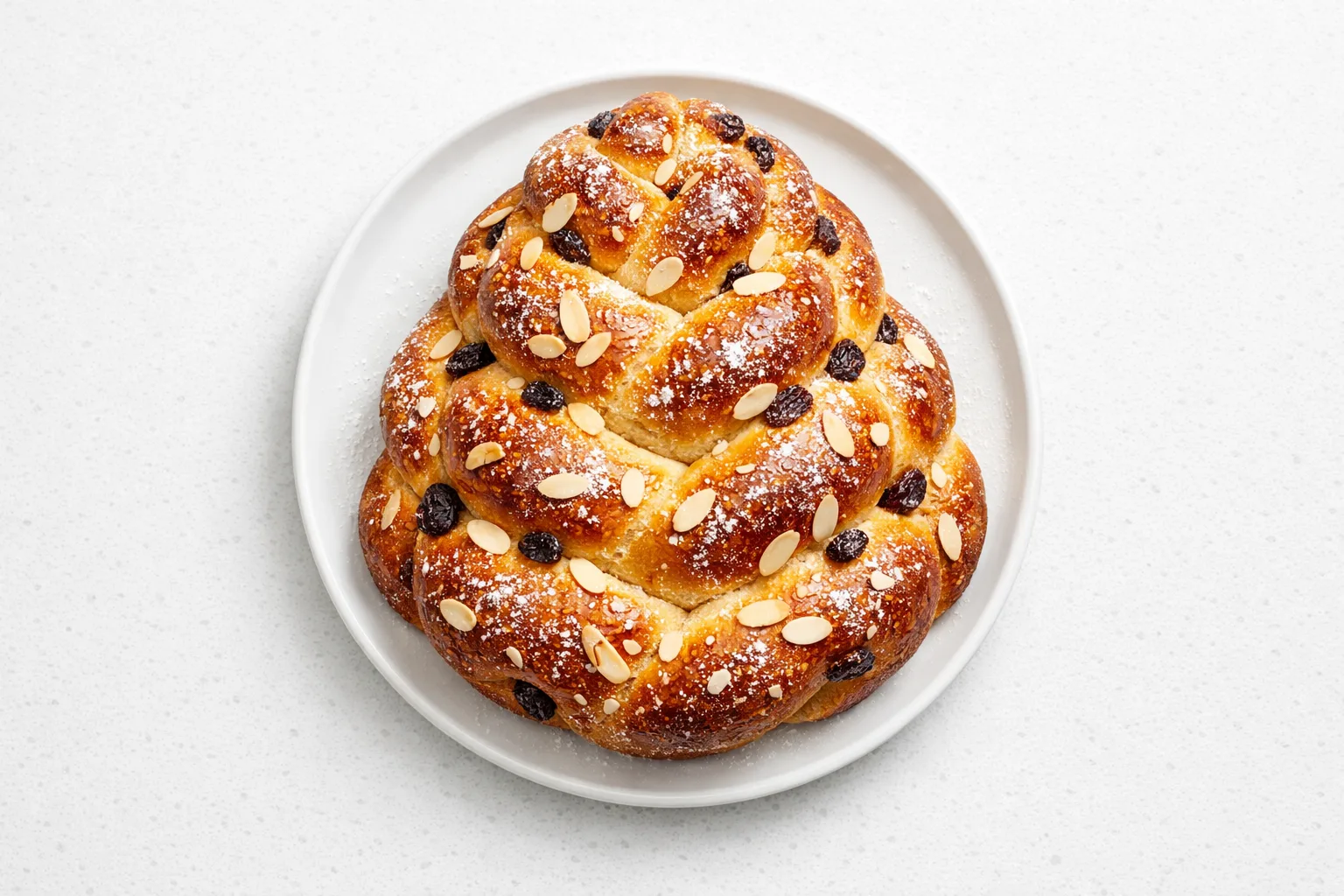
Vanocka (pronounced VAH-noch-kah) is the Czech Christmas bread, a richly enriched braided loaf that has been baked for the holiday season in Bohemia and Moravia for centuries. Made from a buttery, egg-heavy dough scented with lemon zest and vanilla, it is woven into a three-tiered braid: four strands on the bottom, two in the middle, one on top. Every Czech family bakes or buys one for Christmas Eve morning, and the shape itself carries symbolic meaning: the braided tiers represent the ladder to heaven, or in older folk tradition, the swaddling of the Christ child.
The dough is a classic enriched bread, similar in style to brioche or the German Hefezopf, but with its own character: slightly less sweet, with raisins soaked in rum folded through, slivered almonds pressed into the crust, and a glaze of egg wash that bakes to a deep amber. The slow rise is not optional. A rushed vanocka is a dense one. Give the dough two full rises and it will repay you with a feather-light crumb that pulls apart in long, satisfying strands.
Equipment
Instructions
Tap each step to track your progress
- 1
Soak the raisins in the rum or orange juice for at least 30 minutes, or up to overnight. Drain and pat them dry on paper towels before adding to the dough; wet raisins make the dough sticky.
- 2
Combine the flour, yeast, sugar, and salt in the bowl of a stand mixer fitted with the dough hook. Add the warm milk, eggs, vanilla, lemon zest, and mace. Mix on low for 2 minutes until a shaggy dough forms.
- 3
Increase to medium speed and knead for 5 minutes. The dough will feel stiff. Begin adding the softened butter a few pieces at a time, waiting for each addition to be fully incorporated before adding more. This takes about 8 to 10 minutes total. The finished dough should be smooth, slightly tacky, and pull cleanly from the sides of the bowl.
- 4
Add the drained raisins and knead on low for 1 to 2 minutes until evenly distributed. Shape the dough into a ball, place in a lightly greased bowl, cover with plastic wrap, and refrigerate for at least 8 hours or overnight. A cold, slow rise gives the bread its best flavor and makes the dough much easier to braid.
- 5
Remove the dough from the refrigerator 30 minutes before shaping. Line a large baking sheet with parchment paper. Divide the dough into 7 equal pieces: 4 pieces of roughly 135g each for the bottom layer, 2 pieces of roughly 100g for the middle, and 1 piece of roughly 95g for the top. Roll each piece into a smooth strand about 40cm long for the four bottom strands, 35cm for the two middle strands, and 30cm for the single top strand.
- 6
Braid the four bottom strands: press them together at the top and braid them using a standard 4-strand braid (outside right over to the middle, outside left over to the middle, repeat). Pinch the bottom ends firmly together. Transfer to the prepared baking sheet.
- 7
Braid the two middle strands together like a simple 2-strand twist (cross them over each other repeatedly). Place this braid centered on top of the 4-strand base, pressing gently so it seats. Lay the final single strand on the very top. Tuck and pinch all ends underneath the loaf.
- 8
Cover loosely with a clean kitchen towel and let rise at room temperature for 1.5 to 2 hours, until visibly puffed and the loaf feels soft and springy when gently pressed with a finger.
- 9
Preheat the oven to 350F (175C). Brush the entire loaf generously with egg wash, making sure to get into the braid crevices. Scatter the slivered almonds over the top and press them lightly so they adhere.
- 10
Bake for 35 to 40 minutes, until the crust is a deep mahogany brown and an instant-read thermometer inserted into the thickest part reads 190F (88C). If the top browns too quickly in the last 10 minutes, tent loosely with foil. Let the bread cool on a wire rack for at least 1 hour before cutting. Dust with powdered sugar just before serving.
Tips & Tricks
Cold overnight rise is not optional
Refrigerating the dough overnight does two things: it develops flavor through slow fermentation, and it makes a rich, buttery dough much easier to shape. Trying to braid warm enriched dough at room temperature is an exercise in frustration. Cold dough holds its shape, warm dough smears.
Weigh the dough for even strands
If one strand is thicker than another, the braid will be lopsided and the thicker strand will stay undercooked while the thinner one overbakes. Use a kitchen scale to divide the dough and roll each strand to the same length before braiding.
Press the layers down firmly
The middle and top braid layers need to be seated, not just rested on top. Press each layer gently into the one below it before the final rise, so they bake as a unified loaf rather than sliding apart.
Brush generously with egg wash twice
Apply egg wash before adding the almonds, then give it a second pass over the almonds once they are in place. Two coats produce the deep, glossy amber crust that defines a bakery-quality <em>vanocka</em>.
Raisins must be dry
Wet raisins introduce pockets of moisture that prevent the surrounding dough from baking properly and can cause the braid to tear. After soaking, drain thoroughly and press them dry with paper towels before folding into the dough.
Troubleshooting
The dough won't come together or feels too sticky
Enriched doughs take time to develop. Keep mixing. If it is genuinely too sticky to work with after 12 minutes of kneading, add flour one tablespoon at a time, but resist the urge too early. A slightly tacky dough is correct; a dry dough bakes up dense.
My braid fell apart or collapsed during baking
The dough was under-proofed, or the braid strands were not sealed tightly enough at the ends. Make sure to pinch the ends firmly underneath the loaf, and allow the full second rise. A well-proofed loaf should jiggle very slightly when the tray is gently shaken.
The bread is too dense
This is almost always an under-risen loaf. Enriched doughs enriched with fat and eggs rise more slowly than lean doughs. In a cool kitchen, the second rise can take 2.5 hours. The loaf should look distinctly puffed before it goes in the oven. Also make sure your yeast is active.
The crust is dark but the inside is still goughy
The braid layers mean the center of the loaf is thick. Reduce the oven temperature to 325F (165C) and bake 5 to 10 minutes longer with a foil tent. An instant-read thermometer is the most reliable way to confirm doneness: the center should reach 190F (88C).
The almonds are burning
Press the almonds into the dough more firmly so they sit in the crevices rather than sitting on top of exposed surfaces. You can also scatter them in the last 10 minutes of baking rather than from the start.
Variations
Walnut and Dried Apricot Version
Replace the golden raisins with a mix of chopped dried apricots and roughly chopped walnuts, using the same soaking method with orange juice instead of rum. The apricots add a bright tartness and the walnuts give each slice a slightly more substantial texture. Keep all other quantities the same.
Dairy-Free Adaptation
Replace the butter with a high-fat vegan butter (such as Miyoko's or Violife) and substitute the whole milk with full-fat oat milk. The dough behaves nearly identically. The crumb will be very slightly less tender but the flavor difference is minimal. Use a flax egg (1 tbsp ground flax plus 3 tbsp water, rested 5 minutes) mixed with oat milk for the egg wash if needed.
Mini Vanocky for Gifting
Divide the total dough into thirds and make three smaller loaves, reducing each braid layer proportionally. Mini loaves bake in 25 to 28 minutes. They wrap beautifully in parchment tied with ribbon and are one of the most appreciated homemade Christmas gifts in Czech households.
Without Rum (Kid-Friendly)
Soak the raisins in warm apple juice with a pinch of cinnamon instead of rum. The flavor is slightly sweeter and lighter, and the bread becomes fully appropriate for children without sacrificing the plump, juicy raisins that define the texture.
Serving & Gifting
<em>Vanocka</em> is traditionally served on Christmas Eve morning and throughout the holiday, sliced and spread with good unsalted butter or honey. It also works well with a soft fresh cheese. For a more indulgent treatment, thick slices make exceptional French toast the next day: soak in an egg-cream mixture and fry in butter until caramelized. To gift a whole loaf, let it cool completely, wrap tightly in parchment and then cling film, and deliver within 2 days.
Storage & Freezing
Store at room temperature wrapped in a clean kitchen towel or parchment (not sealed in plastic, which softens the crust) for up to 3 days. From day 3 onward, it is better toasted or used for French toast than eaten fresh. The fully baked and cooled loaf freezes well for up to 2 months: wrap tightly in cling film and then foil, thaw overnight at room temperature, and warm briefly in a 300F (150C) oven for 10 minutes to refresh the crust. The unbaked shaped loaf can also be frozen after the first rise before the second proof; thaw in the refrigerator overnight and proof at room temperature before baking.
Common Questions
What is vanocka?
<em>Vanocka</em> is a traditional Czech Christmas bread, an enriched braided loaf made from a butter-and-egg dough with raisins, lemon zest, and slivered almonds. It is baked in a distinctive three-tiered braid and is a fixture of the Czech Christmas Eve table.
How do you pronounce vanocka?
It is pronounced VAH-noch-kah, with stress on the first syllable. The full Czech spelling is <em>vánočka</em>, with a long A and a softened ch sound at the end.
Can I make vanocka without a stand mixer?
Yes, but it requires sustained effort. Knead by hand for 15 to 18 minutes, adding the butter in small pieces as you go. The dough will be very sticky initially. Resist adding extra flour and trust the process; it will eventually become smooth and elastic.
How long does vanocka stay fresh?
Freshly baked vanocka is best within the first 2 days. After that, it dries out quickly, though it makes excellent French toast or bread pudding up to 5 days after baking. Properly wrapped and frozen, it keeps for 2 months.
Is vanocka the same as challah?
They are both enriched braided breads but are distinct. Challah is pareve (made without dairy) and leavened with eggs and oil, with a more neutral flavor. Vanocka uses butter and milk, is spiced with lemon and mace, and includes raisins and almonds. The braid structure is also different: vanocka uses a three-tiered system, challah is typically a single 6-strand braid.
Can I use active dry yeast instead of instant yeast?
Yes. Dissolve the active dry yeast in the warm milk with a pinch of sugar and let it stand for 5 to 10 minutes until foamy before adding it to the flour. Use the same quantity (2 1/4 tsp). If the yeast does not foam, it is no longer active and the bread will not rise.