
Christmas Crackers: History, Jokes, and Tradition
A London confectioner, a trip to Paris, and a log fire sparked the invention of the Christmas cracker. Here's how a cardboard tube with a tiny explosive became the most beloved (and groan-inducing) fixture of the British dinner table.
A Christmas cracker is a cardboard tube wrapped in twisted, decorated paper that two people pull apart at the dinner table, producing a small bang and releasing a paper crown, a tiny gift, and a joke so bad it could only be funny at Christmas. About 300 million of them are pulled across the UK each December. And every single one traces back to a confectioner named Tom Smith who, in the 1840s, could not stop tinkering with his candy wrappers.
Contents
- 1. Who Invented Christmas Crackers?
- 2. How Does a Christmas Cracker Snap Work?
- 3. What Is Inside a Christmas Cracker?
- 4. Why Are Christmas Cracker Jokes So Bad?
- 5. The British Dinner Table Ritual
- 6. How Christmas Crackers Spread to Commonwealth Countries
- 7. Luxury and Novelty Crackers Today
- 8. Frequently Asked Questions
Who Invented Christmas Crackers?
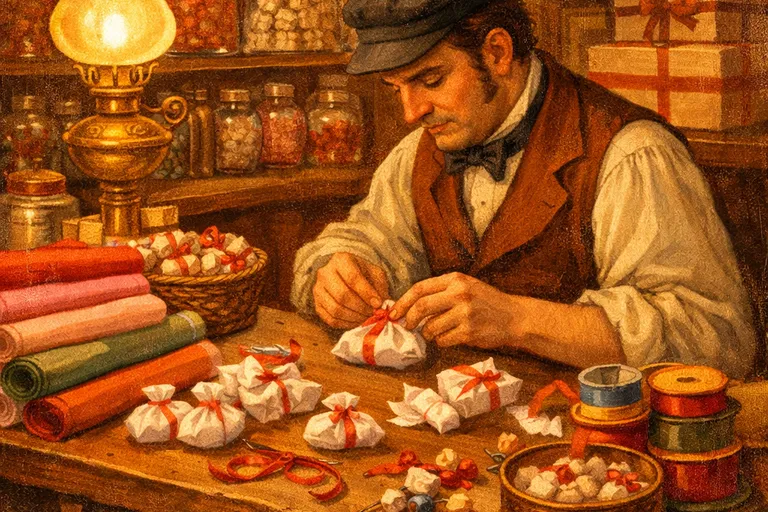
Tom Smith was born in 1823 and ran a confectionery shop on Goswell Road in Clerkenwell, East London. In 1846, he traveled to Paris, where he encountered the French bonbon: a sugared almond wrapped in a neat twist of tissue paper. The French had been giving these as gifts for years, especially around the holidays. Smith saw a product with potential and brought the idea back to London.
His English take on the bonbon sold well at first, particularly at Christmas. But novelty fades. By the early 1850s, sales were slowing, and Smith started experimenting. He tucked small love messages and riddles inside the wrappers, turning the bonbon from a sweet into a small surprise. Still not enough.
The breakthrough, according to the Tom Smith company's own history, came from a log fire. Sitting at home one evening, Smith heard the crackle and pop of a burning log and thought: what if the wrapper itself made a noise when pulled? That spark of an idea took years to develop. He purchased a snap mechanism from a chemist named Tom Brown, who had worked for Brocks Fireworks. The resulting product, which Smith first called "Bangs of Expectation," debuted around 1847. The name didn't stick. Customers started calling them "crackers," and that was that.
How Does a Christmas Cracker Snap Work?
The crack in a Christmas cracker is a controlled micro-explosion, though calling it that makes it sound more dramatic than it is. Two narrow strips of card are layered together inside the cracker. One strip is coated with a small amount of silver fulminate, a friction-sensitive compound. The other has an abrasive surface. When two people pull the cracker apart, the strips rub against each other, generating just enough heat (around 50 to 60 degrees Celsius) to detonate the silver fulminate.
The amount used is measured in micrograms. The compound decomposes rapidly, releasing nitrogen gas and carbon dioxide, and that sudden expansion of gas creates the snap. It is the same basic chemistry that makes cap guns work. Silver fulminate has been known since 1800, and its primary commercial application for over two centuries has been novelty noisemakers and Christmas crackers. Not every chemical compound gets a glamorous career.
What Is Inside a Christmas Cracker?
Tom Smith's original crackers contained a sweet and a love motto. The evolution into the modern cracker happened after Smith's death in 1869, when his three sons, Tom Jr., Walter, and Henry, took over the business. Walter Smith was the real innovator. He dropped the sweet entirely and replaced it with a small trinket or toy. More significantly, he added the paper crown.
The tissue paper hat became the cracker's most visible contribution to Christmas. Nobody is entirely sure why Walter chose a crown, but the leading theory connects it to Twelfth Night celebrations, where a "king" or "queen" was chosen to preside over festivities and given a paper crown. Others trace it further back to the Roman Saturnalia, the winter solstice festival where participants wore festive headgear regardless of social status. Either way, the paper crown stuck. By the early 1900s, it was standard equipment in every cracker.
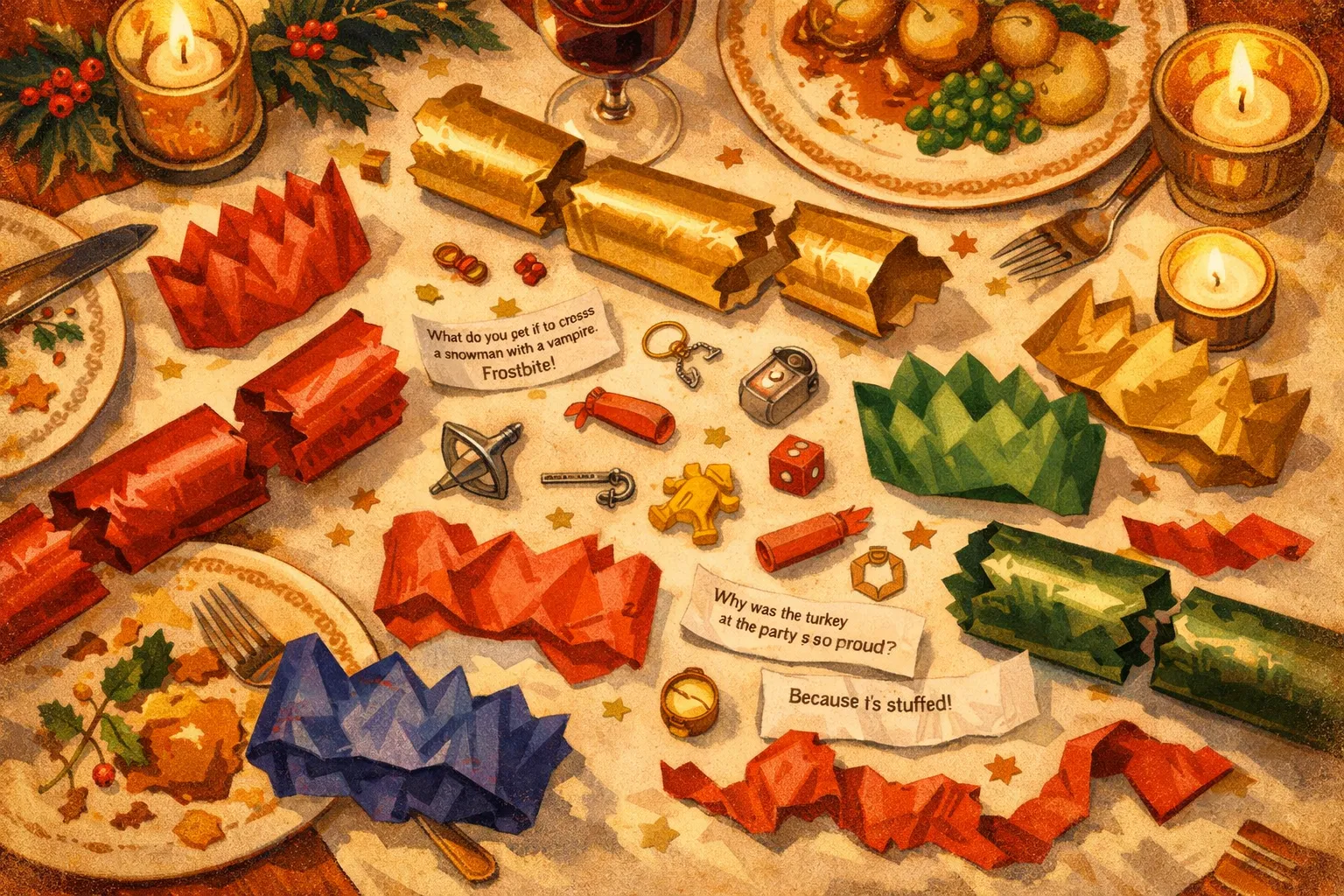
Today, a standard Christmas cracker contains three things: the snap strip, a tissue paper crown, and a slip of paper with a joke or riddle. Cheaper crackers include a small plastic toy. Upmarket ones might offer a keychain, a bottle opener, or a miniature puzzle.
Why Are Christmas Cracker Jokes So Bad?
The early crackers contained love mottoes, little romantic verses tucked inside for sweethearts. By the 1930s, these had been replaced by jokes and riddles, partly to make crackers more appealing to children and families rather than just couples. But the jokes quickly earned a reputation for being terrible, and that reputation has become the point.
Cracker jokes are deliberately awful. They rely on the simplest possible puns ("What do you call a penguin in the Sahara? Lost.") and have been recycled for decades. The same jokes appear year after year, across different manufacturers. Groaning at a cracker joke is itself a Christmas tradition. If someone at the table actually laughs sincerely, something has gone wrong.
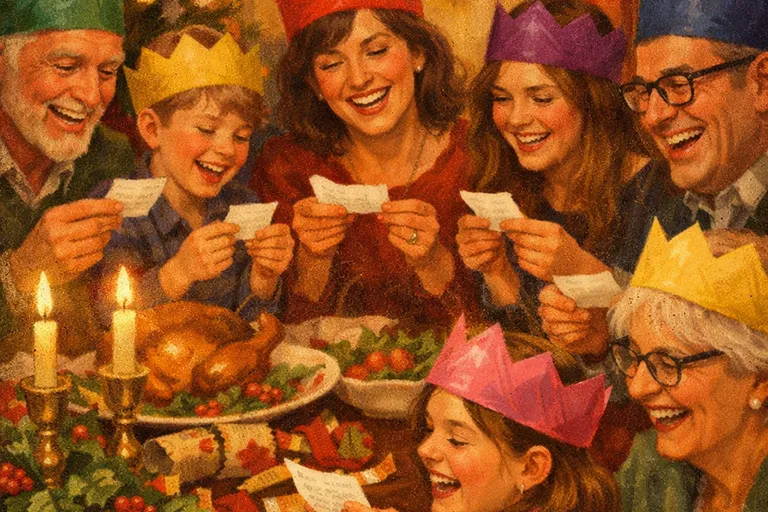
There is a social genius to this. A terrible joke demands nothing from anyone. You don't need to be clever or quick to participate. You just read it out, everyone groans in unison, and the table moves on. It is one of the few Christmas traditions that works equally well with a table of six-year-olds and a table of grandparents.
The British Dinner Table Ritual
In the UK, pulling crackers is as fixed a part of Christmas dinner as the turkey itself. The ritual has a specific choreography. Crackers are placed beside each plate or arranged across the table. Before or after the meal (families have strong opinions about the timing), everyone crosses their arms, holds their own cracker in their right hand, and grips their neighbor's cracker with their left. On a count of three, everyone pulls at once.
The cracker splits unevenly. The person holding the larger piece keeps the contents. Paper crowns go on immediately. Nobody questions this. A Supreme Court judge, a teenager, and a toddler will all sit through Christmas dinner wearing a flimsy tissue crown, and nobody bats an eye. The jokes get read aloud. The trinkets get inspected. The snap strip gets examined by at least one curious child.
The Tom Smith company grew enormous on this ritual. By the 1890s, the firm employed around 2,000 workers and had relocated to three adjoining five-storey buildings on Wilson Street, near Finsbury Square in the City of London. Walter Smith later erected a drinking fountain in Finsbury Square in memory of his mother, Mary, and to commemorate his father's legacy. It still stands there.
How Christmas Crackers Spread to Commonwealth Countries
Crackers followed the British Empire. As settlers, soldiers, and colonial administrators carried their holiday customs abroad, the cracker went with them. By the early 20th century, it was established in Australia, New Zealand, Canada, and South Africa.
In Australia and New Zealand, the tradition arrived with British settlers in the 1800s and never left, despite the obvious absurdity of pulling crackers in 35-degree summer heat. Australian supermarkets stock crackers from October onward. In Canada, the adoption is regional. Provinces with strong British heritage connections, particularly Ontario and British Columbia, treat crackers as essential. In South Africa, crackers remain common at Christmas lunch, another holdover from the colonial period.
In the United States, crackers have never fully caught on. They appear in specialty shops and British import stores, but they aren't part of the mainstream Thanksgiving-to-Christmas cycle. Americans who encounter them for the first time often find the whole package, the tiny explosion, the terrible joke, the obligation to wear a paper crown, baffling and charming in equal measure.
Luxury and Novelty Crackers Today
The cracker market has split into two directions. At one end, supermarket six-packs sell for a few pounds and contain plastic combs, miniature screwdrivers, and jokes that were old when Margaret Thatcher was young. At the other end, luxury crackers have become a serious business.
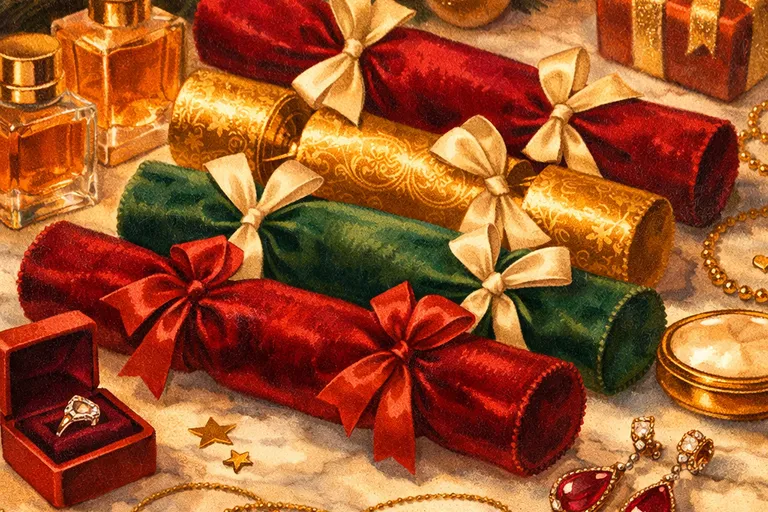
Fortnum and Mason sells crackers for over 200 pounds per box. Harrods, Liberty London, and Harvey Nichols all compete for the premium market. These crackers contain actual useful objects: Jo Malone fragrances, silk scarves, champagne stoppers, even jewelry. Claridge's produces handmade crackers with mother-of-pearl caviar spoons and sterling silver keepsakes.
There is also a growing market for sustainable crackers. Reusable crackers made from fabric, refillable with new snaps and gifts each year, address the environmental criticism that traditional crackers generate significant paper waste. Some manufacturers have replaced plastic toys with plantable seed paper or wooden trinkets.
The most expensive Christmas cracker ever made reportedly cost 4,000 pounds and contained a diamond ring. Tom Smith, who started with sugared almonds and tissue paper, would probably have approved. He was, after all, a man who understood that the wrapping matters as much as what's inside.
Frequently Asked Questions
What is a Christmas cracker?
A Christmas cracker is a festive cardboard tube wrapped in decorated paper that two people pull apart at the dinner table. The pulling triggers a small snap mechanism that makes a popping sound. Inside, you'll find a tissue paper crown, a small gift or trinket, and a printed joke or riddle. They are a staple of Christmas dinner in the UK and many Commonwealth countries.
Who invented Christmas crackers and when?
Tom Smith, a London confectioner from Clerkenwell, invented Christmas crackers around 1847. He was inspired by French bonbons he discovered during a trip to Paris in 1846 and added a snap mechanism after hearing a log crackle in his fireplace. His sons Walter, Tom Jr., and Henry later added the paper crowns and trinkets that define the modern cracker.
How does the snap in a Christmas cracker work?
The snap uses two strips of card layered together. One strip is coated with a tiny amount of silver fulminate, a friction-sensitive compound, while the other has an abrasive surface. When the cracker is pulled apart, friction between the strips generates enough heat to detonate the silver fulminate, producing a small pop. The amount of explosive used is measured in micrograms and is completely safe.
Why are Christmas cracker jokes always so bad?
Cracker jokes replaced romantic love mottoes in the 1930s and were deliberately made simple and family-friendly. Over the decades, the same puns and riddles have been recycled so many times that their terribleness has become the tradition itself. Groaning at a bad cracker joke is now as much a part of Christmas dinner as wearing the paper crown.
What countries have Christmas crackers as a tradition?
Christmas crackers are a standard part of Christmas celebrations in the United Kingdom, Australia, New Zealand, Canada, South Africa, and Ireland. The tradition spread through the British Empire during the late 19th and early 20th centuries. They are less common in the United States and continental Europe, though they can be found in specialty shops.
What is inside a luxury Christmas cracker?
Luxury Christmas crackers from retailers like Fortnum and Mason, Harrods, and Liberty London contain high-end gifts such as designer fragrances, silk accessories, jewelry, champagne stoppers, and sterling silver items. Premium boxes can cost over 200 pounds. They still include the traditional snap and paper crown alongside the upgraded contents.