

Rudolph the Red-Nosed Reindeer Story and History
A department store copywriter, a dying wife, a glowing nose, and the corporate act of generosity that turned a store giveaway into the most famous reindeer in history.
In 1939, a 34-year-old copywriter named Robert L. May sat in his Chicago apartment, broke, grieving, and facing a work assignment he didn't want. His wife Evelyn was dying of cancer. His salary at Montgomery Ward barely covered her medical bills. And his boss had just asked him to write a cheerful children's booklet the department store could hand out to Christmas shoppers. Out of that grim personal moment came Rudolph the Red-Nosed Reindeer, a character who would eventually generate more than 150 million song sales, star in the longest-running holiday TV special in American history, and become as recognizable as Santa Claus himself.
Contents
The story of how Rudolph came to exist is stranger and more moving than the story itself. It involves a fog rolling off Lake Michigan, a corporate act of unusual generosity, a brother-in-law with a knack for melody, and a singing cowboy who didn't want to record a Christmas song.
Who Created Rudolph the Red-Nosed Reindeer?
Robert Lewis May grew up shy and small for his age in a middle-class Jewish family in New York. He studied English at Dartmouth, graduating in 1926, and eventually landed a copywriting job at Montgomery Ward's Chicago headquarters. It was steady work, but not exactly prestigious. Every holiday season, the company bought coloring books in bulk to give away to children who visited Santa at their stores. In 1939, someone in management decided it would be cheaper to create an original booklet in-house.
The assignment fell to May. He chose a reindeer as his protagonist because his daughter Barbara loved the deer at Lincoln Park Zoo. The challenge was the nose. May wanted a reindeer with a glowing red nose, but in 1930s America, a red nose carried one unmistakable association: alcoholism. When May pitched the concept, Montgomery Ward's executives balked.
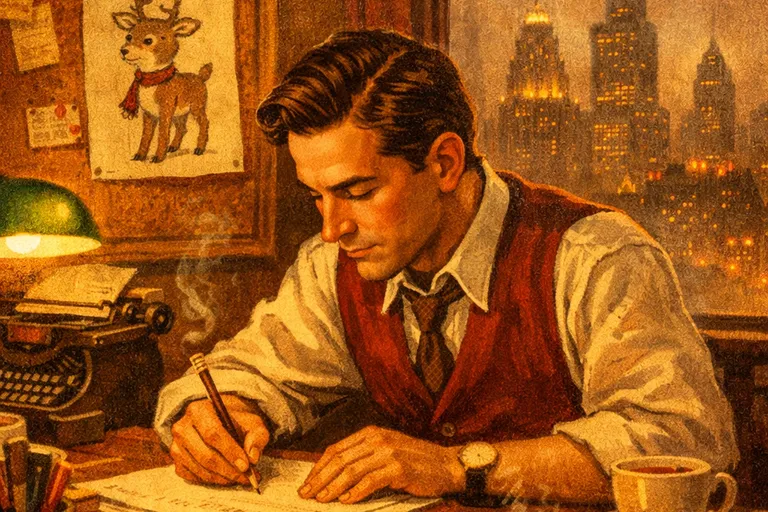
May asked his friend Denver Gillen, an illustrator at Montgomery Ward, to draw a reindeer so endearing that no one could mistake the red nose for a sign of drinking. Gillen went to Lincoln Park Zoo and sketched live deer, producing a round-eyed, floppy-eared character that looked like a puppy with antlers. It worked. Management approved the project.
May also wrestled with the name. He wanted something alliterative that started with "R" and tested options including Rollo, Reginald, Rodney, and Roland. In a 1963 interview, he explained that Rollo "sounded too happy for a reindeer with an unhappy problem" and Reginald "seemed too sophisticated." Rudolph, he felt, simply rolled off the tongue.
The Original 1939 Rudolph Booklet
May wrote Rudolph's story in rhyming couplets, modeled loosely on "The Night Before Christmas." The plot is simple: a young reindeer is mocked for his luminous red nose, then saved from outcast status when Santa needs that nose to guide his sleigh through fog on Christmas Eve. It's an underdog story, clean and effective.
While May was writing, his wife Evelyn's condition worsened. She died on July 28, 1939. May's boss offered to reassign the project, but May declined. He finished the poem in late August, reading drafts aloud to four-year-old Barbara as he went. He later said the story drew on memories of his own "painfully shy childhood" and his sense of being different.
Montgomery Ward printed 2.4 million copies of the Rudolph booklet and gave them away during the 1939 Christmas season. It was a hit. By 1946, the company had distributed roughly 6 million copies. But May didn't see a cent beyond his regular salary. He'd written Rudolph as a work-for-hire, and Montgomery Ward owned every right to the character.
How Montgomery Ward Gave Rudolph Back
This is where the story takes a turn that would be unthinkable in modern corporate America. In 1946, May received an offer from RCA Victor to produce a spoken-word record of the Rudolph poem. He couldn't approve it because Montgomery Ward held the copyright. A company vice president named Wilbur H. Norton brought the matter to Ward's chairman, Sewell Avery, arguing that the company was "not in the business to try to make a couple of thousand in royalties from RCA-Victor."
Avery agreed. Montgomery Ward transferred the Rudolph copyright to Robert May, free and clear, effective January 1, 1947. They let him keep it so they could do one final Christmas giveaway in 1946.
A major corporation voluntarily surrendering the rights to one of the most popular characters in American pop culture. No lawsuit, no buyout, no negotiation. They just handed it over. May, who had been struggling financially since Evelyn's death, suddenly owned a goldmine. Maxton Publishers released a commercial hardcover edition for the 1947 holiday season, printing 100,000 copies at 50 cents each. It sold out.
The Rudolph the Red-Nosed Reindeer Song
May's brother-in-law, Johnny Marks, was a songwriter who had studied music at Columbia University and the Paris Conservatory. In 1949, Marks adapted May's poem into a song, simplifying the rhyme scheme and adding a melody that is almost impossible to forget once you've heard it. Marks would go on to become something of a Christmas music factory, writing "Rockin' Around the Christmas Tree," "A Holly Jolly Christmas," and "Silver and Gold," all of which found their way into the Rudolph TV special years later.

Marks shopped the song to several artists. Bing Crosby and Dinah Shore both turned it down. Gene Autry, the singing cowboy and one of the biggest recording stars in America, wasn't interested either. He thought a children's Christmas song didn't fit his image. His wife, Ina, disagreed. She told him the song reminded her of another novelty tune he'd reluctantly recorded, "Here Comes Peter Cottontail." Autry gave in.
On June 27, 1949, Autry recorded "Rudolph the Red-Nosed Reindeer" in a Hollywood studio, backed by the vocal group the Pinafores and guitarist Johnny Bond. The recording hit number one on the Billboard pop singles chart the week of Christmas 1949. It sold 1.75 million copies in its first season alone. Autry's version eventually moved 12.5 million copies total. When you count every cover version and re-recording, the song has sold over 150 million copies worldwide, second only to Bing Crosby's "White Christmas" as the best-selling Christmas single ever.
The 1964 Rankin/Bass TV Special
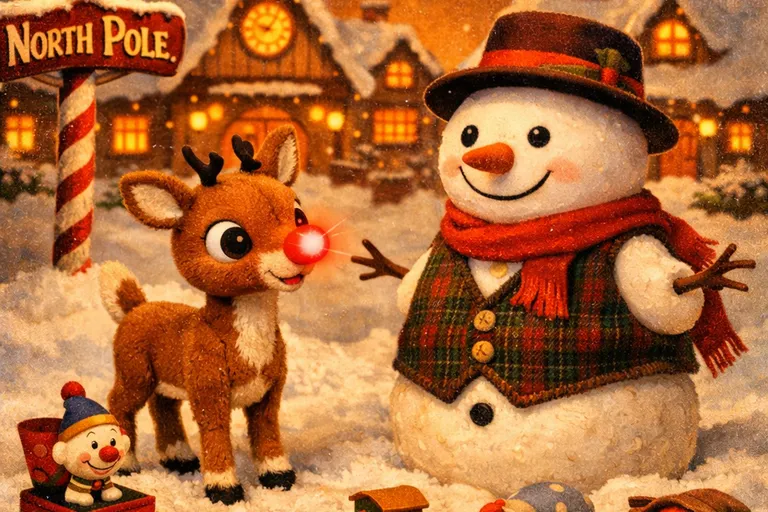
The version of Rudolph most people carry in their heads today isn't May's poem or Autry's recording. It's the 1964 stop-motion television special produced by Arthur Rankin Jr. and Jules Bass, animated by Tadahito Mochinaga's MOM Production studio in Tokyo. The special first aired on NBC on December 6, 1964, with Burl Ives narrating as Sam the Snowman, and it has aired every single year since. That makes it the longest-running holiday TV special in American television history.
The special expanded May's simple poem into a full narrative with new characters. Hermey the elf (often misspelled "Herbie") wants to be a dentist instead of making toys. Yukon Cornelius is a prospector searching for gold and silver. Clarice is the doe who likes Rudolph despite his nose. And the Island of Misfit Toys became so iconic that when the original 1964 broadcast didn't include a scene of Santa rescuing the toys, viewer complaints forced the producers to add one for the 1965 re-airing.
The special had its share of quirks behind the scenes. Rudolph's voice actress, Billie Mae Richards, was credited as "Billy Richards" because Rankin/Bass wanted to hide the fact that a woman voiced the character. The copyright notice in the original broadcast reads "MCMLXIV," but due to a missing "M" in an earlier version of the credits, some prints accidentally displayed the year as 1164. The original puppets were thought lost for decades until they turned up in 2005, eventually selling at auction.
Characters That Defined the Special
Burl Ives as Sam the Snowman gave the special its warmth and personality. His rendition of "A Holly Jolly Christmas" became a holiday standard in its own right. The voice cast also included Larry Mann as Yukon Cornelius, Paul Soles as Hermey, and Stan Francis as Santa Claus. All 11 credited voice actors brought characters to life using a technique Rankin/Bass called "Animagic," their brand name for stop-motion puppet animation.
Is Rudolph a Real Reindeer?
Rudolph is fictional. He doesn't appear in Clement Clarke Moore's 1823 poem "A Visit from St. Nicholas," which established the original eight reindeer: Dasher, Dancer, Prancer, Vixen, Comet, Cupid, Donner, and Blitzen. Rudolph was invented 116 years later by a department store employee. He has no basis in folklore, mythology, or natural history.
That said, real reindeer noses do have an unusually rich blood supply. A 2012 study published in the British Medical Journal found that reindeer have 25 percent more capillaries in their nasal passages than humans, which helps regulate brain temperature in Arctic conditions. The researchers noted, with some amusement, that this dense vascular network could theoretically produce a reddish glow. So while Rudolph isn't real, the biological mechanism behind his defining feature isn't entirely made up.
Rudolph's Cultural Impact
Robert May's creation went from a free department store handout to a character recognized across the globe in under 30 years. The 1949 song and the 1964 TV special cemented Rudolph in the same tier as Santa Claus and the Christmas tree. He appears on ornaments, wrapping paper, pajamas, and postage stamps. The U.S. Postal Service issued a Rudolph stamp in 2014 on the 50th anniversary of the TV special.
Johnny Marks built an entire career on the foundation of that one song. His Christmas catalog, written mostly in the 1950s and 1960s, earns royalties every holiday season. "Rockin' Around the Christmas Tree" alone has been certified Diamond by the RIAA, with over 10 million units sold.
For Robert May, Rudolph was personal salvation. He later said the character put his six children through college. May remarried, rebuilt his life, and spent decades doing public appearances as Rudolph's creator. He died in 1976. His daughter Barbara, the little girl who first heard the story read aloud in that small Chicago apartment, lived to see Rudolph become a permanent part of Christmas.
In 2024, Gene Autry's original 1949 recording of "Rudolph the Red-Nosed Reindeer" was inducted into the Library of Congress's National Recording Registry, designated as "culturally, historically, or aesthetically significant." The singing cowboy who didn't want to record it ended up with one of the most important recordings in American music history.
Frequently Asked Questions
Who created Rudolph the Red-Nosed Reindeer?
Robert L. May, a copywriter at the Montgomery Ward department store in Chicago, created Rudolph in 1939. He wrote the character's story as a free promotional booklet for the store to hand out to children during the Christmas shopping season. May's brother-in-law, Johnny Marks, later adapted the story into the famous song in 1949.
When was the Rudolph the Red-Nosed Reindeer song written?
Johnny Marks wrote the song in 1949, a decade after the original story was published. Gene Autry recorded it on June 27, 1949, and it reached number one on the Billboard chart that Christmas. Autry's recording has sold over 12.5 million copies, and all versions combined have sold more than 150 million copies worldwide.
Is Rudolph one of Santa's original reindeer?
No. Santa's original eight reindeer (Dasher, Dancer, Prancer, Vixen, Comet, Cupid, Donner, and Blitzen) come from Clement Clarke Moore's 1823 poem "A Visit from St. Nicholas." Rudolph was invented 116 years later in 1939 by Robert L. May as a department store promotion. He is not part of traditional Christmas folklore.
What was Rudolph almost named instead?
Robert May considered several names beginning with "R" before settling on Rudolph. His top alternatives were Rollo and Reginald. He rejected Rollo because it "sounded too happy for a reindeer with an unhappy problem" and Reginald because it "seemed too sophisticated." He chose Rudolph because it rolled off the tongue naturally.
Why did Montgomery Ward give the Rudolph copyright back to Robert May?
In 1947, Montgomery Ward's chairman Sewell Avery transferred the full copyright to May at no cost. A company vice president, Wilbur Norton, argued the store was "not in the business" of collecting royalties from outside media deals. The transfer allowed May, who had been struggling financially since his wife's death, to profit from commercial editions, recordings, and licensing.
How long has the Rudolph TV special been airing?
The Rankin/Bass stop-motion special first aired on NBC on December 6, 1964, and has been broadcast every year since. That makes it the longest-running holiday TV special in American television history, with over 60 consecutive years of annual airings.