
The Snowman: A History of Winter's Favorite Figure
Before he was a cheerful yard decoration with a carrot nose, the snowman was a political weapon, a Renaissance art commission, and a symbol of everything that melts away. His story is stranger than you think.
The snowman is so familiar that he barely registers as strange. Three balls of snow, a carrot, some coal, maybe a hat. Children build them. Adults photograph them. Everyone agrees they're charming. But the snowman's actual history is six centuries of politics, protest, high art, and slow-motion death by sunlight. He is, arguably, the most interesting figure in all of Christmas iconography, and almost nobody knows why.
Contents
The earliest known depiction of a snowman appears in a 1380 Book of Hours, an illuminated prayer manuscript held at the Koninklijke Bibliotheek in The Hague, Netherlands. Bob Eckstein, a New Yorker cartoonist who spent years combing through European archives for his book The History of the Snowman, found the image tucked into the margins of folio 78v. The snowman in that illustration is not the friendly fellow you'd expect. He's being roasted over a fire, melting beside a passage about the crucifixion of Christ.
So from the very beginning, the snowman was tied to suffering and impermanence. That tracks.
Who Built the First Snowman?
Nobody knows who actually rolled the first balls of snow into a human shape. People have been doing it for as long as there has been snow and boredom. But the documented history starts in medieval Europe, where snowmen were serious business.
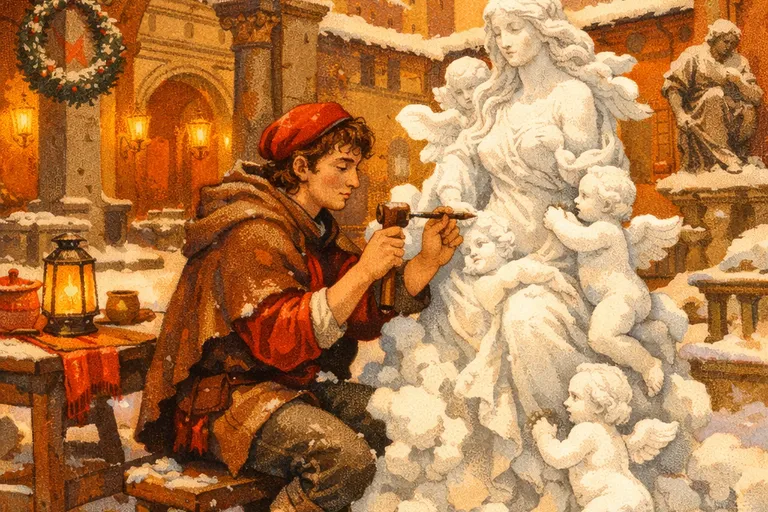
In January 1494, a freak snowstorm buried Florence in white. Piero de' Medici, ruler of the city and patron of the arts, looked out at his courtyard and had a thought that only a Medici would have: he summoned a 19-year-old sculptor to build him a snowman. That sculptor was Michelangelo. Giorgio Vasari recorded the commission in his Lives of the Most Excellent Painters, Sculptors, and Architects, noting that Piero "had him make the statue" in the courtyard of the Palazzo Medici. What Michelangelo actually sculpted, nobody knows. It melted. The greatest snowman ever built left no trace at all.
Seventeen years later, snowmen became a tool of mass protest. During the winter of 1510-1511, Brussels endured what locals called the Winter of Death. Temperatures stayed below freezing from mid-November through February. When the snow finally became workable, the citizens of Brussels built roughly 110 snow sculptures across the city in what became known as the Miracle of 1511. The town poet Jan Smeken documented them in a ballad.
These were not cute. More than half depicted sexual, scatological, or politically charged scenes. Snow nuns, snow centaurs, snow figures from the city's red-light district. The sculptures gave ordinary people a voice during a brutal winter, turning public squares into galleries of frozen satire. Historian Herman Pleij, who studied the event in detail, argued the Miracle of 1511 was the snowman's defining political moment.
How Did the Snowman Become a Christmas Symbol?
For centuries, the snowman had nothing to do with Christmas. He was a winter figure, full stop. The shift happened during the Victorian era, when Christmas itself was being reinvented as a domestic, family-centered holiday.
In the 1840s, Christmas cards began circulating on both sides of the Atlantic. Snowmen started appearing on their covers alongside Santa, reindeer, and holly. The cheap postcard boom of the 1870s and 1880s, fueled by chromolithography and Germany's mass-produced card industry, spread the image further. By the end of the 19th century, the snowman had quietly joined the Christmas cast.
Prince Albert's enthusiasm for German holiday customs helped, too. The Victorian Christmas absorbed skating, sleigh rides, and snowmen into its vision of festive winter charm. The snowman became shorthand for the season itself: cold weather, warm hearts, children outdoors.
But Victorian snowmen on cards were often bizarre. Some had shark-like teeth. Others appeared menacing or grotesque. The cheerful, round, harmless snowman we recognize today is a 20th-century invention.
What Is the Origin of Frosty the Snowman?
The modern snowman's personality comes almost entirely from one song. "Frosty the Snowman" was written by Walter "Jack" Rollins and Steve Nelson and first recorded by Gene Autry in 1950. Autry's recording of "Rudolph the Red-Nosed Reindeer" had been a massive hit the year before, and his label wanted another holiday character. Rollins and Nelson delivered a snowman brought to life by an old silk hat.
The song doesn't mention Christmas once. Frosty comes to life, plays with children, and melts. That's it. Yet it became one of the most recorded Christmas songs in history, permanently fusing the snowman to the holiday season.
In 1969, Rankin/Bass Productions turned the song into a 25-minute animated television special. Jimmy Durante narrated. Jackie Vernon voiced Frosty. Billy De Wolfe played Professor Hinkle, the magician who wants his hat back. The special first aired on CBS on December 7, 1969, right after A Charlie Brown Christmas, and both pulled enormous ratings. The Rankin/Bass version added a villain, a journey to the North Pole, and Santa Claus himself. It gave the snowman a plot, and more importantly, it gave him stakes. Frosty could die. He melts in a greenhouse, and only Santa's intervention brings him back.
That tension between joy and loss is the snowman's entire appeal. He's alive, but temporarily. He's happy, but doomed. Frosty just made it explicit.
Why Do Snowmen Have Carrot Noses and Top Hats?
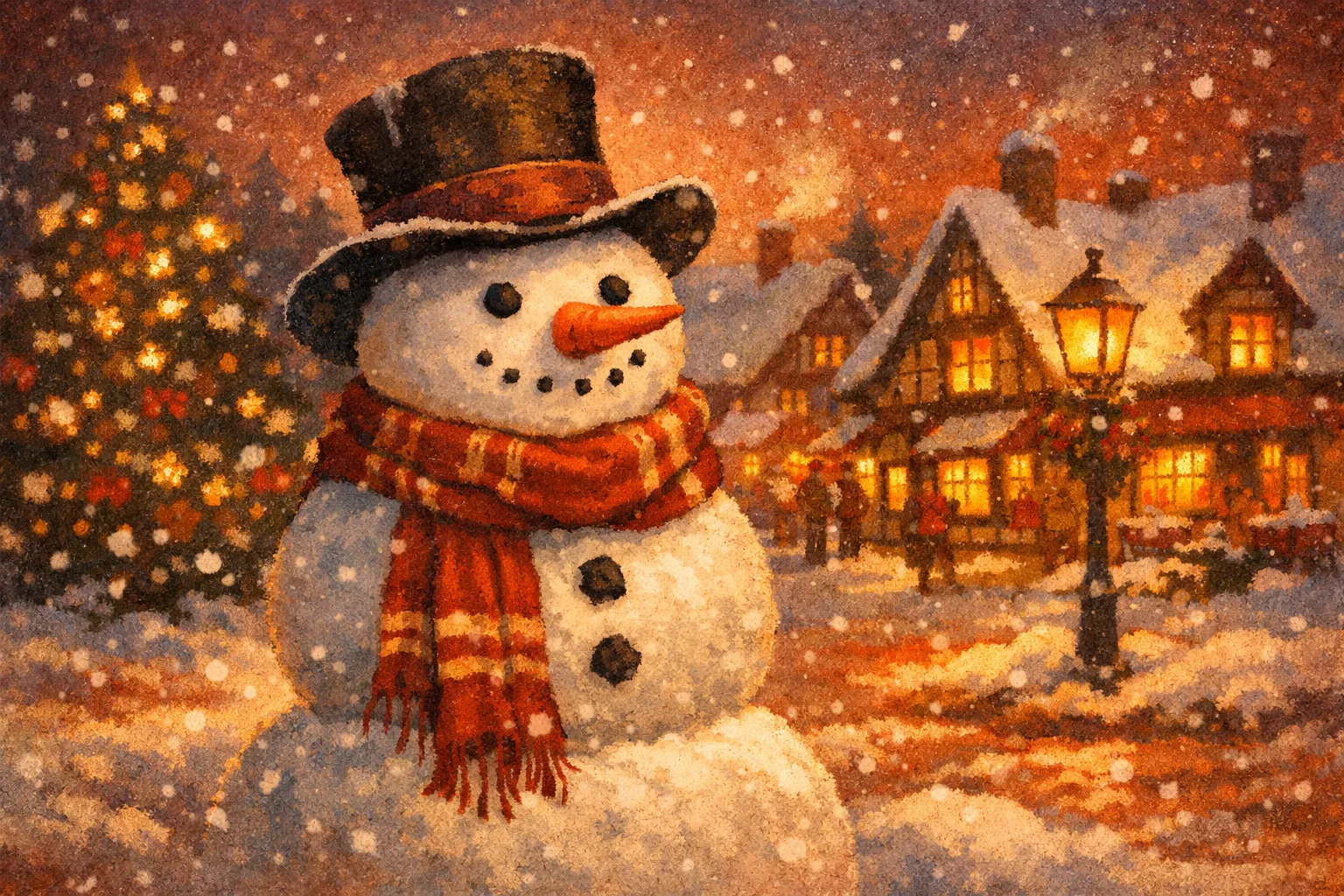
The classic snowman silhouette, three stacked spheres topped with a hat, coal eyes, and a carrot nose, solidified in the early-to-mid 20th century, but its components come from different eras.
The carrot nose appears to be a relatively recent tradition. The earliest known snowman character with a carrot nose showed up in the 1943 German animated short Der Schneemann. Before that, snowmen wore all sorts of noses, or none at all. Carrots worked because they were plentiful in winter (harvested in late autumn and stored through the cold months), cheap, and naturally tapered to a point. Some historians have noted that early snowmen were often depicted as fierce or witch-like, and a long, pointed nose added to the menace.
The top hat came from a different direction. In the 19th century, top hats were common menswear, not fancy dress. Putting an old, battered one on a snowman was like giving him a hand-me-down. Frosty's "old silk hat" in the 1950 song cemented the image. Today, almost nobody owns a top hat, but every snowman wears one.
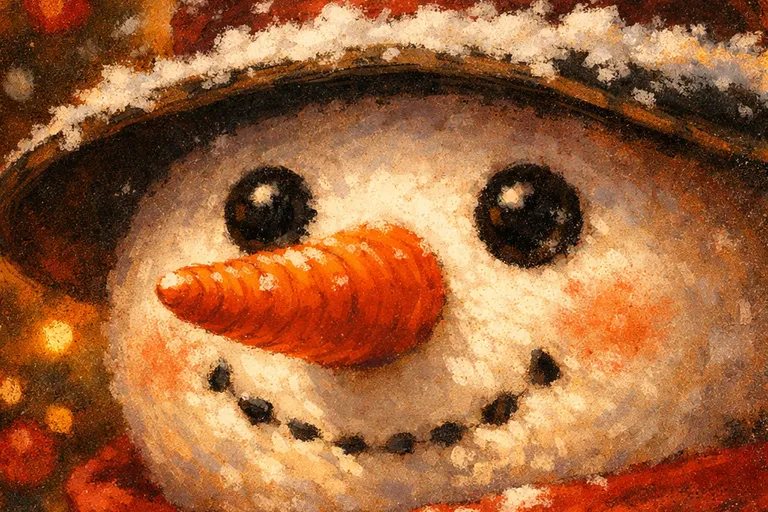
The corncob pipe, mentioned in the Frosty lyrics alongside "a button nose and two eyes made out of coal," rounds out the kit. Note that the original song says button nose, not carrot. Popular culture merged the two versions into the hybrid we know today.
Snowman Building Traditions Around the World
Not every culture builds the same snowman. In Japan, the yukidaruma is made of two stacked balls, not three. The name combines yuki (snow) with daruma, the round, weighted dolls modeled after the Buddhist monk Bodhidharma. Japanese snowmen often have bucket hats and simple branch arms. Two balls are considered sufficient. Three would be excessive.
In Russia, the snegovik typically holds a broom and wears a bucket on his head. German Schneemanner often get a carrot nose and a scarf. In Switzerland, brooms serve as arms. British snowmen traditionally use two spheres rather than three, matching the Japanese approach more than the American one.
The three-ball design, large base, medium torso, small head, is primarily a North American convention. It's the version that conquered global pop culture through movies, cards, and television specials, but it's not universal. Build a snowman in Sapporo and you'll get a two-part daruma. Build one in Moscow and you'll get a broom-wielding figure with a tin pail for a crown.
The World Record for the Tallest Snowman
In February 2008, the residents of Bethel, Maine, completed a snow figure that stood 122 feet and 1 inch tall (37.21 meters). They named her Olympia, after Maine's U.S. Senator Olympia Snowe. Building her took a month and approximately 13 million pounds of snow. Her eyelashes were made from eight pairs of skis. Her nose, an eight-foot carrot shape, was built from chicken wire and cheesecloth. She wore a 48-foot-wide fleece hat sewn by local schoolchildren.
Bethel had practice. In 1999, the town built its first record-breaking snowman, named Angus, King of the Mountain, after the governor at the time. Olympia broke their own record by more than nine feet. As of 2026, nobody has surpassed her.
What Does the Snowman Symbolize?
The snowman means different things depending on when and where you encounter him. In medieval Europe, he represented winter's brutality, something to conquer or burn. In Hans Christian Andersen's 1861 fairy tale "The Snowman," the title character falls in love with a stove and is destroyed by the very thing he desires. Andersen was writing about how passion can consume us, but the metaphor works because everyone already understood: snowmen don't last.
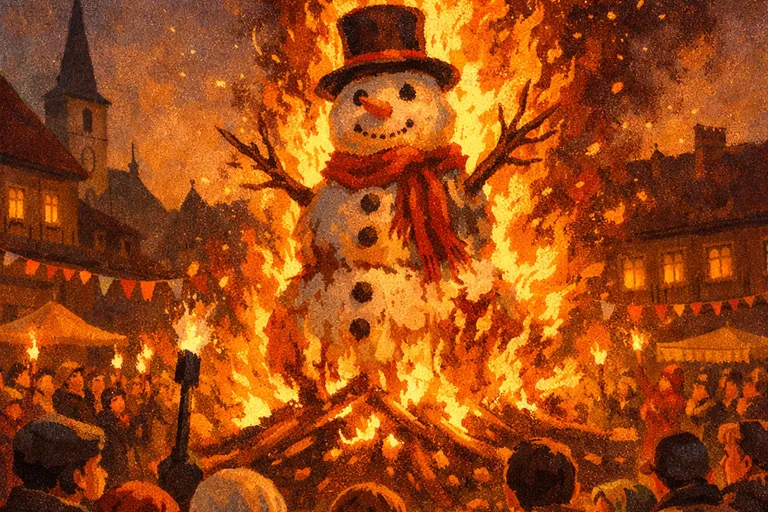
In Zurich, Switzerland, a giant snowman figure called the Boogg is stuffed with firecrackers and detonated every spring during the Sechselauten festival. The faster the Boogg's head explodes, the better the coming summer will be. Across Northern and Eastern Europe, similar rituals destroy winter effigies to mark the return of warmth. The snowman is winter itself, and winter must end.
But as a Christmas symbol, the snowman represents something gentler: the fleeting joy of winter. He's built to disappear. Kids know this. They build him anyway. That willingness to create something beautiful and temporary is part of what makes the snowman resonate, year after year, across cultures and centuries.
Frequently Asked Questions
Who built the first snowman in recorded history?
The earliest known depiction of a snowman comes from a 1380 Book of Hours manuscript, now held at the Koninklijke Bibliotheek in The Hague, Netherlands. Bob Eckstein, author of The History of the Snowman, discovered the illustration during years of research through European archives. The actual identity of the first person to build a snowman is unknown, as the practice predates written records.
When was Frosty the Snowman written?
The song "Frosty the Snowman" was written by Walter "Jack" Rollins and Steve Nelson and first recorded by Gene Autry in 1950. It was created as a follow-up to Autry's hit "Rudolph the Red-Nosed Reindeer." The animated TV special based on the song, produced by Rankin/Bass with Jimmy Durante as narrator, first aired on CBS on December 7, 1969.
Why do snowmen have carrot noses?
The carrot-nose tradition appears to date from the mid-20th century, with the earliest known depiction in the 1943 German animated short Der Schneemann. Carrots were a practical choice because they were harvested before winter, stored easily, and had a naturally tapered shape. Before carrots became standard, snowmen wore various objects as noses, or none at all.
What is the world record for the tallest snowman?
The tallest snowperson ever built was Olympia, completed in Bethel, Maine, on February 26, 2008. She stood 122 feet, 1 inch (37.21 meters) tall, required roughly 13 million pounds of snow, and was named after U.S. Senator Olympia Snowe. Her eyelashes were made from eight pairs of skis, and local schoolchildren sewed her 48-foot-wide hat.
How did the snowman become a Christmas symbol?
The snowman was not originally associated with Christmas. The connection developed during the Victorian era in the mid-1800s, when Christmas was being reshaped as a family holiday. Snowmen began appearing on Christmas cards in the 1840s, and the postcard boom of the 1870s-1880s spread the image widely. The 1950 song "Frosty the Snowman" and its 1969 TV special permanently cemented the snowman as a Christmas icon.
Why do Japanese snowmen have two balls instead of three?
Japanese snowmen, called yukidaruma, are traditionally built with two stacked snowballs rather than three. The name references the daruma doll, a round, weighted figure modeled after the Buddhist monk Bodhidharma. The two-ball design mirrors the daruma's shape. The three-ball snowman is primarily a North American convention that spread through popular culture.