
Twelve Days of Christmas Meaning, Song and History
The real Christmas season starts on December 25 and runs for twelve more days of feasting, singing, and gift-giving. Here's what the liturgical period actually means, where the famous song came from, and why the gifts would cost you over $200,000.
The Twelve Days of Christmas are the twelve days between December 25 and January 5, a liturgical season that the Western Christian church has observed since at least the sixth century. Most people today think of the famous cumulative song, but the period itself predates that tune by over a thousand years. In 567, the Council of Tours formally declared the stretch from Christmas Day to the eve of Epiphany a sacred festive season, establishing a duty of Advent fasting in preparation for it.
Contents
- 1. When Are the Twelve Days of Christmas?
- 2. Where Did the Twelve Days of Christmas Song Come From?
- 3. How Many Gifts Are in the Twelve Days of Christmas?
- 4. Is the Song a Secret Catholic Catechism?
- 5. Twelfth Night Traditions
- 6. How Different Cultures Observe the Twelve Days
- 7. Frequently Asked Questions
That council was solving a practical problem. The Western Church celebrated Christ's birth on December 25. The Eastern Church celebrated it on January 6, a date known as Epiphany. By declaring all twelve days sacred, the council stitched the two observances together into a single extended celebration. The period closes with the Feast of the Epiphany on January 6, commemorating the visit of the Magi to the infant Jesus.
When Are the Twelve Days of Christmas?
The counting starts on December 25 (day one) and ends on January 5 (day twelve), with Epiphany falling on January 6. Some traditions count differently: certain Anglican communities consider Twelfth Night to be January 5, while others place it on January 6 depending on whether you count Christmas Day itself. The Orthodox churches that still follow the Julian calendar shift everything forward by about thirteen days, celebrating Christmas on January 7 and Epiphany on January 19.
The Armenian Apostolic Church takes yet another approach: it celebrates Christ's birth and baptism on the same day, January 6, with no distinction between Christmas and Epiphany at all.
Where Did the Twelve Days of Christmas Song Come From?
The earliest known printing of the words appeared in a children's book called Mirth Without Mischief, published in London around 1780. The book, printed by J. Davenport for C. Sheppard, included the lyrics alongside other parlor games and entertainments. A broadsheet from Angus of Newcastle dates to roughly the same period.
Many historians believe the text originated as a French poem that crossed the Channel to northeastern England, which would explain some of the imagery. "French hens" and "turtle doves" carry continental flavor. The original purpose was not singing but a memory-and-forfeits game: a leader recited cumulative verses while players tried to repeat them without mistakes. Anyone who stumbled paid a penalty, usually a kiss or a sweet.
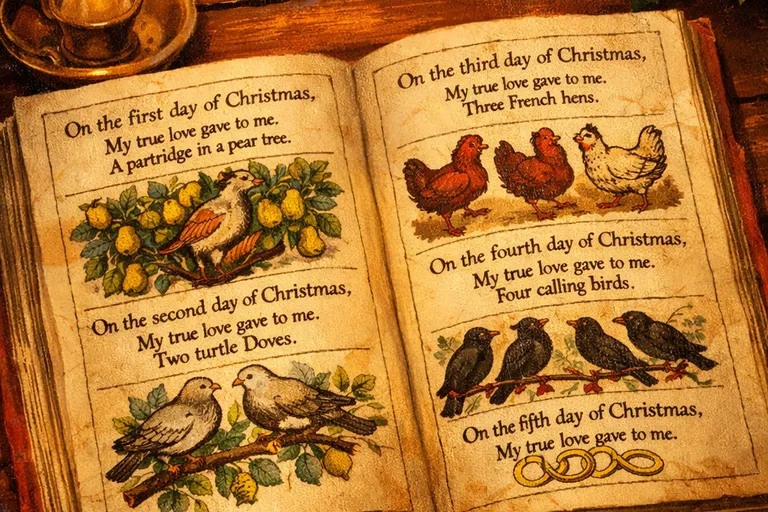
The melody most people know today didn't exist until 1909, when English baritone and composer Frederic Austin published an arrangement through Novello and Co. Austin had grown up hearing a version of the tune in his family and claimed he hadn't encountered it elsewhere. His arrangement introduced the drawn-out, dramatic "five go-old rings" that now defines the song's character. He also changed the fourth day's gift from "four colly birds" (blackbirds, from the Old English word for coal) to "four calling birds," which stuck.
Before Austin's version, variants included "four canary birds," "four colour'd birds," and "four curley birds." The word "colly" appeared in Arthur Golding's 1565 translation of Ovid's Metamorphoses, where it described something covered in coal dust. Joseph Wright's English Dialect Dictionary confirmed that "colley" referred specifically to the blackbird, Turdus merula.
How Many Gifts Are in the Twelve Days of Christmas?
The song's cumulative structure means that on each day, the singer receives all the gifts from previous days plus a new set. On day one, you get one partridge. On day two, two turtle doves plus another partridge, for a running total of four. By the time the twelfth day arrives, you've received 364 individual gifts. That's one for every day of the year except Christmas itself, though nobody planned it that way.
The math follows a pattern called triangular numbers. Each day's gifts form a triangle: 1, then 1+2, then 1+2+3, and so on. The sum of all twelve triangular numbers from 1 through 78 equals 364. If you only count one of each gift type (ignoring the repetitions), you get 78 items.
What Would the Gifts Actually Cost?
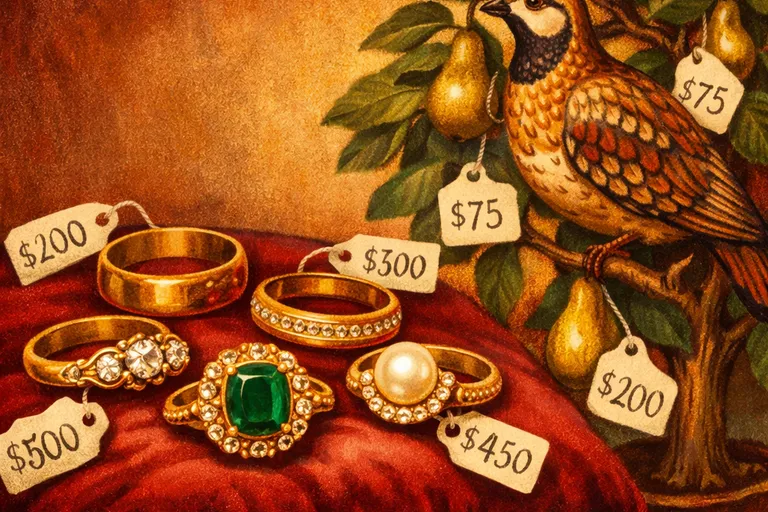
Since 1984, PNC Financial Services has published an annual Christmas Price Index that calculates the real-world cost of all the gifts in the song. In 2025, the twelve gift categories (one of each) came to $51,476.12, a 4.5% increase over the previous year. The five gold rings drove much of that spike, jumping 32.5% thanks to surging gold prices. The pear tree climbed 14.3%, pushed by rising costs for land, labor, and fertilizer.
If you wanted to buy all 364 gifts as the song's verses actually describe them (with all the repetitions), PNC calculated the "True Cost of Christmas" at $218,542.98 in 2025. Some prices held steady: turtle doves, French hens, calling birds, swans, and maids-a-milking all stayed flat. The human performers (ladies dancing, lords-a-leaping, pipers piping, drummers drumming) reflect prevailing entertainment industry wages.
Is the Song a Secret Catholic Catechism?
A widely shared claim holds that English Catholics wrote the song during the Reformation as a coded catechism for children who couldn't openly learn their faith. In this reading, the partridge in the pear tree represents Jesus, two turtle doves stand for the Old and New Testaments, three French hens are faith, hope, and charity, and so on up to twelve apostles.
The theory is almost certainly false. Snopes, the Smithsonian, and multiple Catholic publications (including the National Catholic Register and Ascension Press) have debunked it. The problems are straightforward. First, there's zero documentary evidence predating the 1990s. The claim appears to have been invented in that decade and spread virally. Second, the song was originally French, not English. Third, the symbolic connections are forced: "eight maids a-milking" doesn't naturally suggest the Eight Beatitudes. Fourth, and most damaging: every doctrine the song supposedly encodes was shared by both Catholics and Anglicans, so there was nothing to hide.
The catechism theory tells us more about the internet's appetite for hidden meanings than it does about Tudor-era religious persecution.
Twelfth Night Traditions
Before Christmas Day became the main event, the biggest party of the holiday season fell on Twelfth Night, the evening of January 5. In Tudor England, Henry VII appointed a "Lord of Misrule" to oversee celebrations where social hierarchies were temporarily flipped: servants were waited on by their employers, and a commoner ruled the feast.
The centerpiece was the Twelfth Night cake, baked with a dried bean and a dried pea hidden inside. Whoever found the bean in their slice became king of the festivities. Whoever found the pea became queen. Robert Herrick described this custom in his 1648 poem "Twelfth-Night, or King and Queene," which also mentions "lamb's wool," a warm drink of ale, sugar, nutmeg, and ginger. Samuel Pepys recorded elaborate Twelfth Night celebrations in his famous diary.
The tradition of wassailing belongs to this period too. Door-to-door wassailing resembled carol singing, with groups traveling between houses offering toasts of spiced ale. Orchard wassailing was different and stranger: processions marched to apple orchards, placed toast from the wassail bowl in tree branches, and poured the drink over the roots, all to coax a good harvest in the coming year. Both practices survive in pockets of England.
How Different Cultures Observe the Twelve Days
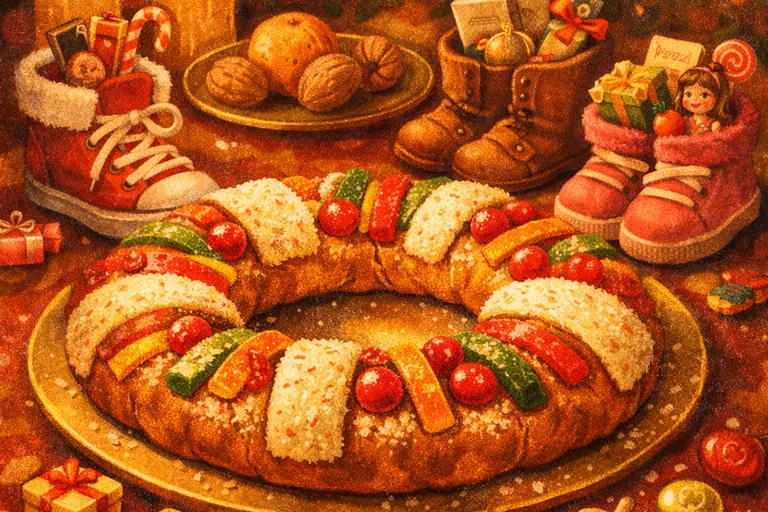
In Spain, the main gift-giving event was traditionally not Christmas but the eve of January 6, when the Three Magi (Los Reyes Magos) delivered presents. Children leave their shoes outside with grass and water for the kings' camels, in the same spirit as leaving milk and cookies for Santa Claus. A parade of the Three Kings through city streets remains one of the biggest annual spectacles in Madrid and other Spanish cities.
Across Latin America, Dia de los Reyes carries the same weight. In Mexico, families share a Rosca de Reyes, a ring-shaped cake studded with candied fruit meant to look like jewels on a crown. A small figurine of baby Jesus is hidden inside. Whoever finds it hosts a tamale party on February 2, Candlemas. The tradition extends from Guatemala to Argentina.
In Ireland, January 6 is known as Little Christmas or Women's Christmas (Nollaig na mBan). Tradition holds that women rest on this day after the work of the holiday season while men handle household duties. The three kings' figures are placed into the household nativity scene on Twelfth Night.
In England, Twelfth Night marks the deadline for removing Christmas decorations. A persistent superstition holds that leaving them up past this date invites bad luck. The game of snapdragon, once popular on Twelfth Night, involved plucking raisins from a tray of flaming brandy with bare hands. It went out of fashion, understandably.
Frequently Asked Questions
What are the Twelve Days of Christmas?
The Twelve Days of Christmas are the Christian liturgical season running from December 25 (Christmas Day) through January 5, ending with the Feast of the Epiphany on January 6. The period was formally established by the Council of Tours in 567 and celebrates the time between Christ's birth and the arrival of the Magi.
How many total gifts are in the Twelve Days of Christmas song?
The cumulative structure of the song produces 364 individual gifts by the end of the twelfth day. Each day repeats all previous gifts plus a new set. If you count each gift type only once (ignoring repetitions), the total is 78.
How much would the Twelve Days of Christmas gifts cost?
According to PNC Financial Services' 2025 Christmas Price Index, one set of each of the twelve gifts costs $51,476.12. If you buy all 364 gifts as the song's cumulative verses describe, the "True Cost of Christmas" reaches $218,542.98. PNC has published this index annually since 1984.
Is the Twelve Days of Christmas song a secret Catholic code?
No. The theory that the song encodes Catholic doctrine for persecuted English believers has been debunked by Snopes, the Smithsonian, and Catholic scholars alike. There is no documentary evidence for the claim before the 1990s, the song likely originated in France, and every doctrine it supposedly encodes was shared by both Catholics and Anglicans.
When is Twelfth Night?
Twelfth Night falls on either January 5 or January 6, depending on the tradition. Most English-speaking customs place it on January 5 (the eve of Epiphany). It was historically the biggest party night of the Christmas season, featuring feasting, wassailing, and the crowning of a bean king and pea queen from a special Twelfth Night cake.
What is Three Kings Day?
Three Kings Day (Dia de los Reyes) is celebrated on January 6 across Spain and Latin America. It commemorates the Magi's visit to the infant Jesus and serves as the primary gift-giving occasion in many of these cultures. Children leave shoes out for the kings, and families share a ring-shaped cake called Rosca de Reyes with a hidden figurine inside.