
Christmas Elves: Origins, History and Traditions
Santa's little helpers have a backstory far stranger than toy-making. It starts with Scandinavian farm spirits, passes through Civil War propaganda, and ends with a doll that watches your children sleep.
Christmas elves are among the most recognizable figures of the holiday season, yet most people would struggle to explain where they came from. The short answer: they evolved from Scandinavian household spirits that had nothing to do with Christmas, got drafted into Santa's workforce by 19th-century American writers and illustrators, and eventually became the toy-making, list-checking, shelf-sitting creatures we know today.
Contents
- 1. Where Did Christmas Elves Come From? Scandinavian Folklore Origins
- 2. How Elves Became Santa's Helpers: The 19th-Century American Invention
- 3. What Do Christmas Elves Do? The Workshop Mythology
- 4. What Are the Names of Santa's Elves?
- 5. Christmas Elves in Movies: From Stop-Motion to Will Ferrell
- 6. What Is the Origin of Elf on the Shelf?
- 7. Iceland's Yule Lads: A Different Kind of Christmas Elf
- 8. Frequently Asked Questions
The longer answer involves Norse ancestor worship, a Civil War cartoonist, a poem in Harper's Weekly, and a mother-daughter duo from Georgia who turned a family game into a multimillion-dollar empire.
Where Did Christmas Elves Come From? Scandinavian Folklore Origins
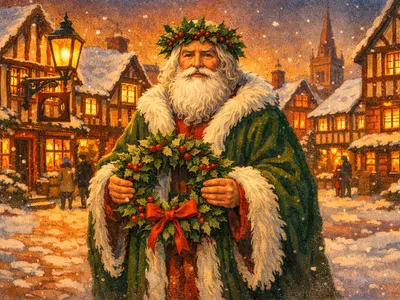
Long before elves had anything to do with Santa Claus, they were protecting Scandinavian farmsteads. In Norway and Denmark, these figures were called nisse. In Sweden, tomte. In Finland, tonttu. The word "nisse" derives from Nils, the Scandinavian form of Nicholas. The word "tomte" comes from tomt, meaning homestead or plot of land.
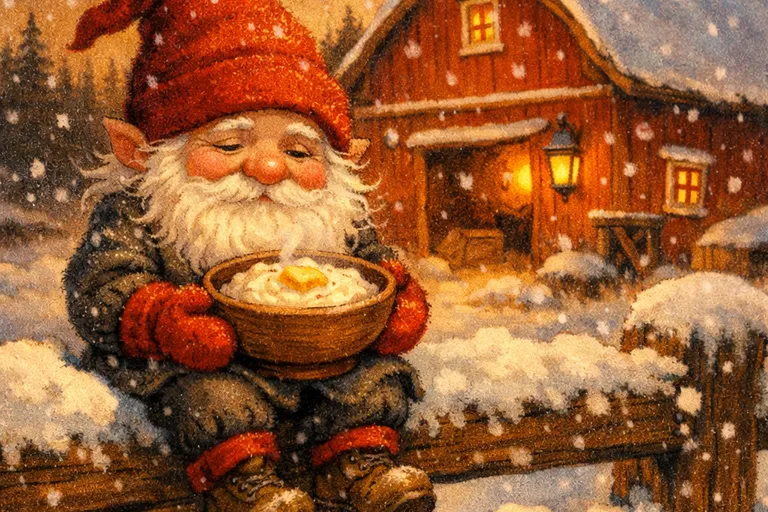
These weren't cute toy-makers. They were small, bearded, temperamental household spirits rooted in pre-Christian Norse traditions of ancestor worship. Farmers believed a tomte or nisse lived secretly on the property, guarding the family, livestock, and fields from misfortune. Treat one well, leave out a bowl of porridge with a pat of butter on Christmas Eve, and the spirit would help with chores and ward off harm. Offend one, and your cows might go dry or your barn might burn.
One piece of later folklore held that a tomte was the soul of a slave from the Viking era, bound to maintain the household's farmland while the master was away raiding, and duty-bound to continue doing so until the end of days. That's a considerably darker backstory than anything in a Rankin/Bass special.
These domestic spirits eventually evolved into the julenisse (Denmark and Norway) and jultomte (Sweden), Christmas-specific versions that shifted from farm guardians to gift-bringers. But the transformation happened slowly, and the modern julenisse looks almost nothing like the original: he's now a full-sized, white-bearded man in red, essentially a Scandinavian Santa Claus rather than a two-foot-tall spirit living under your barn.
How Elves Became Santa's Helpers: The 19th-Century American Invention
The connection between elves and Christmas gift-giving is an American creation, and it happened in print. In 1850, Louisa May Alcott completed a book titled Christmas Elves. She never published it, but the title alone tells us that the idea of specifically Christmas-themed elves was circulating in the American literary imagination by mid-century.
The real turning point came in the December 26, 1857 issue of Harper's Weekly, which published a poem called "The Wonders of Santa Claus." Before this poem, most Americans imagined Santa as a solitary figure. The poem changed that. It declared that Santa "keeps a great many elves at work, all working with all their might, to make a million of pretty things, cakes, sugar-plums, and toys." In a single stanza, the elf workforce was born.
Then came Thomas Nast. The German-born cartoonist, working for Harper's Weekly during and after the Civil War, produced 33 Christmas-themed illustrations between 1863 and 1886. His 1866 double-page spread "Santa Claus and His Works" showed, for the first time in a major publication, Santa's complete operation: workshop, tools, elves, and a record book for tracking naughty and nice children. Nast drew on the Germanic folk traditions of his childhood, blending images of small, industrious elves with the emerging American Santa mythology. He also placed Santa at the North Pole, giving the workshop a permanent address.
The 1873 Christmas issue of Godey's Lady's Book sealed the image. Its cover illustration showed Santa surrounded by toys and elves, captioned: "Here we have an idea of the preparations that are made to supply the young folks with toys at Christmas time." Godey's was the most influential women's magazine in America. Its 1850 Christmas issue had already introduced the modern Christmas tree to a mass audience. Now it was standardizing the elf workshop.
What Do Christmas Elves Do? The Workshop Mythology
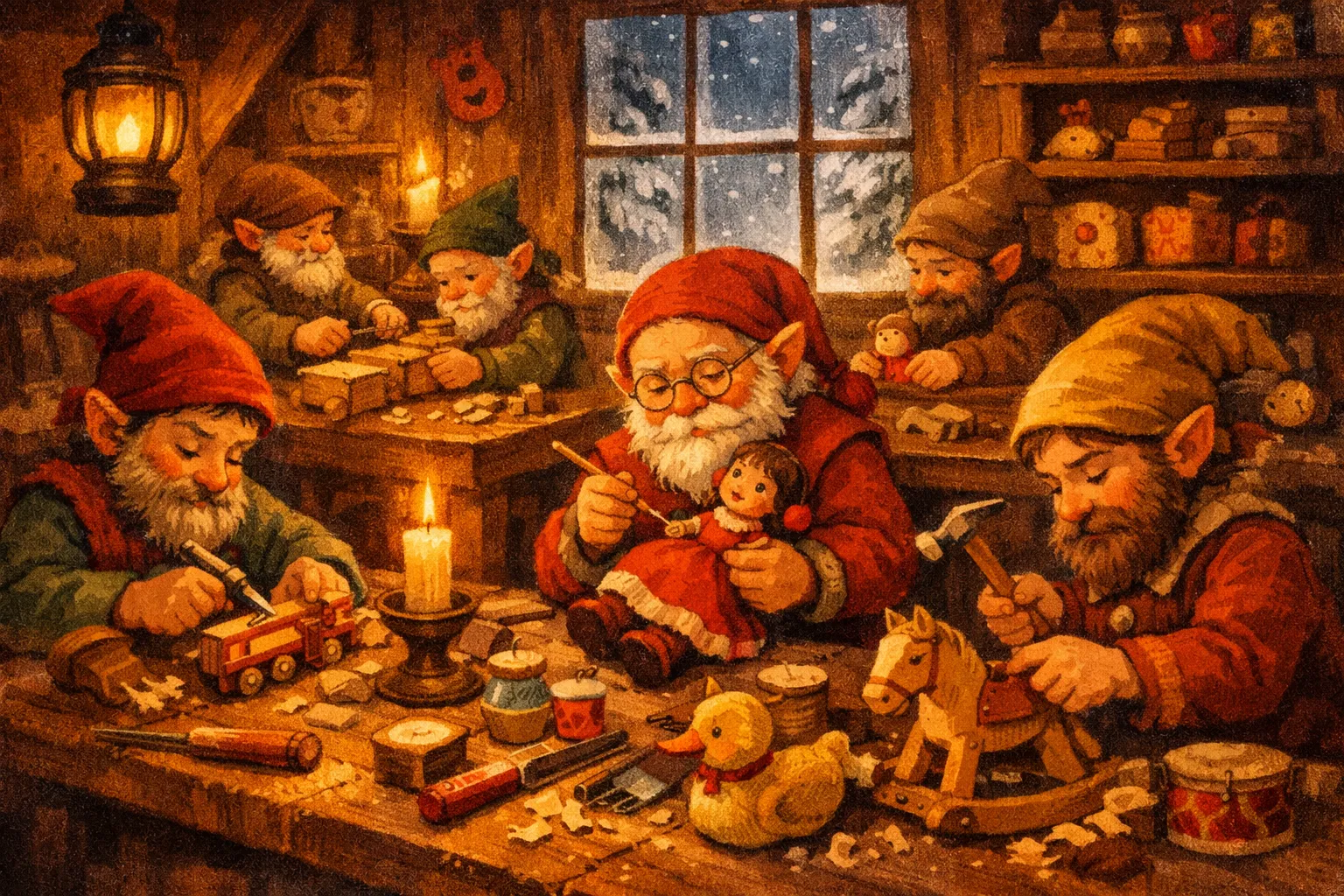
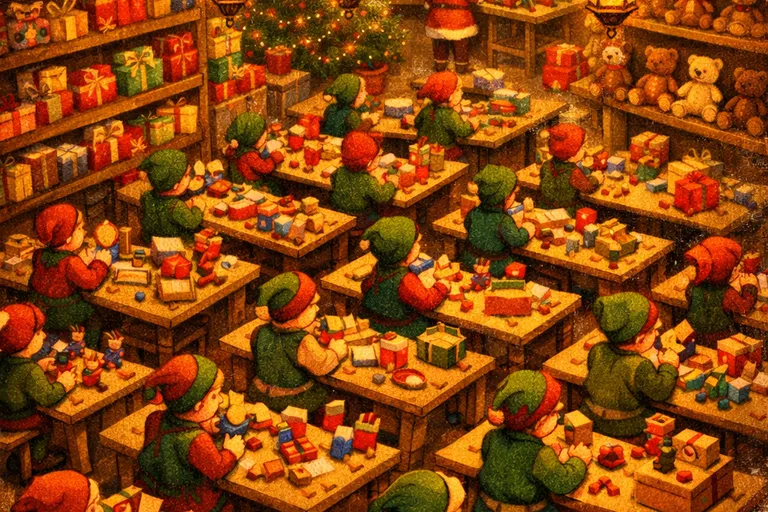
By the early 20th century, the elves' job description had solidified into something remarkably specific. They make toys. They maintain Santa's sleigh. They feed the reindeer. They keep the Naughty and Nice list. They run quality control. The North Pole had become, in the American imagination, a kind of benevolent factory staffed by cheerful, pointy-eared workers who never ask for overtime pay.
This mythology got its most detailed treatment through popular culture, particularly The Santa Clause film franchise, which named six key elves: Alabaster Snowball (administrator of the Naughty and Nice list), Bushy Evergreen (inventor of the magic toy-making machine), Pepper Minstix (guardian of the village's secrecy), Shinny Upatree (Santa's oldest friend and co-founder of the hidden village), Sugarplum Mary (head of the sweets department), and Wunorse Openslae (sleigh engineer, his name a pun on "one horse open sleigh").
None of these names come from folklore. They're pure 20th-century invention. But they reveal something about the function elves serve in the Christmas story: they make the operation feel real by giving it organizational detail. A single magical Santa is a fairy tale. Santa with a named staff, specialized departments, and a physical headquarters is a world you can imagine living in.
What Are the Names of Santa's Elves?
There is no single canonical list. Different movies, books, and TV specials have created their own rosters. The most widely referenced names come from The Santa Clause films: Alabaster Snowball, Bushy Evergreen, Pepper Minstix, Shinny Upatree, Sugarplum Mary, and Wunorse Openslae.
The 1964 Rankin/Bass special Rudolph the Red-Nosed Reindeer gave us Hermey, the elf who wanted to be a dentist. The 2003 film Elf introduced Buddy. Bernard the Head Elf appears in The Santa Clause. Each version adds to the mythology without replacing what came before, which is part of why Christmas elf lore feels so sprawling. There's no single authority.
Christmas Elves in Movies: From Stop-Motion to Will Ferrell
The 1964 Rankin/Bass stop-motion special Rudolph the Red-Nosed Reindeer was the first time most Americans saw Santa's elves as fully realized characters on screen. Hermey, the blonde elf who hates making toys and dreams of becoming a dentist, was a genuinely subversive creation for a children's special. He runs away from the workshop, befriends a reindeer outcast, visits an island of broken toys, and confronts an abominable snow monster. His storyline is about rejecting the role assigned to you by your community, which is a surprisingly grown-up theme hiding inside a puppet show.
Jon Favreau's 2003 comedy Elf, starring Will Ferrell as Buddy, a human raised as an elf at the North Pole, took the opposite approach. Where Hermey wanted out of the elf life, Buddy can't let go of it. The film's production design deliberately mimicked the 1964 Rankin/Bass aesthetic. The wardrobe department replicated the puppet-style costumes, and Buddy's green-and-yellow outfit is essentially Hermey's uniform scaled up to six-foot-three. Elf earned over $220 million worldwide and made the fish-out-of-water elf its own subgenre.
What both films share is the idea that being an elf is an identity, not just a job. That shift, from workers to characters with inner lives, is the biggest change in elf mythology over the past sixty years.
What Is the Origin of Elf on the Shelf?
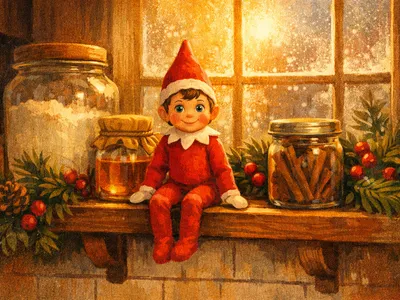
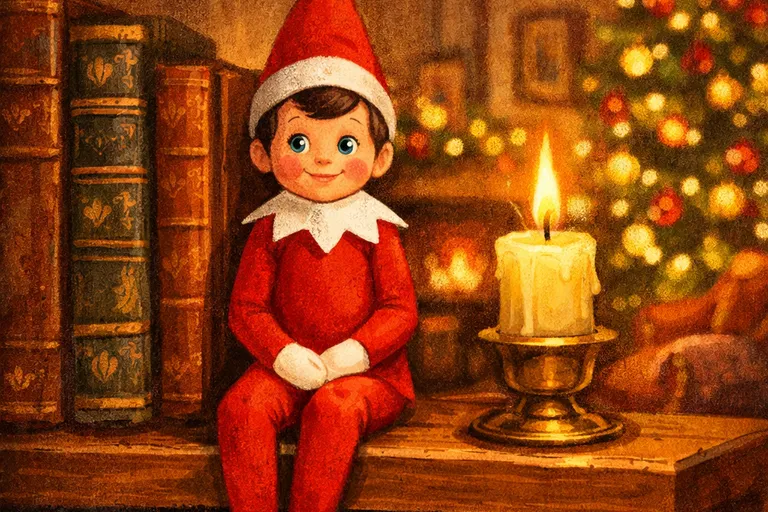
In 1974, a small elf doll arrived in the home of Bob and Carol Aebersold in Atlanta. The family named him Fisbee and told their three children that he watched over them for Santa, flying to the North Pole each night to report on their behavior and returning to a new hiding spot by morning. It was a family game, nothing more.
Three decades later, Carol's daughter Chanda Bell proposed turning the tradition into a children's book. Together with Carol and illustrator Coe Steinwart, they self-published The Elf on the Shelf: A Christmas Tradition in 2005. The book came packaged with a small scout elf doll. Their first public appearance was a book signing in Marietta, Georgia.
Growth was slow at first. Then Jennifer Garner was photographed carrying the book in 2007. The Today Show picked up the story. By 2012, the Elf on the Shelf had its own balloon in the Macy's Thanksgiving Day Parade. As of 2023, more than 22.5 million scout elf dolls have been sold worldwide.
The tradition is not without critics. Writing for The Atlantic, Kate Tuttle called it "a marketing juggernaut dressed up as a tradition." Psychologist David Kyle Johnson, in Psychology Today, described it as a "dangerous parental crutch" that normalizes surveillance. Privacy advocates have raised concerns about teaching children that being watched constantly is acceptable. The Lumistella Company, which owns the brand, has dismissed all such criticism. Whatever your position, the Elf on the Shelf is probably the most successful new Christmas tradition created in the 21st century.
Iceland's Yule Lads: A Different Kind of Christmas Elf
Iceland has its own tradition of Christmas visitors, and they make Santa's elves look tame. The Yule Lads (Jolasveinarnir) are thirteen troll-like figures who descend from the mountains one per night starting on December 12. They are the sons of Gryla, a terrifying troll who, according to legend, eats misbehaving children.
Each Yule Lad has a name describing his particular brand of mischief. Stekkjastaur (Sheep-Cote Clod) harasses sheep. Giljagaur (Gully Gawk) steals cow's milk. Stufur (Stubby) swipes food from frying pans. Thvorusleikir (Spoon Licker) does exactly what his name suggests. Hurdaskellir (Door Slammer) keeps families awake at night. Ketkrokur (Meat Hook) hangs from rafters with a metal hook to steal smoked lamb. Kertasnikir (Candle Beggar), the last to arrive on Christmas Eve, steals candles, which in earlier centuries meant stealing your only light source.
The most widely known version of the Yule Lads comes from a 1932 poem by Johannes fra Kotlum. But the figures are much older than that. In 1746, the Icelandic authorities actually banned using the Yule Lads to frighten children, which tells you how seriously people took the practice. Today, Icelandic children place a shoe on their windowsill each of the thirteen nights. Good children receive a small gift. Naughty children get a raw potato.
The Yule Lads aren't elves in the Scandinavian nisse sense, and they're certainly not Santa's helpers. But they occupy the same cultural space: supernatural figures who appear at Christmas, judge children's behavior, and blur the line between reward and punishment. They're a reminder that not every culture's Christmas mythology is built around generosity. Some of it is built around fear.
Frequently Asked Questions
Where did the idea of Christmas elves originate?
Christmas elves trace their roots to Scandinavian folklore, specifically the nisse (Norway, Denmark) and tomte (Sweden), small household spirits believed to guard farmsteads. These figures had no connection to Christmas until they merged with gift-giving traditions in the 19th century. The link between elves and Santa's toy workshop was established in American publications like Harper's Weekly (1857) and Thomas Nast's illustrations for the same magazine in the 1860s.
What do Santa's elves do at the North Pole?
According to modern Christmas mythology, Santa's elves manufacture toys in a workshop at the North Pole, maintain Santa's sleigh, care for the reindeer, and manage the Naughty and Nice list. Some named elves have specialized roles, such as Wunorse Openslae (sleigh maintenance) and Alabaster Snowball (list administration). These specific details come primarily from 20th-century movies and TV specials, not older folklore.
When did Elf on the Shelf start?
The Elf on the Shelf began as a family tradition in the Aebersold household in 1974, when a small elf doll was used to monitor children's behavior during the Christmas season. Carol Aebersold and her daughter Chanda Bell published it as a children's book with an accompanying doll in 2005. More than 22.5 million scout elf dolls have been sold since then.
What are the names of Santa's elves?
There is no single official list. The most commonly cited names come from The Santa Clause films: Alabaster Snowball, Bushy Evergreen, Pepper Minstix, Shinny Upatree, Sugarplum Mary, and Wunorse Openslae. Other well-known elf characters include Hermey from the 1964 Rudolph special and Buddy from the 2003 film Elf. Different sources create different rosters.
Who are the Icelandic Yule Lads?
The Yule Lads (Jolasveinarnir) are thirteen troll-like figures from Icelandic Christmas folklore. They are the sons of the troll Gryla and descend from the mountains one per night in the thirteen days before Christmas. Each has a name reflecting his specific mischief, such as Spoon Licker, Door Slammer, and Meat Hook. Children who behave receive gifts in their shoes; naughty children get a raw potato.
How are Scandinavian Christmas elves different from American Christmas elves?
Scandinavian nisse and tomte originated as solitary household guardian spirits tied to specific farms, rooted in pre-Christian ancestor worship. American Christmas elves are a 19th-century literary invention, depicted as a large workforce manufacturing toys in Santa's North Pole workshop. The Scandinavian figures are independent and sometimes dangerous. The American versions are cheerful, obedient, and exist entirely in service to Santa Claus.