
History of Christmas: How the Holiday Began
Christmas didn't arrive fully formed with a tree, a turkey, and a man in a red suit. It was assembled over centuries from Roman festivals, medieval church politics, Victorian nostalgia, and American commercialism. Here's how it actually happened.
The history of Christmas stretches back over two thousand years, but almost none of it looks like what you'd expect. The holiday that billions celebrate on December 25 was not observed by the earliest Christians, was banned by Puritans, nearly died out in the 18th century, and was reinvented almost from scratch by the Victorians. The Christmas we know is less an ancient tradition than a surprisingly recent invention built on very old parts.
Contents
- 1. What Are the Pagan Origins of Christmas?
- 2. Why Is Christmas on December 25?
- 3. How Did Christmas Develop in the Middle Ages?
- 4. When Did Christmas Nearly Disappear?
- 5. How Did the Victorians Reinvent Christmas?
- 6. How Did Christmas Traditions Start in America?
- 7. Where Did Specific Christmas Traditions Come From?
- 8. Frequently Asked Questions
Christmas began not with a single event but through a slow accumulation. Pagan winter solstice celebrations, Roman festivals, early Christian theology, and centuries of local folk customs all fed into the holiday. Understanding how these threads came together answers one of the most common questions about the season: why December 25?
What Are the Pagan Origins of Christmas?
Long before anyone celebrated the birth of Jesus, people across Europe and the Mediterranean marked the winter solstice. The shortest day of the year, falling around December 21 or 22, was a natural turning point. After weeks of darkening skies, the sun began its return. Cultures built festivals around this astronomical fact.
In Rome, Saturnalia ran from December 17 to 23. It was a week of feasting, gift-giving, gambling, and social inversion where masters served slaves at dinner. The Roman poet Catullus called it "the best of days." Schools closed, courts adjourned, and normal social rules dissolved. The parallels to modern Christmas celebrations are hard to miss.
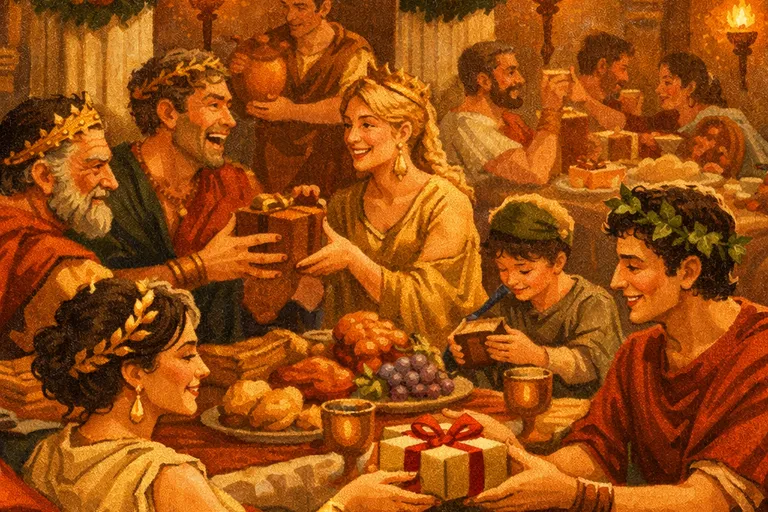
Then there was Sol Invictus, the festival of the "Unconquered Sun," established by Emperor Aurelian in 274 CE on December 25. And in Northern Europe, Germanic and Norse peoples celebrated Yule, a midwinter festival that lasted roughly twelve days. Yule logs, evergreen decorations, and communal feasting all have roots in these pre-Christian winter traditions.
The early Christian church didn't celebrate Jesus' birth at all. Easter was the central holiday. The New Testament gives no date for the Nativity, and early theologians like Origen of Alexandria (around 200 CE) actually argued against birthday celebrations as a pagan custom.
Why Is Christmas on December 25?
This is one of the most debated questions in religious history, and there are two main theories.
The first, and most widely cited, is the "History of Religions" hypothesis: that the church deliberately placed Christmas on December 25 to absorb and replace existing pagan festivals, particularly Sol Invictus and the tail end of Saturnalia. The logic was practical. If people were already celebrating, redirect that energy toward Christ. This theory has been popular since the 12th century and remains the standard explanation in most history textbooks.
The second theory, championed by scholars like Thomas Talley, is the "Calculation" hypothesis. Early Christians believed that great prophets died on the same date they were conceived. Working backward from a presumed crucifixion date of March 25, they placed the Annunciation (the conception of Jesus) on that same date. Count nine months forward and you land on December 25. This theory suggests the date was arrived at through theological reasoning, not pagan borrowing.
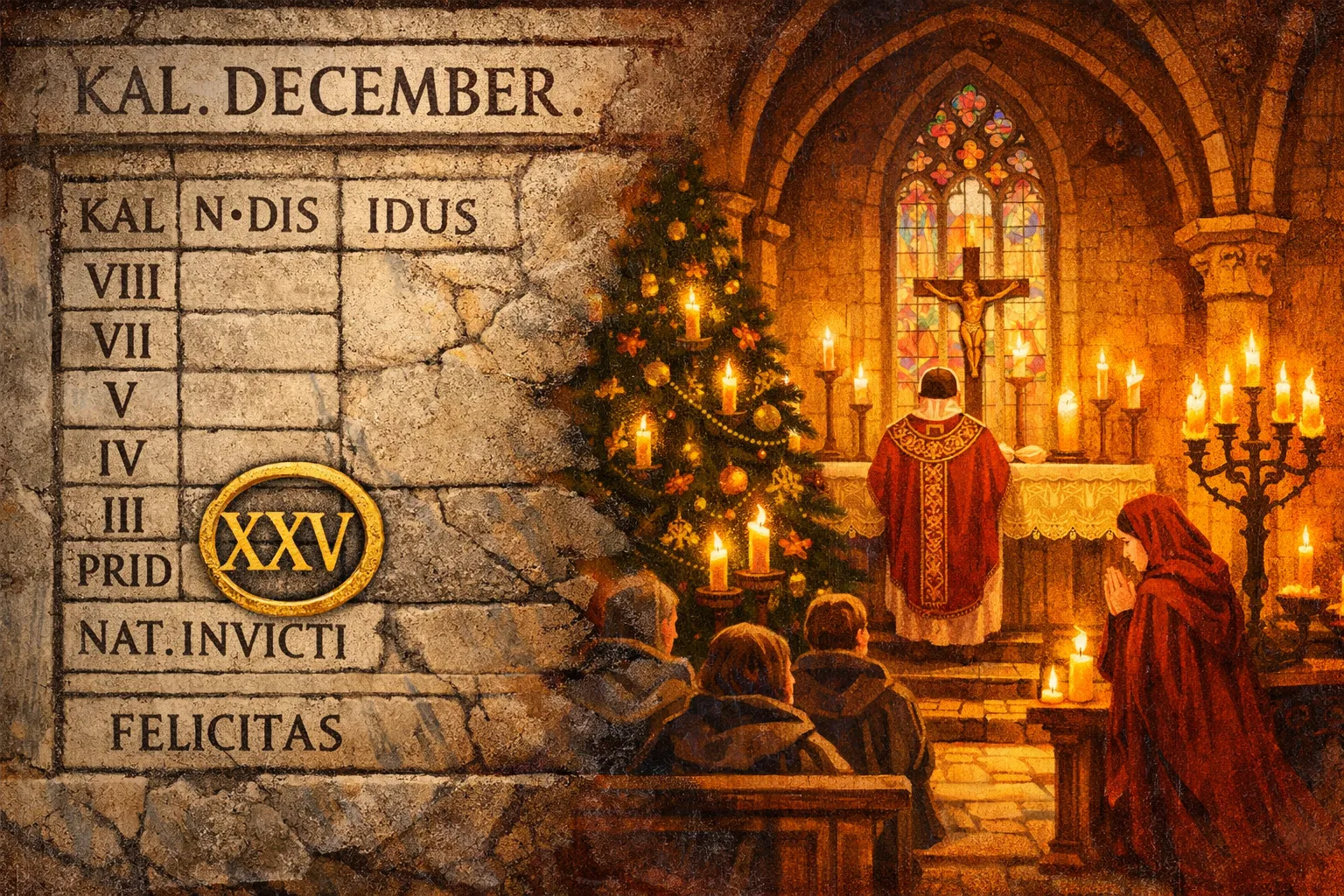
The earliest known reference to December 25 as the date of Christ's birth comes from the Chronograph of 354, a Roman almanac. By the late 4th century, the date was widely accepted across Western Christianity. The Eastern churches initially preferred January 6 (Epiphany), and some, like the Armenian Apostolic Church, still celebrate Christmas on that date.
How Did Christmas Develop in the Middle Ages?
Medieval Christmas was a public, communal affair that would look strange to modern eyes. The "Twelve Days of Christmas" from December 25 to January 6 were an extended season of feasting, not a single day. In England, the celebrations resembled Carnival more than a family holiday. There were plays, processions, and a tradition called the "Lord of Misrule," where a commoner was appointed to preside over the revelry.
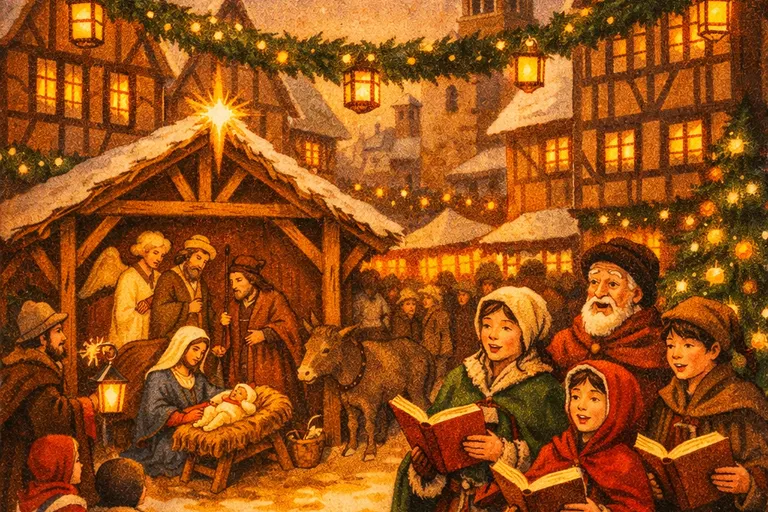
The church formalized the season through liturgy. The Feast of the Nativity anchored December 25, Epiphany marked January 6, and Advent (a period of fasting and preparation) was established in the weeks before Christmas. St. Francis of Assisi created what is believed to be the first live nativity scene in Greccio, Italy, in 1223, giving the faithful a tangible, visual connection to the biblical story.
Carols emerged as a distinct form during this period. Early carols were not solemn hymns but lively songs meant for dancing. The word "carol" itself derives from the Old French "carole," a circle dance. Many of the carols that survive from the 15th century mix sacred narrative with earthy humor.
When Did Christmas Nearly Disappear?
The Protestant Reformation hit Christmas hard. Reformers saw the holiday as too Catholic, too rowdy, and too contaminated by pagan elements. In 1647, the English Parliament under Oliver Cromwell effectively banned Christmas. Shops were ordered to stay open on December 25. Soldiers patrolled the streets to ensure compliance. Pro-Christmas riots broke out in Canterbury and other cities.
In colonial New England, the Puritans who settled Massachusetts also rejected Christmas. From 1659 to 1681, celebrating Christmas was actually illegal in Boston, with a fine of five shillings for anyone caught feasting or taking the day off work. It took until 1870 for Christmas to become a federal holiday in the United States.
Even after the bans were lifted, Christmas remained a relatively minor occasion through the 1700s. In many places, it was more of a rowdy street festival than a family holiday. Groups of young men would go "wassailing" from house to house, demanding food and drink from the wealthy. Think of it less as caroling and more as organized seasonal intimidation.
How Did the Victorians Reinvent Christmas?
The Christmas we recognize today is largely a Victorian creation. In the span of about 20 years, from the 1840s to the 1860s, nearly every major element of the modern holiday was either invented or popularized.
Charles Dickens published "A Christmas Carol" in 1843. The novella did not invent the idea of Christmas generosity, but it gave the holiday a specific moral framework: Christmas as a time for compassion, family reconciliation, and social responsibility. The book sold out its first edition in days and has never gone out of print. Dickens essentially wrote the emotional template for the modern holiday.
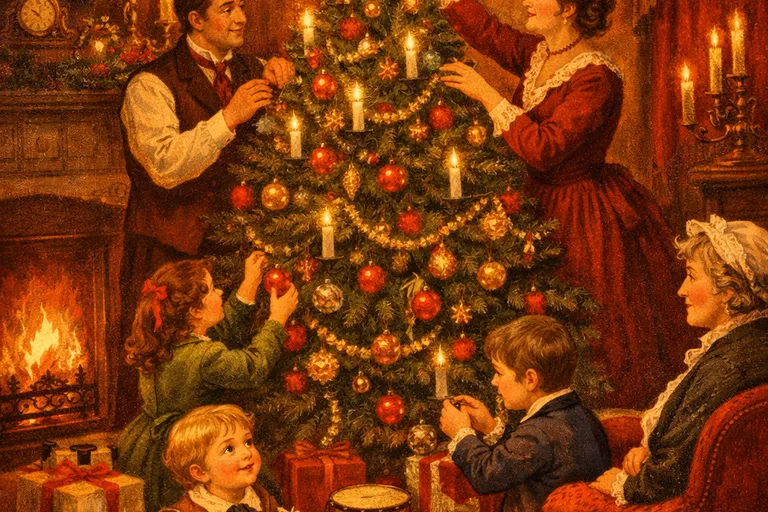
That same year, Sir Henry Cole commissioned the first commercial Christmas card in London. In 1848, the Illustrated London News published an image of Queen Victoria and Prince Albert standing around a decorated Christmas tree at Windsor Castle. Albert, who was German, brought the tradition from his homeland. Within a decade, Christmas trees became standard in British and American homes.
The Victorians also formalized Christmas dinner, popularized gift-giving to children (previously, gifts were exchanged on New Year's Day or Epiphany in many cultures), and established the expectation that Christmas was primarily a domestic, family-centered occasion. This was a radical shift. For centuries, Christmas had been a public, often unruly event. The Victorians made it private, sentimental, and child-focused.
How Did Christmas Traditions Start in America?
American Christmas is a patchwork of borrowed traditions, literary inventions, and commercial innovation. The Dutch settlers in New York brought Sinterklaas, who morphed into Santa Claus. Washington Irving's 1809 "Knickerbocker's History of New York" described a pipe-smoking St. Nicholas flying over rooftops in a wagon. Clement Clarke Moore's 1823 poem "A Visit from St. Nicholas" (commonly known as "'Twas the Night Before Christmas") added the sleigh, the reindeer, and the chimney descent.
Thomas Nast, a cartoonist for Harper's Weekly, drew Santa Claus repeatedly between 1863 and 1886, gradually establishing the visual image of a plump, bearded figure in fur-trimmed clothing. Nast also invented Santa's North Pole workshop and the idea of a naughty-or-nice list.
The 20th century added layer after layer. Electric Christmas lights appeared in 1882 when Edward Johnson, an associate of Thomas Edison, hand-wired 80 red, white, and blue bulbs for his tree. Coca-Cola's 1930s advertising campaigns featuring Haddon Sundblom's paintings helped standardize Santa's red-and-white color scheme (though Santa had appeared in red before). Rudolph the Red-Nosed Reindeer was created in 1939 as a coloring book promotion for Montgomery Ward department stores.
By the mid-20th century, Christmas had become the economic engine it remains today. The National Retail Federation estimates that holiday spending in the United States reached $964 billion in 2023. The holiday that Puritans once banned for its frivolity has become the largest annual commercial event on the planet.
Where Did Specific Christmas Traditions Come From?
Most individual Christmas traditions have surprisingly specific origin stories.
- Christmas trees: Originated in 16th-century Germany. The earliest documented tree was in Strasbourg in 1605. Martin Luther is often credited with adding candles, though this story may be apocryphal.
- Stockings: Traced to a legend about St. Nicholas of Myra dropping gold coins down a chimney, where they landed in stockings hung to dry. The tradition became widespread in the 19th century.
- Mistletoe: Revered by the Druids as a symbol of fertility. The kissing tradition appears in English literature by the 18th century.
- Candy canes: First documented in 1670s Germany, where a choirmaster at Cologne Cathedral reportedly gave sugar sticks bent into shepherd's crooks to children during Nativity services.
- Gift wrapping: Decorative wrapping paper became common only after 1917, when the Hall Brothers (later Hallmark) ran out of tissue paper and substituted decorated envelope linings.
Each of these traditions arrived at different times and from different places. The genius of Christmas is its ability to absorb new customs and make them feel as though they've always been there.
Frequently Asked Questions
When did Christmas start being celebrated?
The earliest known reference to December 25 as the date of Christ's birth appears in the Chronograph of 354, a Roman document. By the late 4th century, the Feast of the Nativity on December 25 was established across Western Christianity. However, many elements of modern Christmas celebrations only became widespread in the 19th century during the Victorian era.
Is Christmas based on a pagan holiday?
Christmas incorporated elements from several pre-Christian winter celebrations, including the Roman festivals of Saturnalia and Sol Invictus and the Norse celebration of Yule. Whether the December 25 date was deliberately chosen to replace these festivals or was calculated independently through Christian theology is still debated by scholars. The answer is likely a combination of both influences.
Why is Christmas celebrated on December 25 if Jesus wasn't born then?
The Bible does not specify a date for Jesus' birth, and most historians agree that a late December date is unlikely based on the biblical account of shepherds in the fields. The December 25 date was either chosen to coincide with existing Roman solstice festivals or calculated by early theologians who believed Jesus was conceived on March 25, placing his birth exactly nine months later.
Who invented the modern Christmas?
No single person invented modern Christmas, but the Victorians deserve the most credit. Charles Dickens shaped the holiday's moral character with "A Christmas Carol" in 1843. Prince Albert popularized the Christmas tree in Britain. Sir Henry Cole created the first Christmas card. In America, Washington Irving, Clement Clarke Moore, and Thomas Nast built the Santa Claus mythology over several decades.
When did Christmas become a federal holiday in the United States?
Christmas became a U.S. federal holiday on June 26, 1870, when President Ulysses S. Grant signed it into law. This was remarkably late. Christmas had been banned in parts of colonial New England, and the holiday only gained broad cultural acceptance in America during the mid-19th century, driven largely by immigration and the influence of Victorian British customs.
How did Santa Claus become part of Christmas?
Santa Claus evolved from St. Nicholas of Myra, a 4th-century Christian bishop known for his generosity. Dutch settlers brought the Sinterklaas tradition to New York. Washington Irving, Clement Clarke Moore, and cartoonist Thomas Nast each added key elements to the character over the 19th century. Coca-Cola's 1930s advertising campaigns by artist Haddon Sundblom further standardized Santa's modern red-suited appearance.