
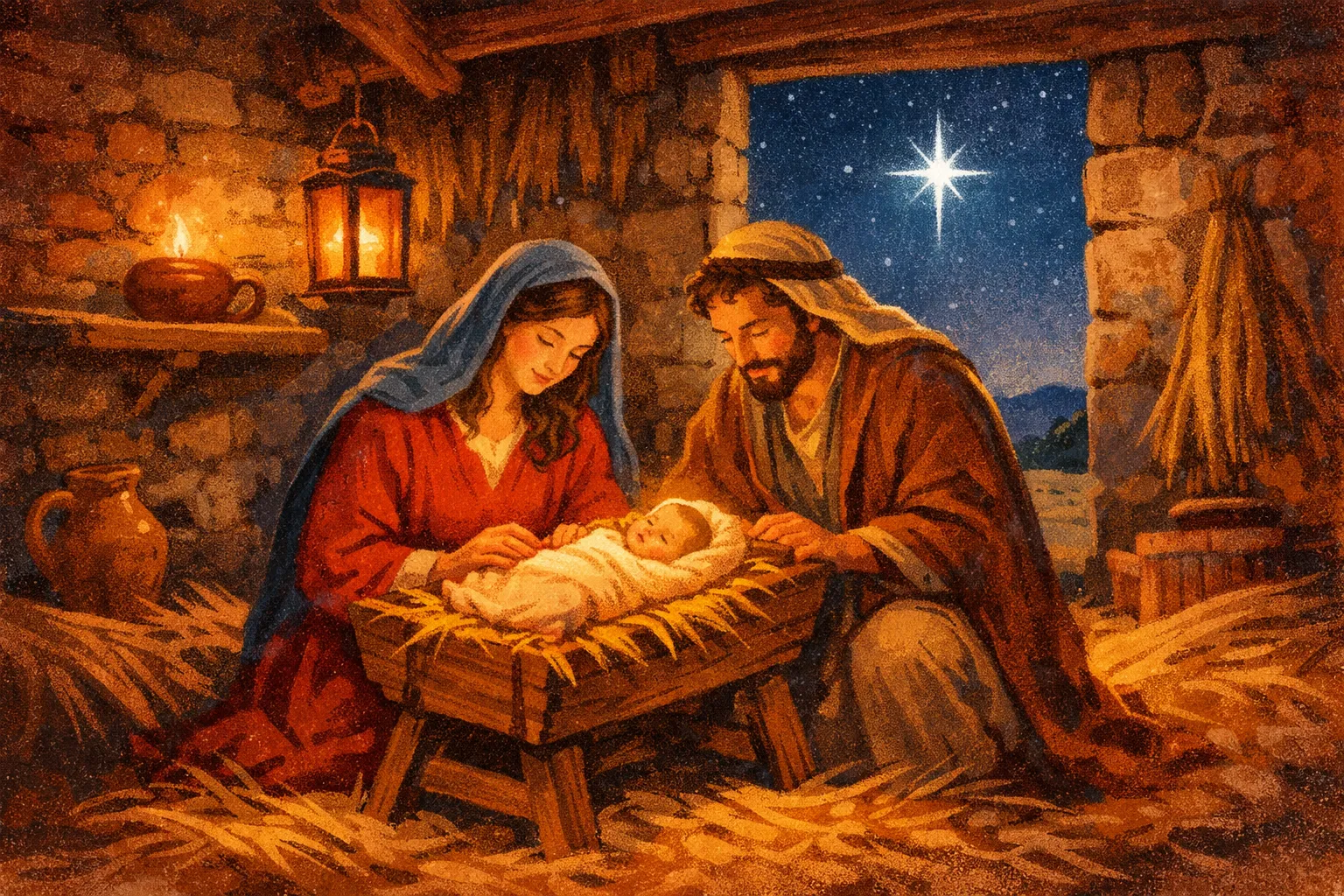
Birth of Jesus: The Nativity Story Explained
The nativity story has been told billions of times, painted by Renaissance masters, staged by children in bathrobes, and debated by scholars for centuries. Here's what we actually know, and what we don't.
The birth of Jesus is the event behind Christmas itself. Strip away the reindeer, the shopping, the office parties, and what remains is a story first recorded nearly two thousand years ago: a child born in Bethlehem, laid in a feeding trough, visited by shepherds and, eventually, by travelers from the East. The nativity story sits at the foundation of the world's largest religion, and it has shaped December 25 into the cultural phenomenon it is today.
Contents
- 1. What Does Nativity Mean?
- 2. The Nativity Story in the Bible
- 3. Where Was Jesus Born?
- 4. When Was Jesus Born?
- 5. Why Do We Celebrate Christmas on December 25?
- 6. The Nativity Scene: From Francis of Assisi to Your Living Room
- 7. The Star, the Magi, and the Shepherds
- 8. How the Birth of Christ Shaped Christmas
- 9. Frequently Asked Questions
But the version most people carry in their heads is a composite. It blends two different Gospel accounts, medieval traditions, Renaissance paintings, and a healthy dose of Victorian sentimentality. The actual biblical texts are shorter and stranger than most people expect.
What Does Nativity Mean?
The word "nativity" comes from the Latin nativitas, meaning birth. In Christian usage, it refers specifically to the birth of Jesus Christ. When someone says "the Nativity," capitalized, they mean this one birth in particular. The term has been in English since at least the 12th century, and it appears in church calendars, art history, and common speech alike.
Beyond its religious meaning, "nativity" gave its name to the nativity scene, the nativity play, and the broader nativity tradition that millions of families set up in their homes each December. The word carries two thousand years of accumulated meaning, but at its root, it simply means: the birth.
The Nativity Story in the Bible
Only two of the four Gospels describe the birth of Jesus, and they tell quite different stories. Matthew and Luke each provide an account, but Mark and John skip the birth entirely. Mark begins with Jesus as an adult. John opens with theology, not biography.
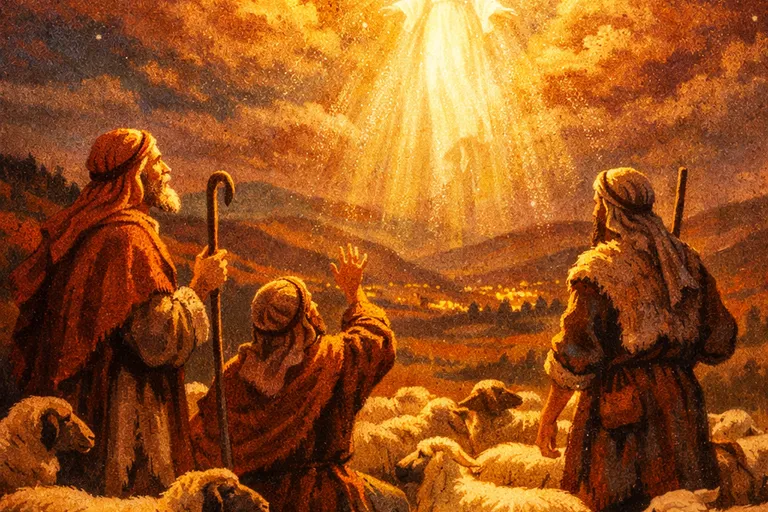
Luke's Gospel gives the fuller narrative. According to Luke, the Roman Emperor Augustus ordered a census that required Joseph to travel from Nazareth to Bethlehem, the city of his ancestor David. Mary, his betrothed, was pregnant and traveled with him. When they arrived, there was no room at the inn, so Jesus was born and placed in a manger. Shepherds in nearby fields received an angelic announcement and came to see the child.
Matthew's account is different in nearly every detail. There are no shepherds, no manger, no census. Instead, Matthew focuses on the Magi, the wise men from the East who followed a star to find the newborn king. He tells of King Herod's fear, the flight to Egypt, and the massacre of infants in Bethlehem. Matthew's birth narrative reads more like political thriller than pastoral scene.
The nativity story people know best is really both accounts stitched together. Shepherds from Luke, wise men from Matthew, a star and a manger combined into a single scene that neither Gospel actually describes on its own.
Where Was Jesus Born?
Both Matthew and Luke agree on one point: Jesus was born in Bethlehem, a small town about six miles south of Jerusalem. The location mattered theologically because the Hebrew prophet Micah had written that a ruler of Israel would come from Bethlehem. Matthew explicitly quotes this prophecy.
The Church of the Nativity in Bethlehem, first built by Emperor Constantine's mother Helena around 330 CE, marks the traditional site of the birth. It is one of the oldest continuously operating churches in the world. A fourteen-pointed silver star embedded in the floor of a grotto beneath the church marks the precise spot where tradition says Jesus was born. The church survived the Persian invasion of 614 CE, possibly because the Persians recognized the Magi depicted in its mosaics as fellow easterners.
Some scholars debate whether Bethlehem was the historical birthplace or a theological claim linking Jesus to King David's lineage. Nazareth, where Jesus grew up, is the other candidate. The Gospels themselves acknowledge that Jesus was commonly known as "Jesus of Nazareth," not "Jesus of Bethlehem."
When Was Jesus Born?
The short answer: nobody knows the exact date, and it almost certainly was not December 25.
The Gospels provide no specific date for the birth of Jesus. Luke mentions shepherds watching their flocks at night, which some scholars argue points to spring or autumn rather than winter, since sheep were typically brought indoors during the cold months in the Judean highlands. The census Luke describes has its own chronological problems. Luke places it during the reign of Herod the Great and the governorship of Quirinius of Syria, but Herod died in 4 BCE and the known census under Quirinius took place in 6 CE, a gap of roughly ten years.
Most historians who weigh in on the question place the birth of Jesus somewhere between 6 BCE and 4 BCE, based on Matthew's account of Herod being alive at the time. The apparent contradiction of Jesus being born "Before Christ" is an artifact of a sixth-century monk named Dionysius Exiguus, who calculated the birth date when creating the AD calendar system and got it slightly wrong.
Why Do We Celebrate Christmas on December 25?
December 25 first appears as the date of Jesus' birth in a Roman document called the Chronograph of 354, which references a list from 336 CE. But Christians likely observed the date even earlier. How it was chosen is one of Christmas history's most interesting puzzles.
The most popular theory connects December 25 to the Roman festival of Sol Invictus, the "Unconquered Sun," which Emperor Aurelian established on that date in 274 CE. The winter solstice in the Julian calendar fell around December 25, and the logic of "Christianizing" a pagan solar holiday by replacing it with the birth of the "Sun of Righteousness" is appealing. Many historians have supported this explanation.
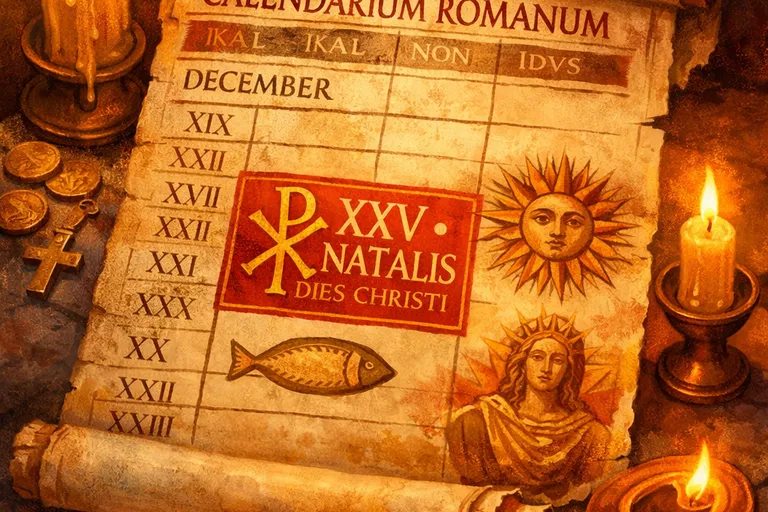
But there's a competing theory, older and arguably more interesting. Early church writers like Tertullian (around 200 CE) calculated that Jesus died on March 25. A Jewish and early Christian tradition held that great prophets died on the same date they were conceived. If Jesus was conceived on March 25, then nine months later lands precisely on December 25. This "calculation hypothesis," championed by scholars like Thomas Talley, suggests December 25 was derived from theology, not from pagan competition.
The Eastern churches initially preferred January 6, the feast of Epiphany, as the celebration of Christ's birth. By the late fourth century, most had adopted December 25 as well, though some, like the Armenian Apostolic Church, still celebrate the nativity on January 6 to this day.
The Nativity Scene: From Francis of Assisi to Your Living Room
The history of the nativity scene begins with a specific man in a specific place. In 1223, Francis of Assisi staged a live nativity in a cave near the Italian town of Greccio. According to his biographer Thomas of Celano, Francis received permission from Pope Honorius III to set up a manger with hay and bring in a live ox and donkey. He wanted people to see and feel the poverty of the birth, not just hear about it.
Francis did not invent the idea of depicting the nativity. Artists had been painting and carving it for centuries. A fresco in the Catacomb of Priscilla in Rome, dating to around the third century, shows one of the earliest known depictions. But Francis turned the nativity into something participatory, and the tradition spread rapidly through Italy and then across Europe.
By the 18th century, Naples had become the capital of elaborate nativity scenes, called presepi. Neapolitan artisans crafted entire miniature cities around the manger, populated by hundreds of terracotta figures including butchers, fishmongers, and musicians alongside the Holy Family. King Charles III of Spain, who had been King of Naples, brought the tradition to the Spanish court, from where it spread to Latin America.
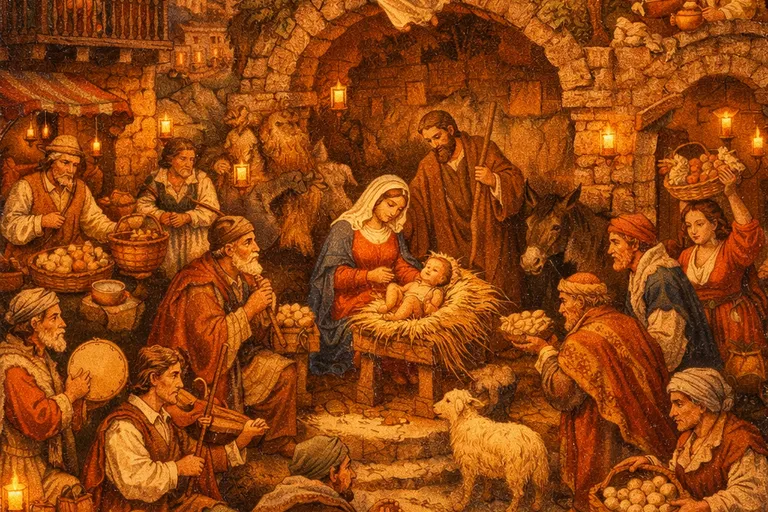
In Central Europe, particularly in the Czech lands, Slovakia, and Poland, hand-carved wooden nativity sets became both folk art and family heirlooms. The Krakow szopka, a uniquely Polish nativity tradition, incorporates elaborate architectural models of Krakow's churches and towers. UNESCO added the Krakow szopka to its Intangible Cultural Heritage list in 2018.
The Star, the Magi, and the Shepherds
The Star of Bethlehem appears only in Matthew's Gospel. It guided the Magi from the East to the place where Jesus was born. Astronomers have spent centuries trying to identify it. Candidates include a conjunction of Jupiter and Saturn in 7 BCE, a nova recorded by Chinese astronomers in 5 BCE, and the appearance of Halley's Comet in 12 BCE. Johannes Kepler proposed the Jupiter-Saturn conjunction theory back in 1614. None of these explanations fully matches Matthew's description of a star that "stopped over the place where the child was."
The Magi themselves are mysterious. Matthew calls them magoi, a Greek term that could mean astrologers, priests, or scholars. He never says there were three of them. That number comes from the three gifts: gold, frankincense, and myrrh. By the sixth century, they had acquired the names Caspar, Melchior, and Balthasar in Western tradition, though Eastern Christian traditions use different names entirely. A magnificent mosaic at the Basilica of Sant'Apollinare Nuovo in Ravenna, dating from the sixth century, is one of the earliest artworks to depict the three named Magi.
The shepherds in Luke's account are simpler figures but carry their own significance. In first-century Judea, shepherds occupied a low social position. Their inclusion in the story as the first visitors to the newborn Jesus was a deliberate choice on Luke's part, consistent with his Gospel's broader theme of reversals: the last becoming first, the lowly being exalted.
How the Birth of Christ Shaped Christmas
For the first three centuries of Christianity, the birth of Jesus received little attention compared to his death and resurrection. Easter, not Christmas, was the primary Christian feast. The earliest church fathers, including Origen in the third century, actually argued against celebrating birthdays at all, considering the practice pagan.
The establishment of December 25 as a feast day in the fourth century changed everything gradually. As Christianity became the official religion of the Roman Empire under Theodosius I in 380 CE, the celebration of Christ's birth absorbed and transformed existing winter customs. Gift-giving, feasting, lights, and greenery all found new meaning within the Christmas framework. By the Middle Ages, Christmas had become a major festival across Europe, with nativity plays, carol singing, and elaborate church liturgies centered on the birth narrative.
The Protestant Reformation disrupted some of these traditions. Puritans in England actually banned Christmas celebrations in the 1640s and 1650s, viewing them as too Catholic and too festive. New England Puritans did the same. Christmas only became a federal holiday in the United States in 1870.
Today, the relationship between the nativity story and the broader cultural celebration of Christmas varies enormously. In Poland, Wigilia, the Christmas Eve supper, begins with the breaking of the oplatek wafer and remains deeply tied to the religious narrative. In much of Western Europe and North America, secular and religious Christmas exist in parallel, sometimes overlapping, sometimes running on entirely separate tracks.
In the Church of the Nativity in Bethlehem, visitors still line up to descend into the grotto and touch the silver star on the floor. The star has fourteen points, one for each of the generations listed in Matthew's genealogy of Jesus. Above ground, the church's narrow entrance, called the Door of Humility, was made low in Ottoman times to prevent horsemen from riding inside. Everyone who enters has to bow. It's an architectural accident that became a metaphor, and the kind of detail that two thousand years of continuous history tends to produce.
Frequently Asked Questions
Was Jesus born on December 25?
Almost certainly not. The Bible gives no date for Jesus' birth. December 25 was established as the feast of the Nativity in the fourth century, possibly to align with the Roman winter solstice festival of Sol Invictus, or possibly derived from an early Christian tradition that calculated Jesus' conception on March 25, placing his birth exactly nine months later.
Where was Jesus born according to the Bible?
Both the Gospel of Matthew and the Gospel of Luke state that Jesus was born in Bethlehem, a town about six miles south of Jerusalem. Luke explains that Mary and Joseph traveled there from Nazareth for a Roman census. The Church of the Nativity, built in Bethlehem around 330 CE, marks the traditional site.
What does nativity mean?
The word "nativity" comes from the Latin nativitas, meaning birth. In Christian tradition, "the Nativity" with a capital N refers specifically to the birth of Jesus Christ. The term also refers to artistic depictions and staged re-enactments of the birth scene, such as nativity scenes and nativity plays.
Who started the tradition of nativity scenes?
Francis of Assisi created the first known live nativity scene in 1223 in the Italian town of Greccio. He set up a manger with hay and live animals to help people visualize the humble circumstances of Jesus' birth. The tradition spread through Italy and across Europe over the following centuries, evolving from live re-enactments to the carved and molded figurine sets common today.
How many wise men visited Jesus?
The Bible does not say. The Gospel of Matthew mentions Magi from the East who brought three gifts: gold, frankincense, and myrrh. The assumption that there were three wise men comes from the number of gifts. By the sixth century, Western tradition had given them names: Caspar, Melchior, and Balthasar. Eastern Christian traditions use different names.
Why is the nativity story different in Matthew and Luke?
Matthew and Luke wrote for different audiences with different theological purposes. Luke emphasizes the census, the manger, and the shepherds, highlighting themes of humility and God's care for the poor. Matthew focuses on the Magi, King Herod's threat, and the flight to Egypt, presenting Jesus as a new Moses and a king. The familiar nativity scene combines elements from both accounts into a single composite image.