
Krampus: The Christmas Devil Who Punishes the Naughty
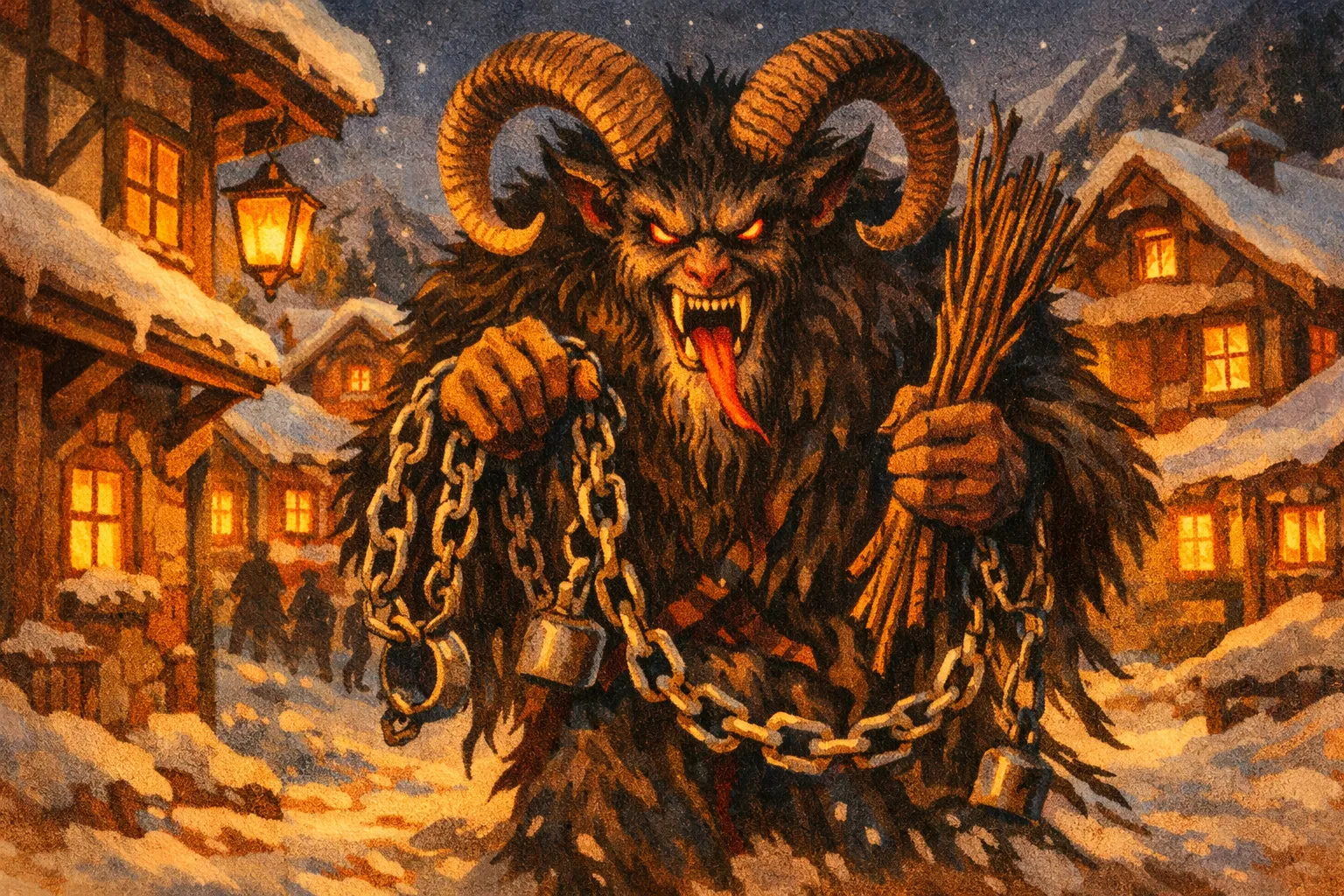
Long before coal in stockings, Alpine villages had a far more persuasive deterrent for misbehaving children: a seven-foot, chain-rattling, birch-wielding goat demon named Krampus.
Krampus is a half-goat, half-demon creature from Alpine folklore who punishes misbehaving children during the Christmas season. His name likely derives from the German word Krampen, meaning "claw," and for over 500 years he has served as the dark counterpart to St. Nicholas across Austria, Bavaria, South Tyrol, and neighboring regions. While St. Nicholas rewards good children with small gifts on December 6, Krampus arrives the night before, on December 5, to deal with the naughty ones. His tools of persuasion include birch switches, heavy chains, and an empty sack large enough to stuff a child inside.
Contents
- 1. What Is Krampus and Where Did He Come From?
- 2. Krampus vs. Saint Nicholas: How the Partnership Works
- 3. What Does Krampus Look Like?
- 4. What Is Krampusnacht?
- 5. The Krampuslauf: When Hundreds of Demons Hit the Streets
- 6. Krampus History: Who Tried to Kill the Christmas Devil?
- 7. Gruss vom Krampus: The Postcard Tradition
- 8. Krampus in Pop Culture: From Alpine Demon to American Icon
- 9. Frequently Asked Questions
That's not a metaphor. Traditional Krampus lore holds that the worst children get bundled into his basket and hauled off to his lair. It's the kind of parenting strategy that would get you investigated today, but for centuries in the Alps, it worked just fine.
What Is Krampus and Where Did He Come From?
The origins of Krampus are genuinely murky. Some folklorists have traced the figure to pre-Christian pagan rituals tied to the winter solstice in the German-speaking Alpine regions. The theory goes that local people would dress as devilish figures during midwinter rites, and when Christianity spread through the Alps, these pagan spirits weren't banished but absorbed into the Christian calendar. The dark winter spirit became attached to St. Nicholas, the bringer of gifts.
Historians are more cautious. According to Britannica, Krampus is not attested in written records before the 16th century, making the pre-Christian origin story difficult to confirm. What's clear is that the tradition was well established across Austria, Bavaria, Slovenia, Croatia, Hungary, and South Tyrol (the German-speaking part of northern Italy) by the time European travelers began documenting folk customs in detail.
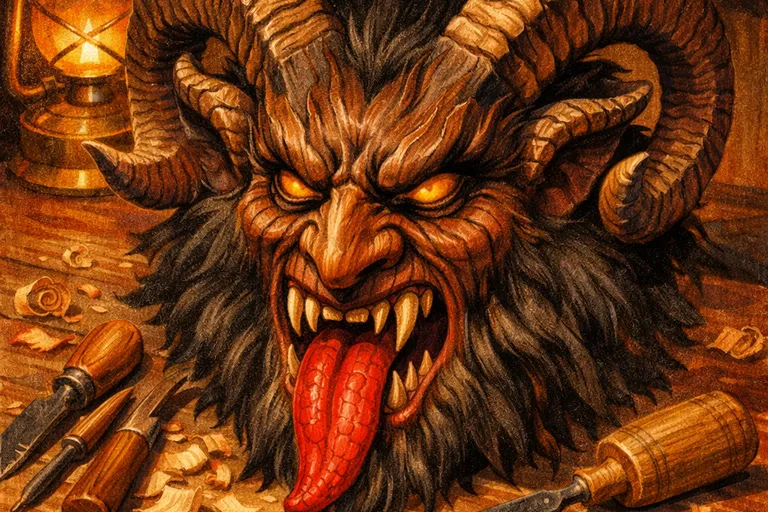
There's a related but distinct tradition worth noting: the Perchten. These are masked figures who appear later in December during the Twelve Nights of Christmas, with the purpose of driving out winter spirits. Perchten masks are massive, weighing 15 to 20 kilograms, while Krampus masks typically weigh two to four kilograms and feature a single pair of horns with a long, protruding red tongue. The two traditions overlap in practice but serve different mythological functions.
Krampus vs. Saint Nicholas: How the Partnership Works
The pairing of Krampus and St. Nicholas is one of the great odd-couple arrangements in European folklore. St. Nicholas, the benevolent bishop, arrives in his red robes with a sack full of sweets, fruit, and small toys for well-behaved children. Krampus arrives with an empty sack. The division of labor is straightforward: Nicholas handles the carrots, Krampus handles the stick. Literally.
In older Alpine traditions, St. Nicholas himself was supposed to handle both rewards and punishments. But punishing children didn't fit well with the image of a Christian saint, so the threatening duties were outsourced to a demonic companion. This split likely solidified during the 17th and 18th centuries as the tradition became more formalized.
On December 5 and 6, the pair would visit homes together. St. Nicholas would consult his book of deeds, praise the good children, and hand out gifts. Krampus would lurk behind him, growling and rattling his chains at the children whose behavior had been less than exemplary. In some regions, families would offer visiting Krampus performers a glass of schnapps before they moved on to the next house.
What Does Krampus Look Like?
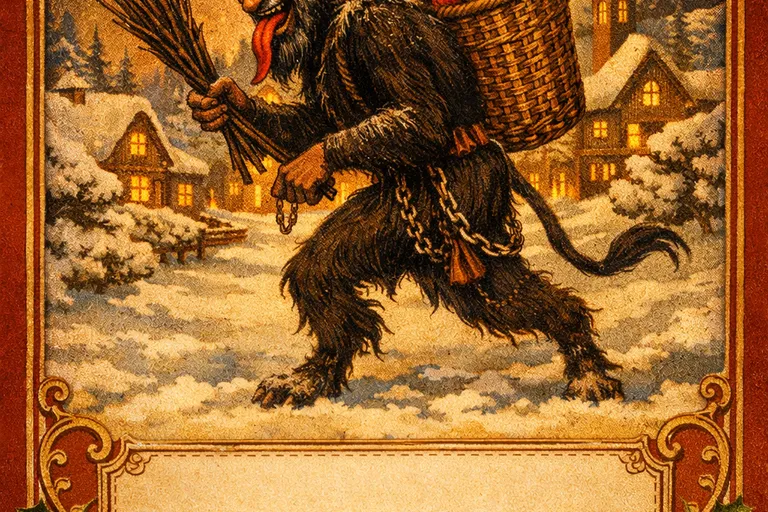
The classic Krampus is a towering, fur-covered creature with the curved horns of a ram or goat, cloven hooves on at least one foot, and a long, pointed tongue that lolls from his mouth. He is usually depicted as brown or black, with fangs and wild eyes. He carries bundles of birch branches, called Ruten, for swatting misbehaving children. In some versions, these are replaced with a whip.
The chains are perhaps his most distinctive accessory. According to folklore, they symbolize the binding of the devil by the Christian Church. Krampus rattles and thrashes them for dramatic effect. Many depictions also include bells of various sizes, which served a practical purpose in the Krampuslauf processions: you could hear him coming before you could see him.
In Styria, a region in southeastern Austria, the birch bundle carries an additional tradition. Krampus presents the Ruten to families, and the twigs are painted gold and displayed in the home year-round as a reminder to children of what awaits them next December.
What Is Krampusnacht?
Krampusnacht, or "Krampus Night," falls on December 5, the eve of the Feast of St. Nicholas. It is the main event of the Krampus calendar. Across Austria, Bavaria, and the broader Alpine region, men dress in elaborate Krampus costumes and take to the streets. They go from house to house making a fearsome racket, and it's customary for households to greet them with an offering of schnapps.
The costumes are no casual affair. Traditional Krampus outfits feature hand-carved wooden masks, called Larven, which can cost up to 1,000 euros apiece. In traditional communities, club members carve the masks themselves, painting them with red, white, and black colors. The masks must meet specific criteria: a red fabric tongue, a defined arrangement of horns from a goat or ram, and an overall appearance that would genuinely frighten a small child in a dark doorway.
The Krampuslauf: When Hundreds of Demons Hit the Streets
The Krampuslauf, or "Krampus Run," is the public procession that has become the most visible expression of the tradition. St. Nicholas leads a parade of costumed Krampus through a village, town, or designated area such as a Christmas market. Multiple Krampus clubs participate, each trying to outdo the others with more elaborate costumes and more convincing performances of menace.
A typical Krampuslauf lasts about two hours. Hundreds of Krampus may participate in larger events. They stomp through the streets, drumming, rattling chains, and chasing spectators. According to the Tyrol tourism board, the tradition is "still cultivated with great passion" in the region, and one of the largest runs takes place annually in Seefeld, drawing groups from across the Alps.
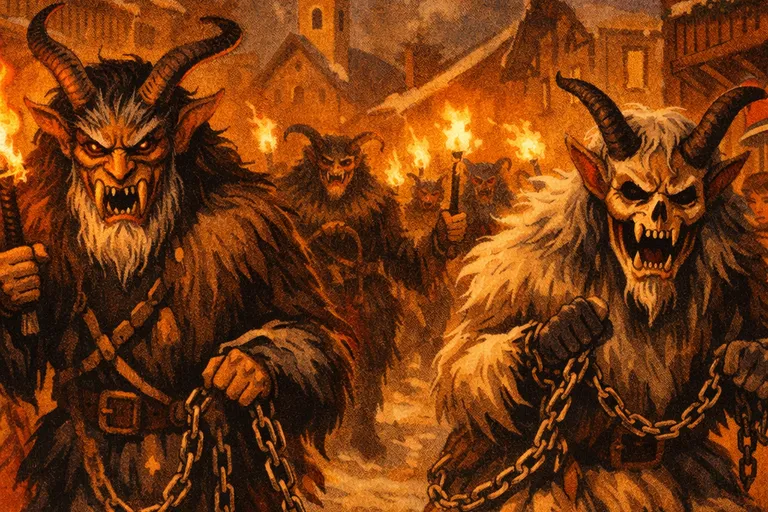
Modern Krampuslaeufe enforce safety rules that earlier versions lacked. But the events remain intense. Performers stay in character, pursuing and confronting bystanders. It is not a parade you watch passively. It's closer to a controlled haunted experience in the open air, with the added element of cultural authenticity that no Halloween attraction can match.
Krampus History: Who Tried to Kill the Christmas Devil?
The Krampus tradition has survived multiple serious attempts at suppression. The Catholic Church reportedly tried to stamp it out as early as the Inquisition, when masquerading as a devil was punishable by death. The tradition survived in remote, inaccessible Alpine valleys where enforcement was impractical.
The most documented crackdown came in the 1930s. After the 1932 Austrian elections, the Dollfuss regime, backed by the clerical fascist Fatherland Front, prohibited Krampus celebrations. As a 1945 New York Times article noted, the regime saw Krampus as a demonic, unruly figure that threatened Christian values. During the broader rise of fascism in the 1930s and 1940s, the Krampuslauf was suppressed again as "degenerate folk culture."
Even after the war, suspicion lingered. In the 1950s, the Austrian government distributed pamphlets titled "Krampus Is an Evil Man," warning that encounters with the creature might damage children's mental health. None of it worked. The tradition persisted in rural communities and roared back to full strength by the late 20th century.
Gruss vom Krampus: The Postcard Tradition
Starting in the late 19th century, Europeans began exchanging Krampus greeting cards, known as Krampuskarten, bearing the phrase "Gruss vom Krampus" ("Greetings from Krampus"). These cards depicted the creature in darkly humorous scenes: chasing children, stuffing them into baskets, or swatting them with birch branches. The cards were rendered in rich reds, blacks, and vintage earthy tones.
The designs grew increasingly playful over time. Some showed Krampus chasing young women, or being chased by them, a theme that reportedly appealed to Victorian sensibilities. The cards became popular collectibles. Today, original early 20th-century Krampuskarten are sought-after items, and Monte Beauchamp's book Devilish Greetings compiled hundreds of them for a modern audience.
Krampus in Pop Culture: From Alpine Demon to American Icon
Krampus crossed the Atlantic around 2010, when a handful of American cities, notably Los Angeles and Philadelphia, began hosting Krampus-themed events and parades. San Francisco launched a bar-hopping "Krampus Krawl." But the real breakthrough came in 2015, when Universal Pictures released Krampus, a comedy-horror film starring Adam Scott and Toni Collette that grossed $61 million worldwide. Two additional Krampus films released the same year: Krampus: The Reckoning and the anthology A Christmas Horror Story.
The figure has since appeared across American pop culture. NBC's The Office featured Dwight Schrute dressed as Belsnickel, a Krampus-adjacent figure. The character has shown up in video games, comic books, and TV series from Supernatural to American Dad. Krampus appeals to Americans who find mainstream Christmas culture too sanitized, offering a counterpoint that's genuinely rooted in centuries of tradition rather than manufactured rebellion.
The largest American Krampus event is the Krampus NOLAuf in New Orleans, organized by the Krewe of Krampus. Most major U.S. cities now host their own Krampus celebrations in some form, from parades to pub crawls to full-scale Krampus Runs modeled on the Austrian originals.
Frequently Asked Questions
What is the meaning of Krampus?
Krampus is a half-goat, half-demon figure from Alpine folklore who punishes naughty children during the Christmas season. His name most likely comes from the German word Krampen, meaning "claw," though some scholars connect it to the Old High German Krampf, meaning "cramp" or "bent." He is the dark counterpart to St. Nicholas in Austrian, Bavarian, and broader Central European Christmas traditions.
When is Krampusnacht?
Krampusnacht ("Krampus Night") takes place on December 5 every year, the evening before the Feast of St. Nicholas on December 6. On this night, people dressed as Krampus roam the streets of Alpine towns, visit homes, and participate in organized Krampus Runs. It is the central event of the Krampus tradition.
Is Krampus real?
Krampus is a figure of folklore, not a real creature. However, the tradition of Krampus is very real and has been practiced for over 500 years across Austria, Bavaria, South Tyrol, and other parts of Central Europe. The Krampuslauf processions, hand-carved masks, and December 5 celebrations are living cultural traditions, not just legends.
How is Krampus different from Saint Nicholas?
St. Nicholas rewards good children with gifts on December 6, while Krampus punishes naughty children on the night before. St. Nicholas appears as a kindly bishop in red robes, while Krampus is a horned, fur-covered creature carrying chains and birch switches. The two operate as a pair, with Nicholas handling rewards and Krampus handling consequences.
Where can you see a Krampuslauf?
Krampuslaeufe take place across Austria, southern Germany, South Tyrol in Italy, Slovenia, and Croatia during early December. Major events occur in Salzburg, Seefeld in Tyrol, Munich, and Vienna. In the United States, cities including New Orleans, Los Angeles, Philadelphia, and San Francisco host Krampus parades and events during the holiday season.
Why was Krampus banned?
Krampus was banned multiple times throughout history. The Catholic Church suppressed devil-masquerading during the Inquisition, and Austria's clerical fascist Dollfuss regime prohibited Krampus celebrations in the 1930s. In the 1950s, the Austrian government distributed pamphlets warning Krampus might harm children's mental health. Despite all suppression attempts, the tradition survived in rural Alpine communities and has since fully revived.