
Advent: Meaning, Calendars, Candles and Traditions
The four weeks before Christmas carry more history than most people realize. Advent shaped how the Western world counts down to December 25, and its symbols still define the season.
Advent is the four-week period before Christmas that marks the start of the Christian liturgical year. The word comes from the Latin adventus, meaning "coming" or "arrival," and it refers to the anticipated arrival of Christ. For roughly 1,700 years, this stretch of late November through December has served as the spiritual and cultural runway to Christmas Day.
Contents
But Advent's influence extends well beyond church walls. The calendars, the wreaths, the daily candle-lighting rituals, the chocolate-filled countdowns that children rip open each morning: all of it traces back to this single concept. Advent invented the idea that Christmas should be anticipated, not just celebrated.
What Does Advent Mean and Where Did It Come From?
The earliest evidence of an Advent observance dates to the late 4th century in what is now Spain and France. The Council of Saragossa in 380 AD instructed the faithful to attend church daily from December 17 to Epiphany on January 6. By the 6th century, Pope Gregory the Great fixed the season at four Sundays before Christmas, a structure the Western church still follows.
The timing shifts each year. Advent Sunday falls on the nearest Sunday to November 30 (the feast of St. Andrew), meaning it can land anywhere between November 27 and December 3. In 2025, Advent begins on November 30.
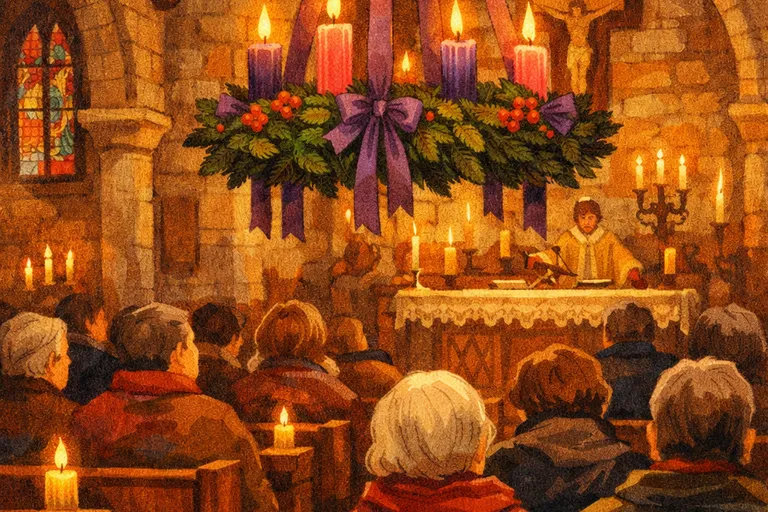
The original Advent had teeth. Early Christians treated it as a "little Lent," a period of fasting, prayer, and penance. Meat, dairy, and celebrations were off the table. Weddings were forbidden. This penitential character survived in Catholic and Orthodox traditions for centuries, though most modern Western Christians have softened it into a season of joyful anticipation rather than strict self-denial.
The Eastern Orthodox churches still observe a more rigorous version. Their Nativity Fast runs 40 days, from November 15 to December 24, with dietary restrictions that mirror Great Lent. For Orthodox Christians, the season retains its original gravity.
What Are Advent Calendars and Who Invented Them?
The Advent calendar is a 19th-century German invention, born from a simple parenting problem: children kept asking how many days until Christmas. German Protestant families in the early 1800s addressed this by marking chalk lines on doors or walls, one for each day in December leading to Christmas. Some families lit a candle each day instead. Others pinned up a devotional image daily.
The first known handmade Advent calendar appeared around 1851. But the person who turned it into a product was Gerhard Lang, a printer from Maulbronn, Germany. As a child, Lang's mother had made him a cardboard calendar with 24 small cookies sewn onto it, one for each day. In 1908, he produced the first commercial printed Advent calendar, called "In the Christmas Country." It featured 24 colorful images that children could attach to a numbered board.
Lang's publishing house, Reichhold and Lang, dominated the market through the 1930s. Then World War II shut it down. Cardboard rationing halted production across Germany. The revival came in 1946, and by the 1950s the Advent calendar had spread across Europe and North America.
The first chocolate Advent calendar appeared in 1958. That single innovation changed everything. Suddenly the calendar wasn't just a countdown. It was a daily reward.
Today the Advent calendar market generates hundreds of millions in annual revenue globally. You can buy calendars filled with LEGO bricks, beauty products, craft beer, artisan cheese, hot sauce, whisky, dog treats, socks, and jewelry. The luxury end of the market routinely crosses the $100 mark. Harrods sold a $10,000 Advent calendar in 2023 stocked with designer goods. The format Gerhard Lang's mother invented with cookies and cardboard now sits at the center of a retail phenomenon.
What Are Advent Candles and What Do They Represent?
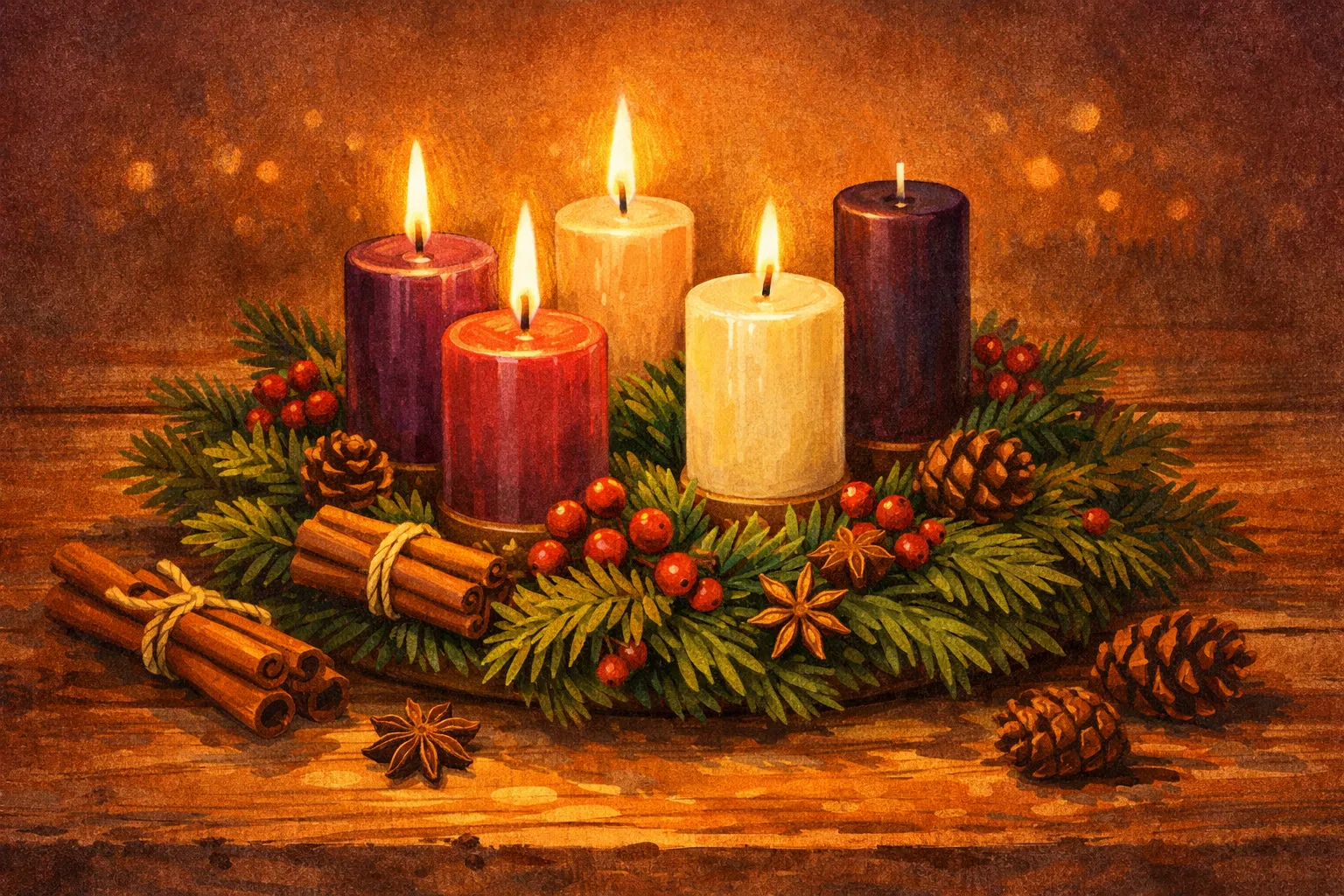
The Advent wreath, a circular arrangement of evergreen branches holding four candles, is the other defining symbol of the season. Its inventor was Johann Hinrich Wichern, a German Lutheran pastor who ran a mission for underprivileged children in Hamburg.
In 1839, Wichern built a large wooden ring from a cart wheel. He placed 20 small red candles and 4 large white candles on it. Each weekday, the children lit a small red candle. Each Sunday, they lit a large white one. By the time all 24 candles were burning, Christmas Eve had arrived. The children could literally see Christmas approaching.
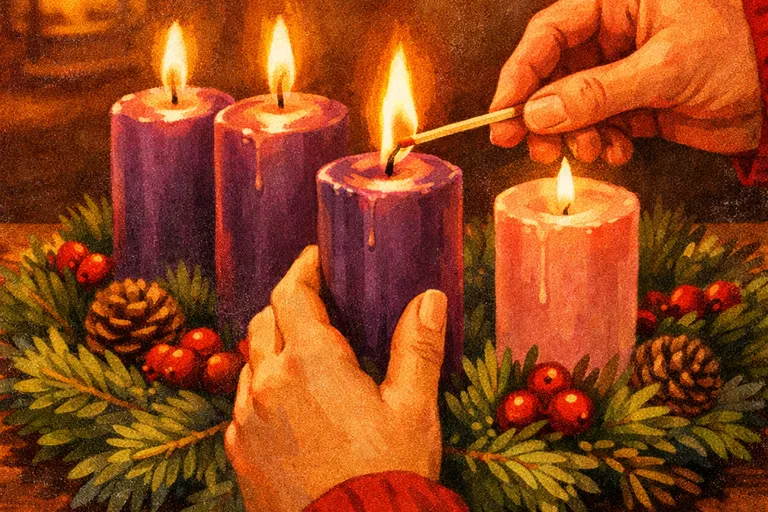
The design simplified over the decades. By the early 20th century, most Advent wreaths used just four candles, one for each Sunday. The circular shape of the wreath represents eternity. The evergreen branches symbolize persistent life in winter. The candles represent light entering darkness.
Candle colors and their meaning
In Catholic tradition, three candles are purple (representing penance and preparation) and one is rose or pink. The pink candle is lit on the third Sunday, called Gaudete Sunday, from the Latin for "rejoice." It signals that the penitential season is more than halfway done.
Many Protestant churches use a different arrangement. Some use all red candles. Others use blue, which some liturgical scholars argue better represents Advent's distinct character rather than borrowing purple from Lent. A fifth white candle, placed in the center of the wreath, sometimes appears on Christmas Day itself. This is the Christ candle.
Each of the four Sundays carries a traditional theme, though the exact assignments vary by denomination. The most common pattern names them Hope, Peace, Joy, and Love. Some traditions use Prophecy, Bethlehem, Shepherds, and Angels instead. The theology differs. The ritual of gathering around a gradually brightening wreath remains the same.
How Advent Shaped Modern Christmas Culture
Advent solved a problem that every culture with a major holiday faces: how do you handle the anticipation? The Roman Saturnalia had its own countdown rituals. Chinese New Year preparations follow a structured timeline. But Advent built the most elaborate framework of any holiday preparation in the Western world.
Think about what December looks like because of Advent. The daily calendar openings. The progressive lighting of candles. The structured four-week arc that gives the season a beginning, middle, and climax. Christmas markets across Germany, Austria, and Central Europe specifically open on the first day of Advent. The entire commercial and cultural apparatus of "the Christmas season" follows Advent's blueprint.

The Advent calendar's transformation tells the broader story. What started as a Lutheran devotional tool became a secular consumer product. The spiritual content drained out. The countdown structure stayed. Most people who tear open a chocolate calendar door each December morning have no idea they're participating in a 19th-century German Protestant tradition. That's arguably the highest compliment a cultural invention can receive: becoming so universal that its origins vanish.
Advent Traditions That Vary by Country
Germany remains the heartland of Advent culture. The Adventskranz (Advent wreath) appears in nearly every German home, and Advent Sundays are treated as genuine family events with coffee, cake, and candle-lighting. Children place shoes outside their doors on the eve of December 6, St. Nicholas Day, to find them filled with treats the next morning.
In Scandinavia, Advent ties directly into the St. Lucia Day celebration on December 13. Swedish families light candles throughout the season, and many communities hold Lucia processions where a young woman wearing a crown of candles leads a choir through darkened streets. The Advent star, a large paper or metal star hung in windows, is a signature Scandinavian decoration visible across entire neighborhoods.
In the Czech Republic and Slovakia, Advent signals the opening of Christmas markets in Prague, Bratislava, and smaller towns. Families buy adventni venec (Advent wreaths) and gather each Sunday to light a candle together. Street-corner carp sellers appear in the final days, selling live fish for the traditional Christmas Eve dinner.
Latin American countries blend Advent with their own traditions. In Mexico and Guatemala, Las Posadas begin on December 16, a nine-night reenactment of Mary and Joseph's search for shelter. In Colombia, Dia de las Velitas (Day of the Little Candles) on December 7 fills streets and balconies with candles and lanterns, effectively merging Advent's candlelight symbolism with local celebration.
Frequently Asked Questions
When does Advent start in 2025?
Advent 2025 begins on Sunday, November 30. It always starts on the fourth Sunday before Christmas Day, so the date shifts each year between November 27 and December 3. The season ends on Christmas Eve, December 24.
How many days does Advent last?
Advent lasts between 22 and 28 days, depending on which day of the week Christmas falls. It always covers four Sundays. Most Advent calendars count 24 days (December 1 through 24), which is a simplified commercial version rather than the liturgical dates.
What is the meaning of the four Advent candles?
The four candles on an Advent wreath each represent one Sunday before Christmas. In the most common tradition, they symbolize Hope, Peace, Joy, and Love, lit progressively each week. In Catholic practice, three are purple and one is pink (rose), with the pink candle lit on the third Sunday to mark Gaudete Sunday, a moment of rejoicing.
Who invented the Advent calendar?
German printer Gerhard Lang produced the first commercial Advent calendar in 1908, inspired by a homemade version his mother created using cookies attached to cardboard. Before Lang, German Protestant families used chalk marks, candles, or devotional images to count down the days. The first chocolate Advent calendar appeared in 1958.
Is Advent only a Christian tradition?
Advent originated as a Christian liturgical season and remains rooted in church practice. However, many Advent symbols, especially calendars and wreaths, have crossed into secular culture. Millions of non-religious households use Advent calendars as a December countdown without any devotional content attached.
What is the difference between Advent and Christmas?
Advent is the four-week preparation period leading up to Christmas. Christmas itself is a single day (December 25) or, in the liturgical calendar, a season of twelve days ending on Epiphany (January 6). Advent focuses on anticipation and waiting, while Christmas celebrates the arrival.