
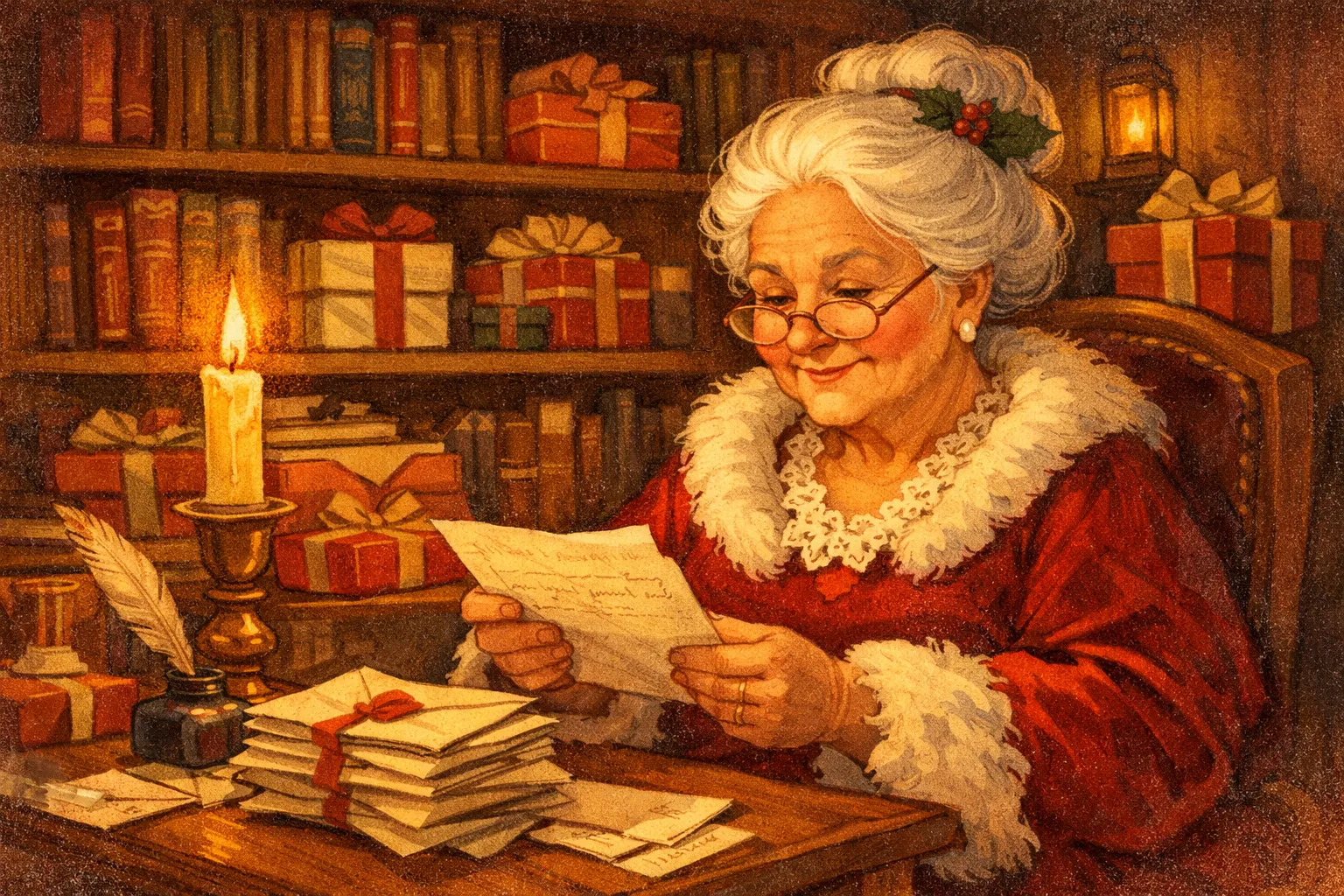
Mrs. Claus: History, Name, Origin and Role
She's been called Goody, Jessica, Anya, and Margaret. She's organized strikes, flown helicopters, and saved Christmas when Santa wouldn't. The history of Mrs. Claus is far stranger and more political than you'd expect.
Mrs. Claus first appeared in print in 1849, tucked inside a short story most people have never heard of. Since then, she has been a kitchen reformer, a labor organizer, a suffragist's mouthpiece, a stop-motion grandmother, and a helicopter pilot. Her husband's image has barely changed in 150 years. Hers has never stopped changing.
Contents
- 1. When Did Mrs. Claus First Appear?
- 2. What Is Mrs. Claus' First Name?
- 3. What Does Mrs. Claus Do at the North Pole?
- 4. How Mrs. Claus Became a Proxy for Women's Rights
- 5. Mrs. Claus on Screen: The Best Portrayals
- 6. How Old Is Mrs. Claus?
- 7. From Background Character to Lead
- 8. Frequently Asked Questions
The character we now call Mrs. Claus has no single origin point, no canonical first name, and no fixed personality. She is whatever each generation needs her to be. That instability is precisely what makes her one of the most interesting figures in Christmas mythology.
When Did Mrs. Claus First Appear?
The earliest known reference to Santa's wife comes from "A Christmas Legend," a short story by James Rees, published in 1849. Rees was a Philadelphia missionary, and his tale describes an elderly couple who appear at a family's door on Christmas Eve, carrying bundles on their backs. The next morning, the children find gifts everywhere. The twist: the old couple turn out to be the family's long-lost daughter and her husband in disguise, not "old Santa Claus and his wife." It's a passing mention, almost a joke, but it's the first time anyone thought to give Santa a spouse.
Two years later, in 1851, a student writing under the initials "A.B." in the Yale Literary Magazine described Santa at a Christmas party, noting: "He seemed to have done his best, and we should think, had Mrs. Santa Claus to help him." Again, barely a character. More of a concept.
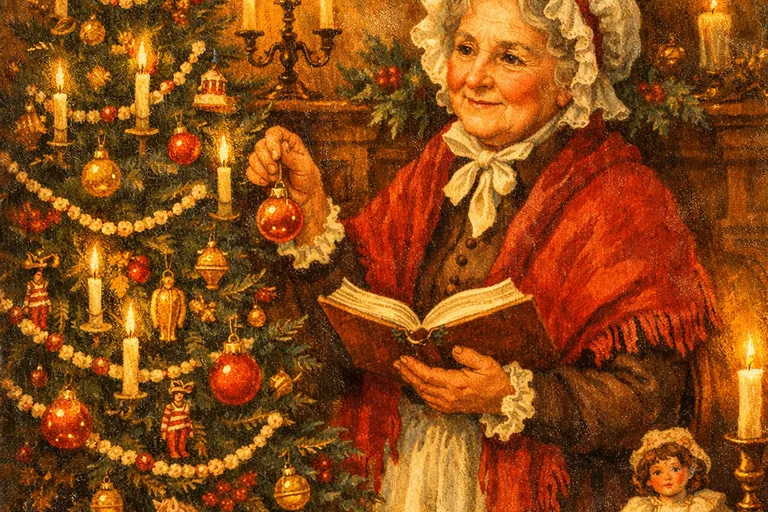
The real transformation came in 1889, when Katharine Lee Bates published "Goody Santa Claus on a Sleigh Ride." Bates is better known for writing the lyrics to "America the Beautiful," but her 27-verse Christmas poem did something no writer had attempted before: it made Mrs. Claus the protagonist. Goody Santa Claus narrates the poem herself, describing the many chores she handles while her husband gets all the credit. She holds the reindeer while Santa goes down chimneys. She darns a stocking with holes. She argues on behalf of an impoverished poet. She is tired, opinionated, and funny.
What Is Mrs. Claus' First Name?
She doesn't have one. Or rather, she has too many.
Throughout the 19th and early 20th centuries, Mrs. Claus was simply "Mrs. Claus" or "Mrs. Santa Claus." No writer thought to name her, because no writer thought of her as a full character. That changed with film and television, where a first name became a practical necessity for dialogue.
In the 1970 Rankin/Bass special Santa Claus Is Comin' to Town, she was christened Jessica. The 1985 film Santa Claus: The Movie called her Anya. Angela Lansbury played her as Anna in the 1996 TV musical Mrs. Santa Claus. The 2011 Aardman film Arthur Christmas went with Margaret. The 2020 movie Fatman chose Ruth.
An internet rumor once circulated that her "original" name was Gertrude, supposedly from the 1849 James Rees story. Snopes debunked this: the character named Gertrude in that story is the mother of the household, not Mrs. Claus. Jessica remains the most popular answer in surveys, thanks to decades of Santa Claus Is Comin' to Town reruns. But there is no official name, and there never has been.
What Does Mrs. Claus Do at the North Pole?
The traditional answer is: she bakes cookies, tends to the elves, and keeps Santa fed. That image comes largely from mid-20th-century TV specials, where she was cast as the archetypal grandmother, warm and supportive but never central to the plot.
But even within that framework, her role has always been more operational than domestic. In the 1964 Rudolph the Red-Nosed Reindeer special, she fusses over Santa's weight and the weather, but she's also the one making sure the whole enterprise doesn't fall apart. In Rankin/Bass's 1974 The Year Without a Santa Claus, voiced by Shirley Booth in her final performance, Mrs. Claus essentially runs the show. When Santa decides to skip Christmas because nobody believes in him anymore, she dispatches two elves to prove him wrong. She negotiates between the Heat Miser and Snow Miser. She saves Christmas, full stop.
Modern depictions have expanded the job description. She oversees toy production schedules. She manages the reindeer. She handles the logistics that Santa, frankly, seems uninterested in. The running joke across most portrayals is that Santa is the face of the operation, and Mrs. Claus is the one actually keeping it running.
How Mrs. Claus Became a Proxy for Women's Rights
Here is where her story gets genuinely surprising. In the late 19th century, writers on both sides of the suffrage debate used Mrs. Claus to make their case.
Katharine Lee Bates, who wrote "Goody Santa Claus on a Sleigh Ride," was a suffragist. Her poem is not subtle about its politics. Goody complains that she does most of the work while Santa gets "all the glory." She demands to ride along on Christmas Eve and proves herself more competent than her husband at several tasks. Published in 1889, during the peak of first-wave feminism, the poem was a deliberate argument for women's recognition.
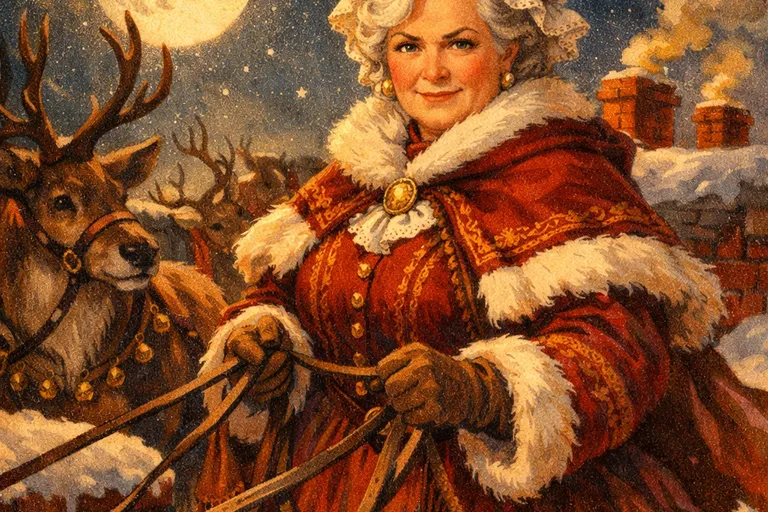
In 1887, two years before Bates' poem, Good Housekeeping published a piece in which Mrs. Claus visits an English architect to complain about kitchen design. She argues that men who design kitchens never consider the women who work in them, leading to injuries and inefficiency. It reads like satire, but the domestic critique is real and pointed.
Anti-suffragists used her too, portraying Mrs. Claus as a cautionary figure, a woman who should stay home and let her husband handle the public-facing work. The tug-of-war over her character mirrored broader cultural debates about where women belonged.
By 1914, a play called Mrs. Santa Claus, Militant pushed the character further into political territory. In it, Mrs. Claus commandeers the sleigh, crash-lands in Manhattan's Lower East Side, discovers child labor at a toy factory, and organizes a strike. Christmas entertainment as labor agitprop. It was a real production.
Mrs. Claus on Screen: The Best Portrayals
Television domesticated Mrs. Claus considerably. The Rankin/Bass specials of the 1960s and 1970s gave her a consistent look (white bun, round spectacles, red dress) and a consistent personality (warm, slightly worried, perpetually baking). That became the default, and it held for decades.
Angela Lansbury's turn in the 1996 CBS musical Mrs. Santa Claus was a deliberate departure. Set in 1910, the film sends Anna Claus to New York City, where she befriends immigrant families, confronts sweatshop conditions, and gets involved in the suffrage movement. Jerry Herman wrote the score. It was a Broadway-caliber production for network television, and it remains the only major screen work where Mrs. Claus is the sole lead.
Goldie Hawn brought a different energy to the role in Netflix's The Christmas Chronicles (2018) and its 2020 sequel. Playing opposite real-life partner Kurt Russell as Santa, Hawn's Mrs. Claus was stylish, sharp, and clearly Santa's equal rather than his assistant. The casting of an actual Hollywood couple gave the Clauses a believable dynamic that most versions lack.
In 2023, Sheryl Lee Ralph became the first Black woman and the first celebrity to portray Mrs. Claus in the Macy's Thanksgiving Day Parade. It was a single appearance, not a film role, but it mattered. The parade's Santa float is watched by millions, and for 97 years, Mrs. Claus had been played by anonymous performers.
How Old Is Mrs. Claus?
This depends entirely on who you ask. Santa's age is usually pegged to the historical Saint Nicholas of Myra, born around 270 AD, making him roughly 1,700 years old. Mrs. Claus has no such anchor. She is a fictional creation from 1849, attached to a character who was already centuries old.
Various Christmas folklore sites place her age anywhere from 229 to 1,144 years old. The 1970 Santa Claus Is Comin' to Town origin story implies she's the same age as Santa, since they meet as young people. Most modern depictions show her as a white-haired woman in her late 60s or 70s, which has been her visual default since the Rankin/Bass era. The honest answer is that nobody has ever established her age with any consistency, and nobody particularly needs to.

From Background Character to Lead
The most significant shift in Mrs. Claus' cultural status happened in 2016, when Marks and Spencer built their entire Christmas campaign around her. Directed by Oscar-winner Tom Hooper and scored by Rachel Portman, the ad showed Mrs. Claus receiving a letter from a boy who wants to make things right with his sister. She flies a helicopter from Lapland to London to deliver the gift herself, while Santa sleeps. The tagline was "Christmas with Love, Mrs. Claus." It was watched by over 3 million people on its premiere alone.
That ad crystallized something that had been building for years. Mrs. Claus works better as a modern character than Santa does. Santa is locked into his role: jolly, generous, unchanging. Mrs. Claus can be anything. She can organize, negotiate, fly aircraft, run operations, challenge authority. She carries none of Santa's mythological baggage and all of his institutional knowledge.
Rhonda Parrish's 2020 anthology Mrs. Claus: Not the Fairy Tale They Say collected short fiction that reimagined Mrs. Claus as a spy, a scientist, a revolutionary, and a dozen other things Santa has never been allowed to be. The book's premise was simple: if Mrs. Claus has no fixed identity, she can be anyone.
Katharine Lee Bates understood that in 1889. Goody Santa Claus, riding alongside her husband on Christmas Eve, darning stockings and advocating for poor poets, was already more interesting than the man driving the sleigh. It just took everyone else 130 years to notice.
Frequently Asked Questions
Who is Mrs. Claus?
Mrs. Claus is the wife of Santa Claus in Christmas folklore. She first appeared in the 1849 short story "A Christmas Legend" by James Rees. Over the years, she has evolved from a passing mention into a fully realized character who manages North Pole operations, cares for the elves and reindeer, and in many modern portrayals, serves as the competent force behind Santa's Christmas mission.
What is Mrs. Claus' real first name?
Mrs. Claus has no single canonical first name. Different movies and TV specials have given her different names: Jessica in Santa Claus Is Comin' to Town (1970), Anya in Santa Claus: The Movie (1985), Anna in the 1996 Angela Lansbury musical, and Margaret in Arthur Christmas (2011). Jessica is the most widely recognized, but none is "official."
When did Mrs. Claus first appear in literature?
The earliest known mention of Santa's wife is in "A Christmas Legend," a short story by James Rees published in 1849. The first substantive portrayal came in 1889, when Katharine Lee Bates wrote the poem "Goody Santa Claus on a Sleigh Ride," which made Mrs. Claus a narrator and protagonist for the first time.
How old is Mrs. Claus?
There is no agreed-upon age for Mrs. Claus. Various folklore sources place her anywhere from 229 to over 1,000 years old. Unlike Santa, whose age is sometimes linked to the historical Saint Nicholas (born around 270 AD), Mrs. Claus has no historical basis. Most screen portrayals depict her as an elderly woman, consistent with the Rankin/Bass specials of the 1960s and 1970s.
What does Mrs. Claus do at the North Pole?
Traditional depictions show Mrs. Claus baking cookies, caring for elves, and supporting Santa. Modern portrayals expand her role significantly: she oversees toy production, manages logistics, tends to the reindeer year-round, and often serves as the true operational leader of the North Pole while Santa handles the public-facing deliveries on Christmas Eve.
Is Mrs. Claus considered a feminist icon?
Increasingly, yes. Her roots are tied to 19th-century suffrage debates. Katharine Lee Bates' 1889 poem explicitly frames Mrs. Claus as a woman demanding credit for her labor. Modern reinterpretations, from Marks and Spencer's 2016 ad campaign to Rhonda Parrish's 2020 fiction anthology, have positioned her as an independent, capable figure rather than a supporting character.