
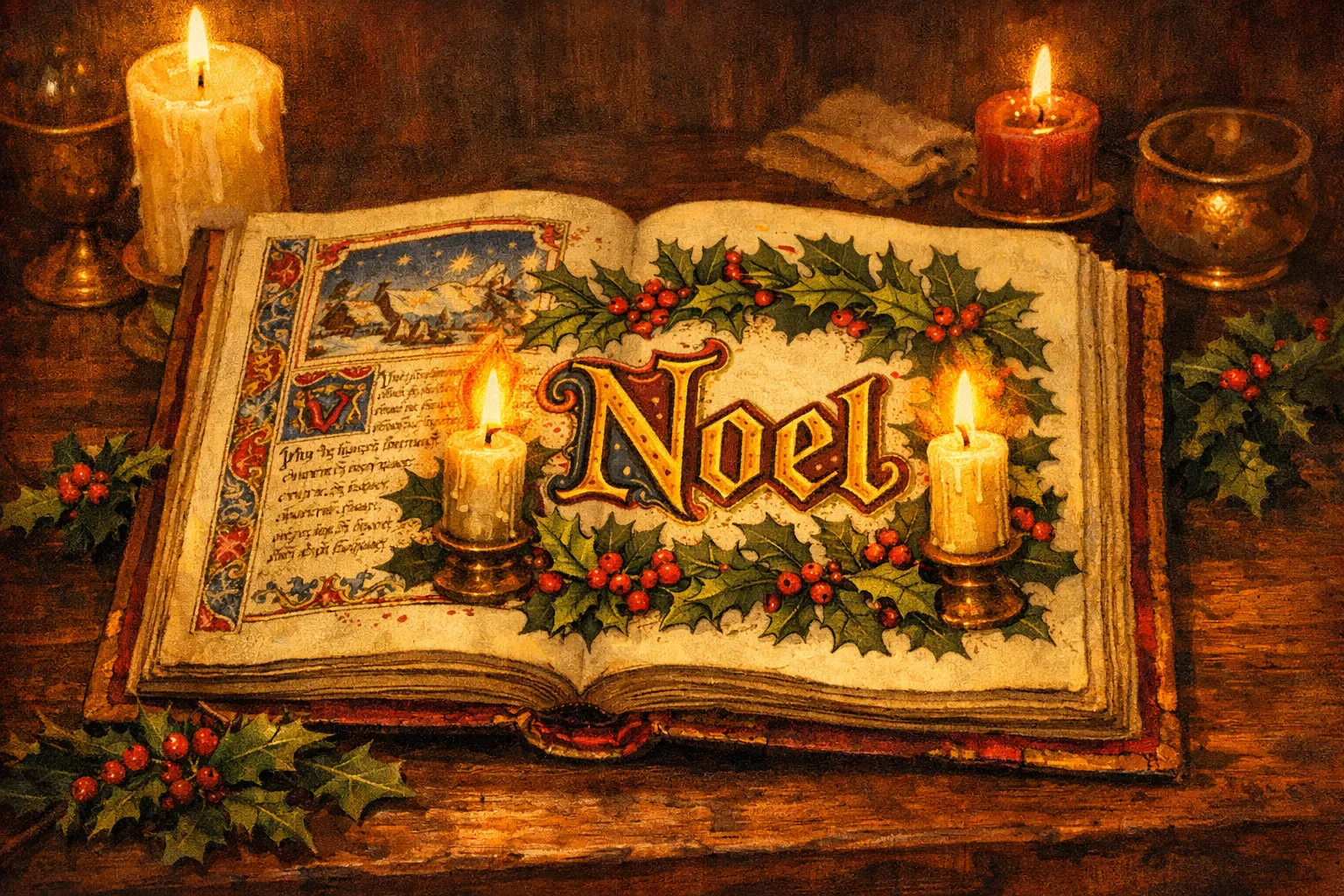
Noel Meaning, Origin, and Why We Say It at Christmas
A single Latin word for "birthday" traveled through Old French, became a shout of celebration in medieval England, and ended up on your mantelpiece. Here's how noel became Christmas.
The word noel means Christmas. More precisely, it traces back to the Latin natalis, meaning "of or relating to birth," which the early Church applied specifically to the birth of Christ. That Latin root passed through Old French as noel (earlier nael), and by the late 14th century it had crossed the English Channel. When you see "NOEL" spelled out in wooden letters on someone's mantelpiece, you're looking at a word that has meant the same thing for roughly 700 years.
Contents
- 1. What Does Noel Mean? The Etymology from Latin to English
- 2. Why Do We Say Noel at Christmas?
- 3. How Different Languages Say Christmas (And Why They All Sound Alike)
- 4. Joyeux Noel: How the French Use the Word
- 5. The First Noel: Origins of the Famous Carol
- 6. Noel as a Given Name
- 7. Noel in English Literature and Tradition
- 8. Frequently Asked Questions
But the story of how a Latin adjective became a carol refrain, a given name, a French cake, and a holiday greeting across a dozen languages is more layered than most people realize.
What Does Noel Mean? The Etymology from Latin to English
The chain is clean and well-documented. Latin natalis dies means "birthday." In Church Latin, it was used specifically as shorthand for the birthday of Christ, often written as dies natalis Christi. Over centuries, the phrase shortened to just natalis, and then Vulgar Latin did what it always does: it wore the word down, reshaping it as speakers passed it from generation to generation.
In Old French, natalis became nael, then noel. The French added their diaeresis to get Noel, the two dots signaling that both vowels should be pronounced separately. According to the Oxford English Dictionary, the word entered English in the late 1300s, initially spelled "Nowel" or "Nowell."
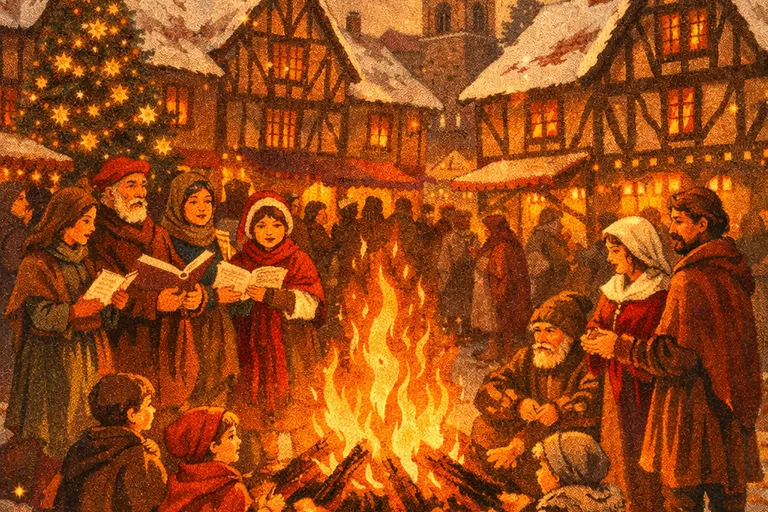
One of its earliest appearances comes from Sir Gawain and the Green Knight, the Arthurian romance written around 1375-1400. The anonymous poet describes the Christmas festivities at King Arthur's court with the line "Nowel nayted onewe, neuened ful ofte," meaning "Noel was proclaimed anew, repeated very often." The word wasn't exotic or foreign at that point. It was simply what you shouted during the Christmas season.
Here's where it gets interesting. In English, "noel" developed a second meaning that the French word never had. By the 18th century, English speakers began using "noel" to mean a Christmas carol or song. The earliest citation for this usage dates to 1771. So when English speakers talk about "singing noels," they're using the word in a way that would puzzle a French speaker, for whom Noel only means Christmas itself.
Why Do We Say Noel at Christmas?
The short answer is that "noel" literally means Christmas, so saying it during the season is no stranger than saying "Merry Christmas." But the word carries a different weight. It's older, more literary, and more connected to the religious core of the holiday.
"Christmas" is a compound word, from Old English Cristes maesse, meaning "Christ's Mass." It names the religious service. "Noel," by contrast, names the birth itself. When medieval crowds shouted "Nowel" in the streets, they were proclaiming the birth, not the worship service. It's a subtle distinction, but it explains why "noel" has always felt slightly more celebratory, more like an exclamation than a label.
The word also persists because it's genuinely useful in art and music. "Christmas" has three syllables and a hard consonant cluster in the middle. "Noel" has two clean syllables that sing well. Hymn writers and poets have always preferred it for exactly this reason.
How Different Languages Say Christmas (And Why They All Sound Alike)
One of the more satisfying facts in linguistics is that you can trace a single Latin word through most of the Romance languages and find it still recognizable after a thousand years of drift. The Latin natalis became:
- French: Noel
- Italian: Natale
- Portuguese: Natal
- Spanish: Navidad
- Catalan: Nadal
All five words mean "Christmas," and all five descend from the same Latin source. The vowel shifts and consonant changes follow predictable patterns. The "t" in natalis softened to a "d" in Catalan and Spanish. French dropped more syllables than the others, as French tends to do. But the family resemblance is unmistakable.
The Slavic languages went a different route, using words derived from their own roots for "birth." Russian uses Rozhdestvo, from the word for "birth." Even Semitic languages followed the birth concept: Arabic uses Milad, from the root meaning "to be born." The idea is universal. The Latin word just happens to have the widest footprint.
Joyeux Noel: How the French Use the Word
"Joyeux Noel" is the standard French Christmas greeting, equivalent to "Merry Christmas." But in France, Noel isn't just a greeting. It saturates the entire holiday vocabulary. The French gift-bringer is Pere Noel, Father Christmas. The iconic rolled cake served at Christmas Eve dinner is the Buche de Noel, the Christmas log. The Christmas tree is le sapin de Noel.

The centerpiece of French Christmas is le reveillon de Noel, the lavish Christmas Eve supper that begins late in the evening and often stretches past midnight. In Provence, the meal concludes with the treize desserts, thirteen desserts representing Jesus and the twelve apostles. This isn't casual snacking. It typically includes dried fruits, nougat, pompe a l'huile (olive oil bread), and calissons d'Aix, a marzipan confection.
For the French, Noel isn't a fancy or archaic word the way it can feel in English. It's the plain, everyday name for Christmas, as ordinary as "Tuesday."
The First Noel: Origins of the Famous Carol
"The First Noel" is one of the most widely sung Christmas carols in the English-speaking world, and almost nothing about its origin is certain. The melody and lyrics are traditionally described as Cornish, from the far southwestern tip of England. Most scholars place the oral tradition somewhere in the 16th or 17th century, though claims pushing it back to the 13th century are hard to verify.
What we know for sure is this: the carol first appeared in print in 1823, when Davies Gilbert included it in his collection Some Ancient Christmas Carols. A decade later, William Sandys published it again in Christmas Carols Ancient and Modern (1833), which brought it to a much wider audience. Anne Gilchrist, writing in the Journal of the Folk-Song Society in 1915, confirmed that no printed record predates the Gilbert collection.
The carol originally had nine stanzas, though most modern performances use only five. The lyrics begin with the angel's announcement to shepherds and follow the narrative through to the arrival of the wise men, guided by a star. Theologically, it covers Luke's Gospel and Matthew's Gospel in about four minutes of singing.
The arrangement most congregations know today is the four-part hymn setting by the English composer John Stainer, published in his Carols, New and Old in 1871. David Willcocks later added a descant that has become nearly inseparable from the melody in church performance. The spelling alternates between "Noel" and "Nowell" depending on the hymnal. Both are correct. "Nowell" simply reflects the older English spelling.
Why the Lyrics Hold Up
The opening lines are deceptively simple: "The first Noel the angel did say / Was to certain poor shepherds in fields as they lay." That phrase "certain poor shepherds" is doing real work. It's specific without being named. It places the listener in a particular scene. Most carols from the same era are more abstract. This one tells a story, and that's why it has survived when thousands of other folk carols haven't.
Noel as a Given Name
The tradition of naming children born around Christmas "Noel" dates back to at least the 12th century. In medieval French records, the name appears for both boys and girls, with most early baptisms clustered in December and early January. The feminine form, Noelle, developed later.
The most famous bearer might be Noel Coward, the playwright, actor, and composer born on December 16, 1899. His parents chose the name because Christmas was just nine days away. Coward went on to write some of the 20th century's sharpest comedies, and the name suited his theatrical flair.
Other notable Noels include Noel Gallagher of Oasis, born in May (no Christmas connection there), and the children's author Noel Streatfeild, born in December 1895, who wrote Ballet Shoes. In the United States, the name has stayed in steady use since at least 1880, when government records began tracking it. In 2024, roughly 728 baby boys and 146 baby girls received the name in America, according to Social Security Administration data.
Noel in English Literature and Tradition
Beyond Sir Gawain, the word "noel" crops up throughout English literary history. It appears in medieval mystery plays, where actors portraying angels would cry "Nowell" as they announced the Nativity. The word functioned almost like stage direction: when you heard it, you knew the birth scene was at hand.
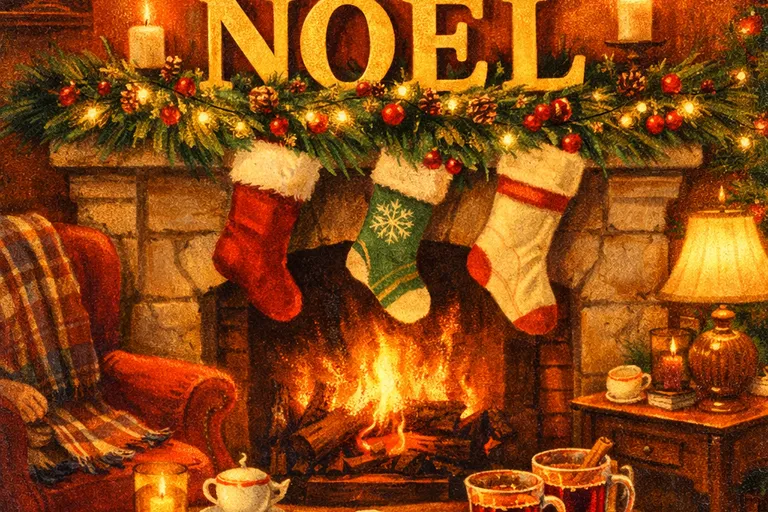
By the Victorian era, the word had acquired a nostalgic quality. Victorian Christmas card designers favored "Noel" for its antique feel, printing it in Gothic lettering alongside holly and ivy. This aesthetic stuck. Today, "NOEL" is one of the most common decorative words in Christmas home decor, typically displayed in individual standing letters across a mantelpiece. It reads as both traditional and slightly European, a small statement that Christmas here is not purely commercial.
The Latin root natalis also gave English the words "natal," "neonatal," "prenatal," and "nativity." So when churches set up a "nativity scene" at Christmas, the connection to "noel" is direct. Both words point back to the same idea: a birth that changed the calendar.
Frequently Asked Questions
What does noel mean in English?
Noel means Christmas. It comes from the Old French noel, which derives from the Latin natalis, meaning "birth" or "birthday." In English, it can also refer to a Christmas carol or song, a secondary meaning that developed in the 18th century.
Why do we say noel at Christmas?
We say noel at Christmas because the word literally means Christmas, referencing the birth of Christ. It entered English from French in the late 14th century and has been used continuously since then. Medieval crowds would shout "Nowel" in the streets as a joyful proclamation of the Nativity.
What is the difference between noel and Christmas?
"Christmas" comes from Old English Cristes maesse, meaning "Christ's Mass," and refers to the religious service. "Noel" comes from Latin natalis, meaning "birth," and refers to the birth itself. Both name the same holiday, but noel emphasizes the birth event while Christmas emphasizes the worship celebration.
Is The First Noel the oldest Christmas carol?
No. "The First Noel" likely dates to the 16th or 17th century in its oral form, but older carols exist. It was first published in 1823 by Davies Gilbert. Carols like "O Come, O Come, Emmanuel" have roots in medieval Latin hymns from centuries earlier.
Is Noel a French word?
Yes. Noel is the standard French word for Christmas, used in everyday speech. English borrowed it from Old French in the late 1300s. In French, "Joyeux Noel" means "Merry Christmas," and the word appears in terms like Pere Noel (Father Christmas) and Buche de Noel (Christmas log cake).
How did noel become a popular name?
Since at least the 12th century, parents have named children born around Christmas "Noel" or "Noelle." The tradition began in medieval France and spread to England. Famous bearers include playwright Noel Coward, born December 16, 1899, whose parents chose the name for its proximity to Christmas.